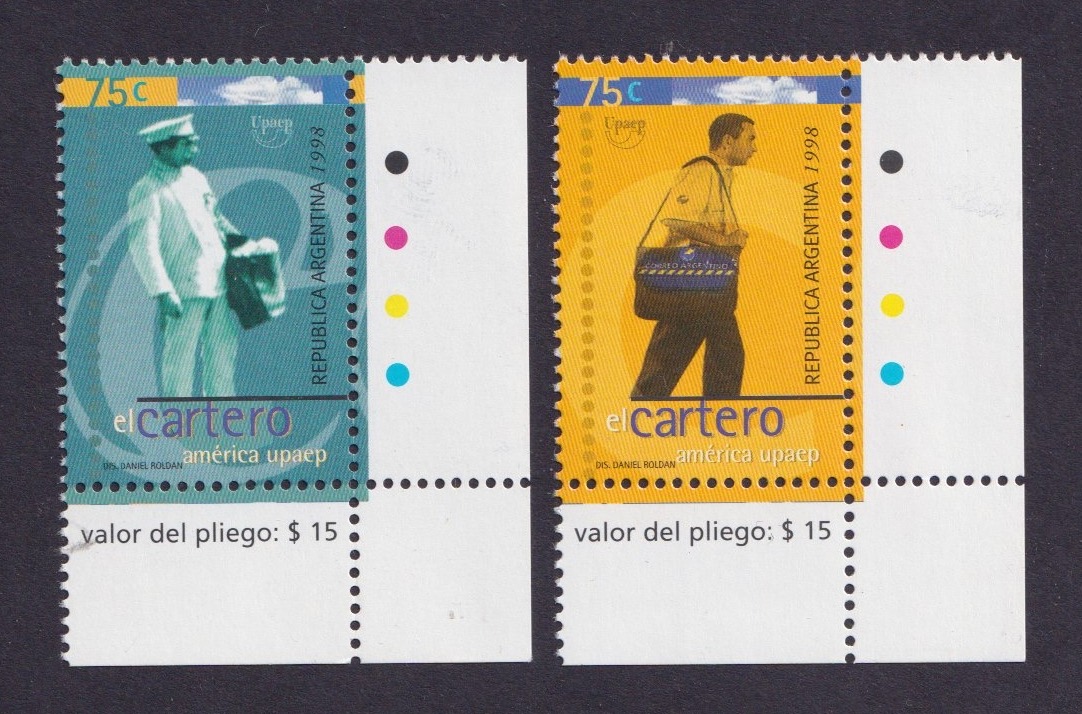
Perforation: 13
Sunday, March 19, 2023
Tuesday, March 7, 2023
Tuesday, February 14, 2023
Suriname 1940 - Social Welfare Fund
Technical Details:
Date of Issued: 08 January 1940
Perforation: 12¾ x 13¾
Designed by: S L Hartz
Print Process: Recess
Perforation: 12¾ x 13¾
Designed by: S L Hartz
Print Process: Recess
2½c+2c - Creole
3c+2c - Javanese
5c+3c - Hindustani (India)
7½c+5c - Native America, Indian
France 1981 - EUROPA, Folklore
Date of Issued: 02 May 1981
Design: Jean Delpech
Perforation: 13
EUROPA 1981 - Folklore
If the bourrée of Auvergne is known for its hard pace and its muscular momentum, the cross bourrée of Berry, slower, requires flexibility, ease and more lightness. THE word "bourrée" first designated the bundle of small wood used for lighting hearths and heating ovens. It then applied itself to a dance performed first around a bundle, then, as in a novel by George Sand, around the last sheaf, the "gerbaude" of the Harvest Festival. The Berrichons call it "crossed" because of its characteristic figure: the dancer passes from the facing position to a "turn of 45 degrees, of the leg and the body, before returning to the primitive position, or "carrement. The men have an austere jacket and "barrage" or drugget breeches; women, a petticoat of the same fabric, a linen apron and a headdress called "grand capichon"The sardana, coming from beyond the Pyrenees, unites Spanish Catalonia with our Catalan countries: Roussillon, Cerda Gene and Vallespir. At first religious and masculine, the sardanas took on more lightness, elegance... and pas- sion when women associated with it. We see on the figurine the dancers who wear the picturesque local costumes. The relations of folklore and music are often discussed in connection with Chopin or Bartok and many other composers. The combination of these two regional dances cannot fail to evoke the name of a great French musician, Emmanuel Chabrier. The author of "Bour-rée fantasque", himself a cabrette player, admitted "rhythmizing his music with his clogs; and a critic hears, in his "'Espana", the striking of the heels of Spanish gypsies and the slipping of Catalan sandals...
Sunday, February 12, 2023
Brazil 2011 - Diplomatic Relations Brazil-Belgium
Technical Details:
Date of Issued: 29 October 2011
Width: 44.00 mm
Height: 26.00 mm
Denomination: 2.55 BRL
Set of 4
Format: Mini Sheet
Perforations: 11.5 x 11.5
Issuing Authority: Empresa Brasileira de Correios e Telegrafos
Printer: Casa da Moeda do Brasil
a. Carnaval
b. Acarajé de iansã, no Ilê Oxumaré - Carybé
Republic of China (Taiwan) 1999 - Taiwanese Opera
Technical Details:
Date of Issued: 15 October 1999
Dimension of stamps: 40 mm x 30 mm
Size of souvenir Sheet (mm.)
Printer: China Color Printing Co.,Inc., R.O.C.
Designer: Lee Kuang-Chi
Sheet Composition: 20 (5 x 4)
Print Color: Colorful
Process: Deep etch offset
Paper: Phosphorescent Stamp Paper
Perforation: 11½ x 11
To increase R.O.C. citizens' understanding of Taiwanese opera and to celebrate Taiwanese culture, the Directorate General of Posts is releasing a set of Taiwanese Opera postage stamps, which is the first of a series of postage stamps on Chinese regional opera.
Each stamp will pay homage to one of four separate elements of Taiwanese opera:
(1) the noise, festivity and excitement associated with the performances;
(2)the contribution these operas make in passing down the island's traditional arts legacy;
(3) their demonstration that women can do everything men can (since women play all the parts, female and male);and
(4) and their plots, which reflect the absurdity of real life. The and their plots, which reflect a absurdity of real life.
The stamps will have denominations of NT$5.00, NT$6.00, NT$10.00 and NT$25.00.
The stamps will feature:
(1) a festively adorned stage with a crowd gathered around it,
(2) a scene of interaction among troupe members in antique garb that conveys the legacy they are passing down,
(3) an actress, made up and dressed as a man, playing a male character; and
(4)another actress playing the role of a clown. The Directorate commissioned Ming Hwa Yuan Taiwanese Opera Company to plan the stamps.
The tunes of Taiwanese opera originated from the chin-ke tunes that were popular in Jangzhou, Fukien, and were brought to Taiwan by Chinese settlers in the late Ming and early Ching dynasties. Later, ke-tsai-chen developed, which was accompanied. by musical instruments such as yue-chin, er-hu and san-hsien (all of which are string instruments). Whenever people were not busy with farm work, they would gather in plazas where rice was dried or in plazas in front of temples, where they would recite, sing and act scenes using every-day vocabulary and simple movements and facial expressions. This kind of improvisation was called lo-ti-sao. It put little emphasis on make-up and costumes, and the stage was simply the ground between four bamboo poles. This was an inchoate version of Taiwanese opera. The choreography, music and costumes of Taiwanese opera have been heavily influenced by Peking opera. Taiwanese opera contains pleasing displays of martial arts, and its lyrics are easy to understand. During folk celebrations, processions and festivals held after great harvests and in honor of local deities, troupes are often asked to put on shows indoors or out. After 1956, Taiwanese operas have also been performed in theaters and turned into films, as well as being broadcast on television and radio.
Dimension of stamps: 40 mm x 30 mm
Size of souvenir Sheet (mm.)
Printer: China Color Printing Co.,Inc., R.O.C.
Designer: Lee Kuang-Chi
Sheet Composition: 20 (5 x 4)
Print Color: Colorful
Process: Deep etch offset
Paper: Phosphorescent Stamp Paper
Perforation: 11½ x 11
To increase R.O.C. citizens' understanding of Taiwanese opera and to celebrate Taiwanese culture, the Directorate General of Posts is releasing a set of Taiwanese Opera postage stamps, which is the first of a series of postage stamps on Chinese regional opera.
Each stamp will pay homage to one of four separate elements of Taiwanese opera:
(1) the noise, festivity and excitement associated with the performances;
(2)the contribution these operas make in passing down the island's traditional arts legacy;
(3) their demonstration that women can do everything men can (since women play all the parts, female and male);and
(4) and their plots, which reflect the absurdity of real life. The and their plots, which reflect a absurdity of real life.
The stamps will have denominations of NT$5.00, NT$6.00, NT$10.00 and NT$25.00.
The stamps will feature:
(1) a festively adorned stage with a crowd gathered around it,
(2) a scene of interaction among troupe members in antique garb that conveys the legacy they are passing down,
(3) an actress, made up and dressed as a man, playing a male character; and
(4)another actress playing the role of a clown. The Directorate commissioned Ming Hwa Yuan Taiwanese Opera Company to plan the stamps.
The tunes of Taiwanese opera originated from the chin-ke tunes that were popular in Jangzhou, Fukien, and were brought to Taiwan by Chinese settlers in the late Ming and early Ching dynasties. Later, ke-tsai-chen developed, which was accompanied. by musical instruments such as yue-chin, er-hu and san-hsien (all of which are string instruments). Whenever people were not busy with farm work, they would gather in plazas where rice was dried or in plazas in front of temples, where they would recite, sing and act scenes using every-day vocabulary and simple movements and facial expressions. This kind of improvisation was called lo-ti-sao. It put little emphasis on make-up and costumes, and the stage was simply the ground between four bamboo poles. This was an inchoate version of Taiwanese opera. The choreography, music and costumes of Taiwanese opera have been heavily influenced by Peking opera. Taiwanese opera contains pleasing displays of martial arts, and its lyrics are easy to understand. During folk celebrations, processions and festivals held after great harvests and in honor of local deities, troupes are often asked to put on shows indoors or out. After 1956, Taiwanese operas have also been performed in theaters and turned into films, as well as being broadcast on television and radio.
Saturday, February 11, 2023
Mongolia 2015 - Dashichoiling Monastery
Technical Details:
Date of Issued: 14 December 2015
Face value: 2400 (Stamp Set); 2600 (Sheet)
Size Stamp: 50mm x 35mm
Face value: 2400 (Stamp Set); 2600 (Sheet)
Size Stamp: 50mm x 35mm
Size Sheet: 40x60mm, 110x150mm
Printing: Offset Lithography
Republic of China (Taiwan) 1997 - Chinese Martial Arts
Designer: Wong Lui - sang
Process: Deep Etch Offset
Printer: China Color Printing Co., Inc., R.O.C.
To publicize our national legacies and help people to know more of the Chinese martial arts, this Directorate especially used Shaolinquan, Form and Will Boxing, Taijiquan, and Eight Diagrams Boxing as subject matter for a set of four Chinese Martial Arts postage stamps. These stamps, in denominations of NT$5.00, 5.00, 9.00 & 19.00, were designed by the Informational and Research Center of Chinese Martial Arts, National College of Physical Educational and Sports.
Chinese martial arts are very rich in content and profound in nature. From ancient times up to the present, the arts. whether utilized to cultivate one's mind, to protect one's life, or to build up one's body, or to defend the country, have been significantly correlated to the society, army, religion, and culture. Characterized by locality, martial arts. in its broadest sense, include the use of different ways of boxing, the employment of various swords, the guidance to happy life, and traditional medicine. The designs for this set of martial arts stamps are four kinds of very popular boxing practiced by the Chinese people to build up their bodies or protect themselves.
Subscribe to:
Posts (Atom)