Tuesday, January 3, 2023
Kyrgyzstan 2022 - National Costumes Of The Kyrgyz People
Date of Issued: 04 November 2022
About Traditional Clothing of Kyrgyz People
Three different stamps showing the traditional clothing of Krygz people.
Saturday, August 13, 2022
Trinidad & Tobago 2018 - Creole Harvest
Coloured: Cassandra Joseph
Stamp Booklet Design: Lantern Designs
The Trinidad & Tobago Postal Corporation is proud to celebrate its Creole Culture by issuing a new collection.
The scenery of the stamps illustrate the Creoles at harvesting time on a Cocoa Estate. Dressed in traditional Creole Dwiyet, the stamps capture the celebration of the estate workers with their local Harvest.
Wednesday, May 4, 2022
Cambodia 2021 - Kun Khmer (Pradal Serey), Cambodian Martial Art
Date of Issued: 28 December 2021
Quantity: 4,000 pieces (Stamp Sets); 500 pieces (SS)
Designer: Cambodia Post
Printer: Vietnam Printing
Pradal Serey was codified by the colonial administration during the French protectorate in the 20th century. Pradal Serey (Khmer for: "bare-handed martial arts") comes from kun daï, which is a military discipline. The Kun daï was taught in the army by the Khmer Empire in the 9th century.
Pradal Serey is a martial art that is characterized by elbow techniques, close combat and knee techniques. Some rules in Pradal Serey favor the opponent's melee and knockout punch while falling.
Similar fighting styles include Muay Thai (Thai boxing), Bama Lethwei, Muay Lao (Lao boxing), and Tomoi (Malaysia).
Sunday, April 24, 2022
India 2022 - Joint Issued With Turkmenistan, 30 Years of Partnership, Dances: Sankirtana and Kushtdepti
Date of Issued: 03 April 2022
Denomination: 25 p
Stamp Printed: 201,600 pieces
Miniature Sheet Printed: 111,000 Sheets
Printing Process: Wet Offset
Printer: Security Printing Press, Hyderabad
India and Turkmenistan – 30 Years of Partnership was celebrated by President of Turkmenistan Serdar Berdimuhamedov and President of India Ram Nath Kovind in Ashgabat, Turkmenistan. To mark this event The Department of Posts released the Sankirtana and Kushtdepdi’s joint postage stamp of “India and Turkmenistan – 30 Years of Partnership” both stamps represent the historical art and culture of both countries which is common for both countries. In modern times, bilateral relations have been strengthened by adopting the social culture of India. Indian movies, music and TV serials are popular in Turkmenistan.
The joint issued of Commemorative Postage Stamp celebrates this natural friendship of India and Turkmenistan through the traditional art of singing and dancing i,e Sankirtana and Kushtdepdi. These traditional dance and singing forms of India and Turkmenistan are part of UNESCO's Representative List of the Intangible Cultural Heritage of Humanity.
Sankirtana encompasses an array of arts performed to mark religious occasions and various stage in the life of the Vaishnava people of the Manipur plains. Sankirtana practices center on the temple, where performers narrate the lives and deeds of Krishna through song and dance. Sankirtana works in harmony with the natural world, whose presence is acknowledged through its many rituals.
Kushtdepdi is a performing art involving creative poeticizing focused on good feelings and wishes. It involves singing with vocal improvisation and dancing with movements of the hands, gestures, and footsteps in accordance with the tune of the song. The rite serves as a tool for conveying good wishes and is an inseparable part of ceremonies and national celebrations.
================================
India and Turkmenistan - 30 years of Partnership
India enjoys friendly and historical ties with Turkmenistan. Archaeological finds in South Turkmenistan including near Ashgabat have revealed their contacts with Indus Valley Civilization. Traces of Soma drink preparation (mentioned in Rig Veda) in the ruins of Gonur Depe archeological site in Mary province supports the theory of early civilizational links between the two countries. Sanskrit Buddhist manuscripts, coins and Buddha statue found in the ruins of Merv (Mary province) suggest continuity of cultural and trade linkages. ‘Turkmen Gate’ built in Delhi in memory of great Turkmen Saint Shams-ul-Arifeen Shah Turkmen Bayabani, who is believed to have lived in India during 13" century, also bears testimony to this friendship.
In modern times bilateral relations have been strengthened by regular high-level visits. Hon'ble President of Turkmenistan Gurbanguly Berdimuhamedov visited India in May 2010. Hon'ble Prime Minister of India, Shri Narendra Modi visited Turkmenistan in July 2015. During these visits, several significant MoUs and agreements were signed covering areas such as Science & Technology, Defence, and Tourism etc.
Indian movies and TV serials are popular with Turkmen people. Similarly, Indian music especially Hindi songs also hold a special place in the hearts of Turkmen people. Indian film festivals are held on regular basis in different cities in Turkmenistan. ‘India Cultural Week’ including exhibition, dance performance, film and food festival was celebrated in Ashgabat in May 2017 to mark the 25" anniversary of diplomatic relations between India and Turkmenistan.
Central Asia's first Yoga and Traditional Medicine Centre was inaugurated by Hon'ble Prime Minister of India in Ashgabat in July 2015. A Yoga Teacher and an Ayurveda Expert have been deputed to the Centre from India and offer classes / consultations to interested people. They also teach at the State Medical University of Turkmenistan, Ashgabat.
India provides training for Turkmen nationals under its Indian Technical and Economic Cooperation (ITEC) programme. Since the inception of the programme for Turkmenistan in 1994, over 400 Turkmen nationals have been trained in various courses. In addition, Indian Council for Cultural Relations (ICCR) provides Scholarships to students from Turkmenistan to pursue graduation, post-graduation and Ph.D. There are currently over 300 students from Turkmenistan pursuing their higher education in various reputed universities in India. In 2010, a Hindi Chair was established by India in Azadi Institute of World Languages, Ashgabat where Hindi is being taught to around 50 university students.
The joint issue of Commemorative Postage Stamp celebrates this natural friendship of India and Turkmenistan through the traditional art of singing and dancing i.e. Sankirtana and Kushtdepdi. These traditional dance and singing forms of India and Turkmenistan are part of UNESCO's Representative List of the Intangible Cultural Heritage of Humanity
Sankirtana encompasses an array of arts performed to mark religious occasions and various stages in the life of the Vaishnava people of the Manipur plains. Sankirtana practices Centre on the temple, where performers narrate the lives and deeds of Krishna through song and dance. Sankirtana works in harmony with the natural world, whose presence is acknowledged through its many rituals.
Kushtdepdi is a performing art involving creative poeticizing focused on good feelings and wishes. It involves singing with vocal improvisation and dancing with movements of the hands, gestures and footsteps in accordance with the tune of the song. The rite serves as a tool for conveying good wishes and is an inseparable part of ceremonies and national celebrations.
Department of Posts is delighted to commemorate the 30 Years of establishment of diplomatic relations between India and Turkmenistan through the Joint Issue of Commemorative Postage Stamp.
Credits:
Stamp/FDC/Brochure/ : Shri Brahm Prakash
Text : Referenced from contents provided by Ministry of External Affairs
Wednesday, April 20, 2022
Romania 2022 - Elisabeta Palace

Issue Date:15 April 2022
Designer: George URSACHI
Process: Offset in 4 colours, paper for stamps, gummed, produced by Tullis Russel (UK origin), purchased by the Stamp Factory; weight: 112 ± 4% g/m2
Colours: 4 colours
Size: 72 × 36 mm
Values: 1,40 Lei, 3,80 Lei, 3,90 Lei, 4,00 Lei, 6,50 Lei, 15,60 Lei, 32 Lei
About Collections - Elisabeta Palace
Romfilatelia continues the series of postage issues with the topic Collections and introduces in the circulation on Friday, April 15th, this year, the issue Collections. Elisabeta Palace.
The issue, consisting of six stamps, six minisheets, a perforated souvenir sheet and two First Day Covers, associates with the folk costumes from the patrimony of Elisabeta Palace, the images of queens or princesses from the Royal Family of Romania and statuary elements, and on the First Covers, interior images of the Elisabeta Palace.
On the stamp with the face value of Lei 1.40 is illustrated a Folk costume distinctive for Pădureni region, first half of the twentieth century, household, worn by the Queen Elena. The main item of this costume is the neck-crinkle shirt, made of homemade thick cotton fabric, woven in two healds. The sleeve is the pičce de résistance of the item, the ornaments are made by sewing in old stitch, the decoration is of the panel type, on a black background, with colour dots in vegetable stylizations - it is an adult woman’s shirt. The chest is also adorned with two compact ornamental stripes. The collar repeats in a reduced pattern the decoration on the chest, and the sleeves are fastened in the bracelet with fodori (n.t. cuff made of crinkled fabric or embroidery, applied to sleeves) of fabric and with a lace edge. The poale (n.t. white skirt) feature homemade lace and a smaller decorative band made of white silk. The front and back poale are made of a fabric in 4 healds with hair warp and black wool weft; they are bordered by a black lace made with crochet. The two şorţ (n.t. apron) are fastened at the waist with a brâu (n.t. belt) woven in 4 healds, decorated with teeth from the nivideală (n.t. pass through the thread and reed, in the order required by the fabric pattern). The balţ was fastened over this brâu - which is a narrow leather belt adorned with small tin links, the fastening system being also made of tin in the form of a pair of paftale (n.t. belt buckles). A specific adornment is the chiciu with rings and rows of brass chains hanging over the front şorţ.
On the stamp with the face value of Lei 3.80 is depicted a Folk bridal gown distinctive for Argeş region, first quarter of the twentieth century, village workshop, by the Queen Marie. The shirt with altiţă (n.t. ornamental stitching on top of sleeve of traditional costume), of Carpathian type, consisting of trup (n.t. body) - made of 4 stani (n.t. sides), altiţă and sleeves. The altiţa is compact with a spaced row, the crinkle is decorative, sewn to the thread, the sleeves have a simple decoration, from a single pillar that resumes the motifs from the altiţa, the front and back are richly decorated with compact decorative stripes, the poale (n.t. white skirt) of the shirt are decorated with geometric motifs. The embroidery of the shirt is made of natural silk, metallic thread and tel - tinsel. The specific items of the traditional wedding costume are the peşteman (n.t. women’s clothing item made of dungaree or other lightweight material, which in some places in the country is wrapped like a skirt around the body) and the şorţ (n.t. apron). They are home woven in two healds, with a cotton warp and a wool weft. The ornaments are later sewn with silk, wool and metallic thread, in a geometric decoration. The brâu (n.t. woven belt) is woven in the same way as the peştemean, and the şorţ is woven in cotton and wool, repeating the motifs sewn on them.
On the stamp with the face value of Lei 3.90 is represented a Folk costume distinctive for Vrancea region, first quarter of the twentieth century, household, worn by the Queen Elisabeta.. The shirt with altiţă (n.t. ornamental stitching on top of sleeve of traditional costume), of Carpathian type, consisting of trup (n.t. body) - made of 4 stani (n.t. sides), altiţă and sleeves. The altiţe comply with the zonal specifics, having vertical rows of motifs separated by narrow strips of metallic thread and tel (n.t. tinsel). The sleeves have a compact panel-type decoration, fastened at the ends in the cuff, the front and back are decorated with decorative strips that represent little skipped pui (n.t. small decorative stitch in the shape of crosses), the poale (n.t. white skirt) of the shirt is not decorated. The embroidery of the shirt is made of cotton, metallic thread, tel, wool and natural silk. The fota (n.t. rectangular wool fabric replacing skirts) is woven in four healds with cotton warp and silk weft, made of two widths of fabric. The ornaments are made over threads with geometric motifs made of metallic thread and coloured silk, being grouped in vertical vergi (singular: vergea) (n.t. lap rods) called vârste (n.t. ornament consisting of stripes of a different colour). The top and bottom of the item feature a compact red warp band called a bată (n.t. the edge of the cloth, which, being particularly coloured from the rest of the fabric, is taken out of the fabric, when cut, and is used as a waist belt.). The brâu (n.t. belt) is woven in two healds with hair warp and metallic thread.
A Folk costume distinctive for Muscel region, traditionally inspired coat, first quarter of the twentieth century, village workshop, is illustrated on the stamp with the face value of Lei 4, worn by the Princess Ileana. The main item of the costume is the shirt crinkled at the neck, consisting of trup (n.t. body) - made of 4 stani (n.t. sides) and sleeves. The sleeves have a panel-type decoration consisting of rows of meanders with vegetable stylizations, the front and back are richly decorated with decorative stripes that repeat the motifs on the sleeves, the poale (n.t. white skirt) of the shirt are decorated with the same motifs. The embroidery of the shirt is made of cotton and metallic thread. Specific is the homemade fabric with orange edges used to manufacture the shirt and the poale, woven in two healds with thin cotton warp and weft. The fota (n.t. rectangular wool fabric replacing skirts) is woven in four healds with cotton warp and silk weft. The ornaments are made over threads with geometric motifs made of metallic thread and coloured silk. The brâu (n.t. belt) is woven in four healds with cotton and metallic thread warp and wool weft. The coat copies the clothes of the coachees specific to the southern part of the country, rich in ornaments made of wool and silk braids. The support material is the aba (n.t. thick wool fabric) and the rich ornaments are made of silk brandenburgs, the cut is wide, on the back it has a closing system with baiere (singular: baieră) (n.t. string, woollen braid to which something is attached or tied), and on the shoulders it has an open hood.
A Folk costume distinctive for Vâlcea region, first quarter of the twentieth century, household, is depicted on the stamp with the face value Lei 6.50, worn by the Princess Mărioara. The main item of the costume is the shirt with altiţă (n.t. ornamental stitching on top of sleeve of traditional costume), of Carpathian type, consisting of trup (n.t. body) - made of 4 stani (n.t. sides), altiță and sleeves. The altiţa is compact with a spaced row, the crinkle is decorative, sewn to the thread, the sleeves have a panel-type decoration, the front and back are richly decorated with compact decorative stripes, the poale (n.t. white skirts) of the shirt are decorated with geometric motifs. The embroidery of the shirt is made of cotton, metallic thread and tel - tinsel. The vâlnic (n.t. wollen kilt) is home woven in two healds, with cotton warp and wool weft. Specific to the region is the decoration of this item, made by alternating on the black background of some decorative strips made by dot stitches and lines made through the alesătură (n.t. fabric adorned with flowers and designs). The brâu (n.t. belt) is woven in two healds with cotton warp and weft, and the alesături are made of straight metallic thread.
On the stamp with the face value of Lei 15.60, is depicted a Folk costume distinctive for Romanați region, first quarter of the twentieth century, household. The shirt with altiţă (n.t. ornamental stitching on top of sleeve of traditional costume), of Carpathian type, consisting of trup (n.t. body) - made of 4 stani (n.t. sides), altiță and sleeves. The altiţa is compact with a spaced row, the crinkle is decorative, sewn to the thread, the sleeves have a panel-type decoration, the front and back are richly decorated with compact decorative stripes, the poale (n.t. white skirts) of the shirt are decorated with geometric motifs. The embroidery of the shirt is made of with natural silk, metallic thread, tel (n.t. tinsel) and sequins. The collar of the shirt is adorned with a row of embroidered cloth. The vâlnic (n.t. wollen kilt) is home woven in two healds, with cotton warp and wool weft. Specific to the region is the manufacture of the vâlnic from two widths of fabric, of red colour - the background, and the alternation of some polychrome ornamental vergi (singular: vergea) (n.t. lap rods) accompanied by rows of alesături over the threads.
On the perforated souvenir sheet of the issue, having the stamp with the face value of Lei 32, is illustrated a Folk costume distinctive for Olt region, first quarter of the twentieth century, household. The main item of the costume is the shirt with altiță (n.t. ornamental stitching on top of sleeve of traditional costume), of Carpathian type, consisting of trup (n.t. body) - made of 3 stani (n.t. sides), altiță and sleeves. The altiţa is compact, made by superimposing three geometric decorative registers, the crinkle is decorative, sewn to the thread, the sleeves have a decoration consisting of three râuri (n.t. decorative element in the Romanian folk costume, sewn in vertical rows on the ia, shirts, coats) made from the alternation of the rhomb in the altiţa, the front and back are richly ornamented with decorative stripes that resume the motifs of râuri, the poale (n.t. white skirt) of the shirt are decorated with geometric motifs. The embroidery of the shirt is made of cotton and metallic thread. The vâlnic (n.t. wollen kilt) is home woven in two healds, with cotton warp and wool weft. Specific to the region is the decoration of this item, made by alternating on the red background of the item some decorative strips made by alesătură (n.t. fabric adorned with flowers and designs) by hand in the Karamani technique.
Saturday, March 26, 2022
Hungary 2020 - History of Clothing #3
Issue Date: 06 February 2020
Designer: István Weisenburger
Printer: ANY Biztonsági Nyomda Nyrt
Process: Offset
Colours: 4 Colours
Size of Stamp: 30 × 50 mm
Size of MS: 80 × 140 mm
Values: HUF 4 × 300
Magyar Posta is continuing its stamp series History of Clothing by presenting two 18th-century outfits. Twenty thousand copies of thenew issue designed by the graphic artist István Weisenburger wereproduced by ANY Security Printing Company.
The third miniature sheet of the stamp series, which began in 2016, shows historic clothing of the Hungarian nobility from the 18th century.
The first stamp features a male full-dress period costume consisting of a close-fitting, csakora-cut dolman with a brown short fur-lined coat bordered with lamb fleece as well as tight, embroidered Hungarian trousers. The garments were bought by the Museum of Applied Arts fromthe Budapest antiques dealer József Wolf.
The female gala dress shown on the second stamp was donated to the Museum of Applied Arts by the widow of the member of parliamentZsigmond Milkovich, Mária Zámory, the owner of the estate at Koroncó.The richly decorated silk skirt appears on the stamp with a low-cut bodice stiffened with whalebone and adorned with silk ribbons.
In the background of the stamps baroque buildings from the centre ofGyőr are depicted as the Milkovich family were closely associated with the city, where Zsuzsanna’s father, Jakab, was the county sheriff. In the frame of the miniature sheet, on the first day cover and in the postmark, stylised graphic designs inspired by the costumes can be seen.
Wednesday, March 23, 2022
Niue 2014 - Niue Traditional Dress
Date of Issue: 23 April 2014
Number of Stamps: Four gummed stamps
Denominations: 30c, $1.40, $2.00 and $4.00
Stamps and First Day Cover Designed By: New Zealand Post Ltd, Wellington, New Zealand
Printer: Collectables and Solutions Centre, New Zealand Post, Whanganui, New Zealand
Number of Colours: Four Process Colours
Stamp Size and Format: 40.00mm x 30.00mm (Horizontal)
Paper Type: Tullis Russell 104gsm red phosphor gummed stamp paper
Number of Stamps per-Sheet: 16 stamps
Perforation Gauge: 13.33
Period of Sale: Unless stocks are exhausted earlier, these stamps will remain on sale until 22 April 2015
30c Pulou
This hat is made from strips of plastic bread bags woven together, probably at a time when weavers were experimenting with materials or there was a material shortage.
$1.40 Pipi
This belt is made from finely plaited human hair. These belts were worn by warriors and were sometimes adorned with feathers or shells to indicate status.
$2.00 Tiputa
This poncho is made from hiapo - a form of decorated barkcloth from Niue and was worn as a form of modesty to cover the upper body.
$4.00 Patutiti
This skirt is made of natural hibiscus fibres dyed red and decorated with rosettes, and may have been used in dance and other performances.
Thursday, March 10, 2022
Thailand 2022 - Thai Heritage Conservation Day: Nora, Dance Drama in Southern Thailand - Intangible Cultural Heritage of Humanity
Date of Issue : 02 April 2022
Denomination : 3.00 Baht (2 Designs), 5.00 Baht (2 Designs)
Quantity : 400,000 pieces per design
Size : 30 x 40.5 mm. (Vertical)
Designer : Ms. Mayuree Narknisorn (Thailand Post Company Limited)
Printer : T.K.S. Technologies Public Company Limited, Thailand
Printing Process and Colour : Lithography Multi – colour
Sheet Composition : 10 stamps
First Day Cover : 28.00 Baht
Souvenir Sheet : 30.00 Baht
Saturday, March 5, 2022
Thailand. 2016 - Thai Heritage Conservation Day (Collection of Queen Sirikit, QSMT)
Technical Details:
Issue Date: 02 April 2016
Perforation: n/a
Denomination: 3 Baht (4 Designs)
Details : n/a
Size: 30 x 48 mm. (Vertical-measured from perforation to perforation)
Printer: Thai British Security Printing Public Company Limited, Thailand
Tuesday, March 1, 2022
Sunday, February 27, 2022
Colombia 2021 - 60 Years of The Folk Festival and National Bambuco Reign
Size: 40 x 50 millimeters
Denomination: $5,000 Colombian Pesos
60 years of the Folkloric Festival, National Bambuco Reign and International Folklore Show
A tribute to the 60 years of the Folkloric Festival, National Bambuco Reign and International Folklore Show.
Friday, February 18, 2022
Faroe Islands 2021 - Bishop's Copes
Technical Details:
Issue Date: 20 September 2021
Illustrator: Fotostudio
Printer: Cartor Security Printing, France.
Process: Offset
Size: 30.0 x 40.0 mm
Values: 17.00 & 27.00 DKK
Faroe Islands 2020 - Chasubles (II)
Designer: Paulina M. K. Eliasen and Jóhanna Jensen.
Printer: Cartor Security Printing, France
Process: Offset
Size: 40,0 x 30,0 mm
Values: 12,00 and 20,00 DKK
Friday, February 11, 2022
USA 2021 - Tap Dances
Date of Issued: 10 July 2021
Denomination: First-Class Mail Forever
Designer: Ethel Kessler, Bethesda, MD
Photographer: Matthew Murphy, New York, NY
Modeler: Joseph Sheeran
Manufacturing Process: Offset
Printer: Ashton Potter (USA) Ltd (APU)
Press Type: Muller A76
Print Quantity: 18,000,000 Stamps
Paper Type: Nonphosphored Type III, Block Tag
Adhesive Type: Pressure-Sensitive
Colors: Black, Cyan, Magenta, Yellow, Custom Spot Grey
Stamp Size: 24.892 x 39.624 mm
Thursday, February 10, 2022
Romania 2020 - The Uniforms of Royalty: The Queens of Romania (III)
Issue Date: 16 September 2020
Designer: George Ursachi
Process: Offset
Colours: 4 Colours
Size: 36 x 72 mm
Values: 1.90 L, 3.30 L, 5 L, 19 L.
About The Uniforms of Royalty (III) - The Queens of Romania
Romania 2020 - The Uniforms Of The Romanian Royalty (II)
Issue Date:15 July 2020
Designer: George Ursache
Process: Offset
Colours: 4 Colours
Size: 36 x 72 mm
Romania 2019 - The Uniforms of the Romanian Royalty (I)
Issue Date: 05 December 2019
Designer: George Ursachi
Process: Offset
Colours: 4 Colours
Stamp Size: 36 x 72 mm
Perforated Souvenir Sheet: 158 x 125 mm; (stamp size: 84 x 52 mm)
Values: 3.10L, 7.00L, 8.50L, 11.50L, 28.50L (Perforated Souvenir Sheet)
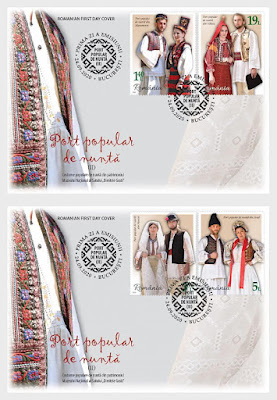
Romania 2020 - Folk Wedding Clothing (II)
Technical Details:
Issue Date: 24 September 2020
Designer: Mihail Vamasescu
Process: Offset
Colours: 4 Colours
Size: 42 x 52 mm
Values: 1.40L, 3.30L, 5L, 19L