IT'S NOT JUST A HOBBY


Tuesday, August 14, 2018

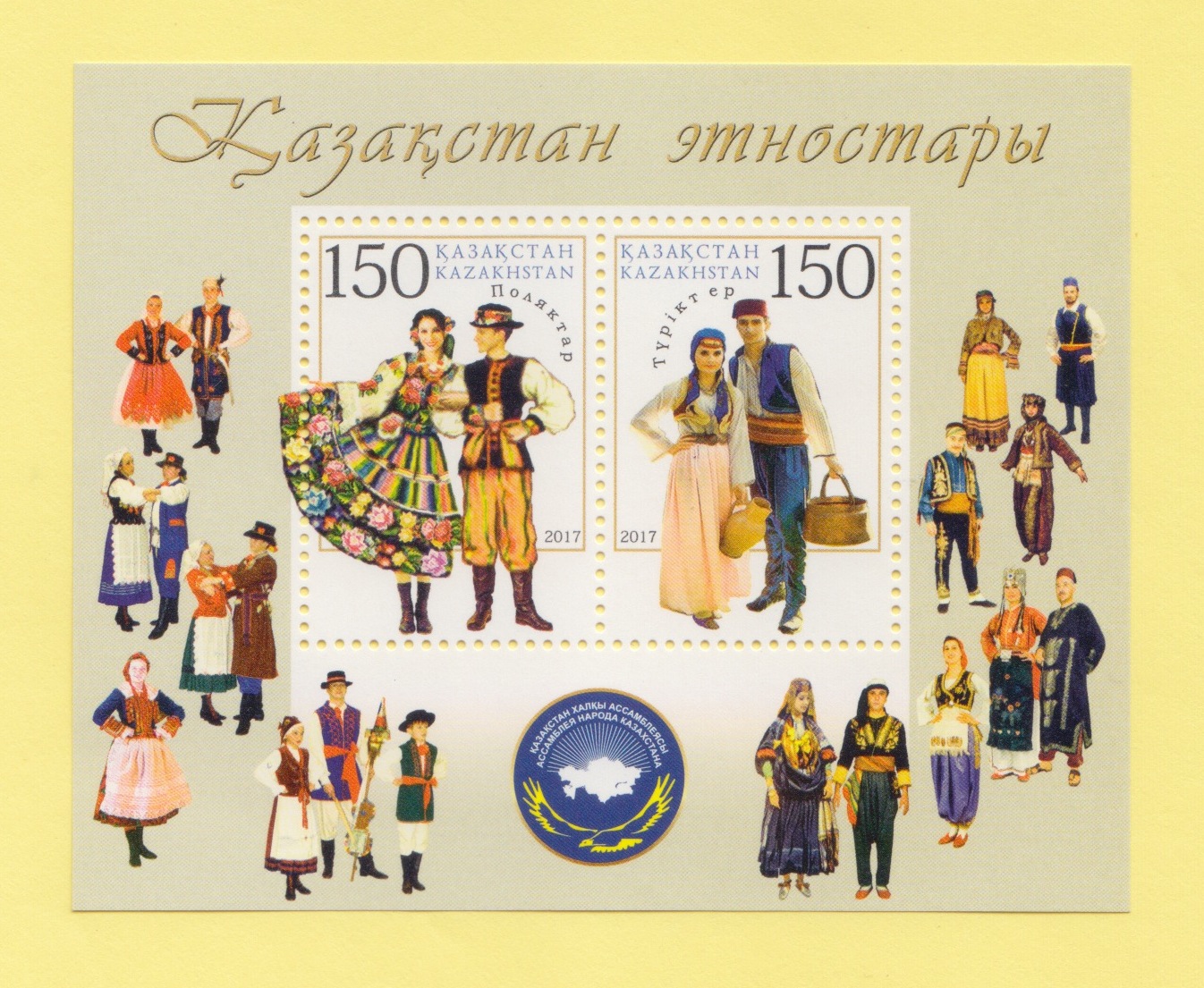
Kazakhstan - Traditional Costumes 2017


Technical Details:
Size: 40 * 28
Edition: 10000
Printing Method: Offset Printing in 4 Colors
Perforation: Comb
Designer/ Artist: Marshev S.
Printing House : RUE "Bobruisk Enlarged P
rinting House. A.T.Nepogodina
Date of Cancellation: 28 December 2017

Kazakhstan - Applied Arts of Kazakhstan, Kimeshek National Headdress 2014


Technical Details:
Date of Issue: 12 April 2015
Number of Stamps: 4

Size of Stamp: 28 mm x 40 mm
Size of Soevenir Sheet: 84 * 120
Edition: 10000

Perforation: 13 by 13
Printing Method: Offset Printing in 4 Colors
Perforation: Frame

Designer / Artist: S. Marshev
Printing House : RUE "Bobruisk Enlarged Printing House. A.T.Nepogodina

50 Kazakhstani Tenge - Kimeshek (Shygys r-n)
50 Kazakhstani Tenge - Kimeshek (Almaty r-n)
50 Kazakhstani Tenge - Kimeshek (Karagandy r-n)
50 Kazakhstani Tenge - Kimeshek (Pavlodar r-n)

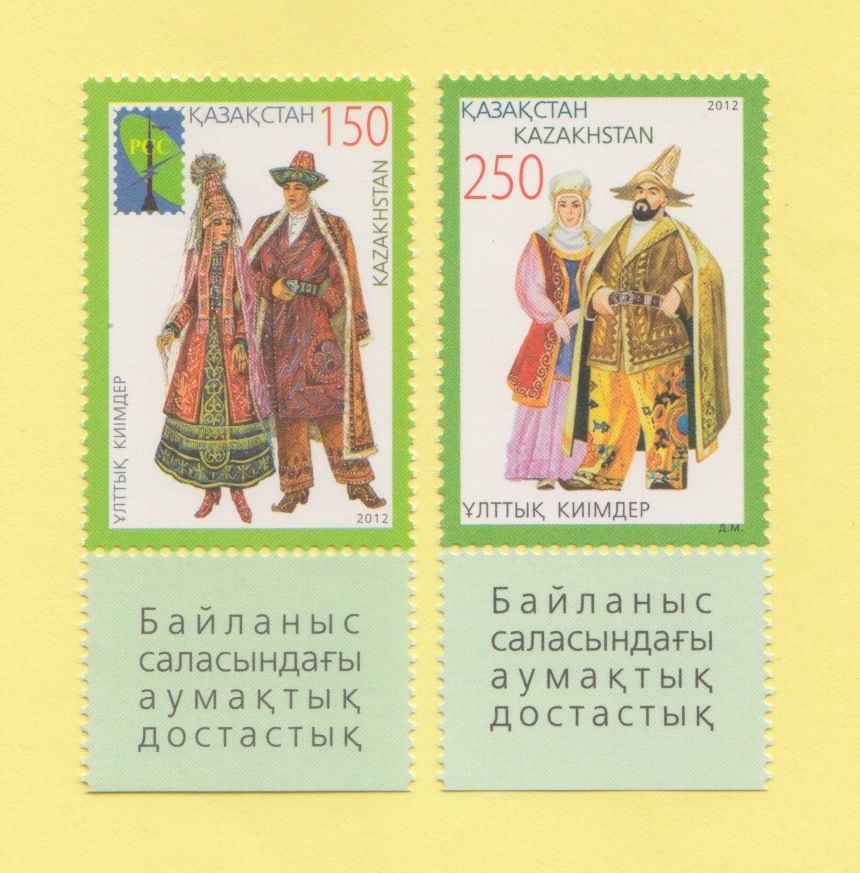
Kazakhstan - National Costumes 2012


Technical Details:
Number of stamps per sheet: 10
Size: 28 * 40
Edition: 22000
Printing Method: Offset Printing in 4 Colors
Perforation: Comb
Designer/ Artist: G.Ibraishina K.Ibraishin
Printing House : RUE "Publishing House" Belarusian Printing House "
The First Day Postmark Design: S.Marshav

Kazakhstan - Headdress, Joint Issue with Mongolia 2004


Technical Details:
Number of stamps per sheet: 20
Edition: 30000
Printing method: Offset Printing in 4 Colors
Perforation: Comb
Designer / Artist: D. Mukhamedzhanov, O. Odbayar
Printing House: Beijing Postal Payment Signage Factory (PRC)

New Zealand - World of Wearable Art 2004


Technical Details:
Date of Issue: 5 May 2004
Number of stamps: Five
Denominations and Designs: 45c 'Dragon Fish', 90c 'Persephone's Descent', $1.35
'Meridian', $1.50 'Taunga Ika', $2.00 'Cailleach Na Mara' (Sea Witch)
Stamps Designed by: Cato Design, Wellington
Printer and process: Southern Colour Print, Dunedin, by offset lithography
Number of colours: Four Process Colours
Stamp Size and Format: 40mm x 30mm (vertical)
Paper Type: Tullis Russell 104gsm Red Phosphor Stamp Paper
Number of Stamps per Sheet: 25
Perforation Guage:14
Special Blocks: Plate/imprint blocks could be obtained by purchasing at least six stamps from a sheet. Barcode, value blocks and logo blocks could be obtained by purchasing at least two stamps from a sheet. Barcode blocks were available in both A and B format.

Garments that defy all preconceptions, performances that draw gasps of awe and astonishment, music that takes your breath away… this is the World of WearableArt, an exhilarating feast for the senses, an inspiring experience for the soul.

Issue information

The wonderful Montana World of WearableArt (WOW) Awards Show is celebrated every year. Ever since its first appearance in Nelson in 1987, WOW has electrified audiences and critics alike. Today, it is an internationally acclaimed seven-night theatrical extravaganza - an achievement we applauded with this gorgeous range of five new stamps.
Imagination Unlimited

The hugely successful WOW Awards attracts entries from New Zealand and around the world, with performers ranging from magicians and ballroom dancers to aerial artists and opera singers.

We celebrated the diversity and colour of this wonderful unique event with a lavish first day cover.

And for the perfect collecting complement, a presentation pack was also available which contained information on each of the stamps as well as copies of the first day cover and five stamps.
Wildly Wonderful Ways

The WOW limited edition was an insight into this multi-award winning event, which has enthralled audiences for over 17 years. With information on the garments, their designers and the history of the Awards, this exclusive product was a highly sought-after collectors item (only 2,000 were produced).

0.45 New Zealand Dollar - Dragon Fish
Using hand-dyed, stencilled and ruched silk organza, split cane and recycled baskets, Susan Holmes of Auckland created 'Dragon Fish', a gloriously fantastic creature that captivated audiences and judges alike in the 1996 WOW® Awards. Winner of the Chez Eelco Supreme Award, Dragon Fish is a superb combination of the impossible and the practical, with a beautiful evening gown skilfully hidden beneath its layers.

0.90 New Zealand Dollar - Persephone’s Descent
'Persephone's Descent' was the first garment Stuart Johnson of Wellington had ever entered in the Montana WOW® Awards Show - and it went on to win him the ultimate accolade, the 2002 Montana Supreme Award. Created from hand-made components of mild and stainless steel, brass, chain, wood, leather, pewter and rotary clothesline parts, the garment reflects Johnson's interest in historical armour and the skills he has applied as armourer to The Lord of the Rings movie trilogy

1.35 New Zealand Dollar - Meredian
Rowan McLennan of Napier entered 'Meridian' as a third entry in the Montana WOW Awards Show. This lovely silk garment symbolises the return of energy, vitality and strength to the artist's body after a long illness, a bold, vibrant and passionate statement that celebrates life, warmth and sunshine. The extravagant creation earned McLennan the 2002 Wales & MacKinlay Silk Award.

1.50 New Zealand Dollar - Taunga ika 
The traditions and traits of Māori culture took on a new twist with 'Taunga Ika', Highly Commended to the Montana Supreme WOW Awards in 2001. Inspiration for designer Louise Neilson of Nelson came from prehistoric Māori fish hooks, representing strength, power, beauty and an entire way of life, while her source materials are harakeke (flax), supplejack, pumice and muka.

2.00 New Zealand Dollar - Cailleach Na Mara
Jan Kerr of Waikanae has long been a successful WOW entrant, but her 2001 entry stood out from the rest. This 'bag lady from the sea' positively drips with oceanic treasures, from recycled materials to old lace, beads, papier mâachée sea creatures, driftwood, old bones and shells. 'Sea Witch' is a product of her possessions and her environment, and deserving of being Highly Commended to the Air New Zealand Oceanic Section of the WOW Awards.
Monday, August 13, 2018

Paraguay - The 50th Anniversary of Diplomatic Relations with South Korea 2012


Technical Details:
Date of Issue: 28 June 2012
Subject Paraguay and Korea's 50th Anniversary of Diplomatic Relationships
Width: 45.0 mm
Height: 35.0 mm
Denomination 2000 PYG
Number in Set: 3 (show set)
Perforations: Imperforate
Stamp Issuing Authority: Correo Paraguayo
Printer: Fiscal Assets Department - Asunción


2000 Paraguayan Guarani - Paraguayan Bottle Dances & Korean Fan Dances
2000 Paraguayan Guarani - Paraguayan Bottle Dances
2000 Paraguayan Guarani - Korean Fan Dances

Moldova - Medieval Moldova 2012


Technical Details:
Date of Issue: 31 May 2012
Primary Theme: Military (Military equipment) 
Width: 46.0 mm
Height: 27.5 mm
Layout/Format: Sheet of 10
Perforations: 14 by 14.5
Stamp Designer: Vladimir Melnic
Printer: Printing House Nova Imprim Chisinau Moldova
Stamp Issuing Authority: Ministére de la technologie de l’information et des communications Republique de Moldova

Medieval Moldova:
0.85 Moldovan Bani - War Machine Berbec
1.20 Moldovan Leu - Soldier
1.50 Moldovan Leu - Captain
5.40 Moldovan Leu - Catapult

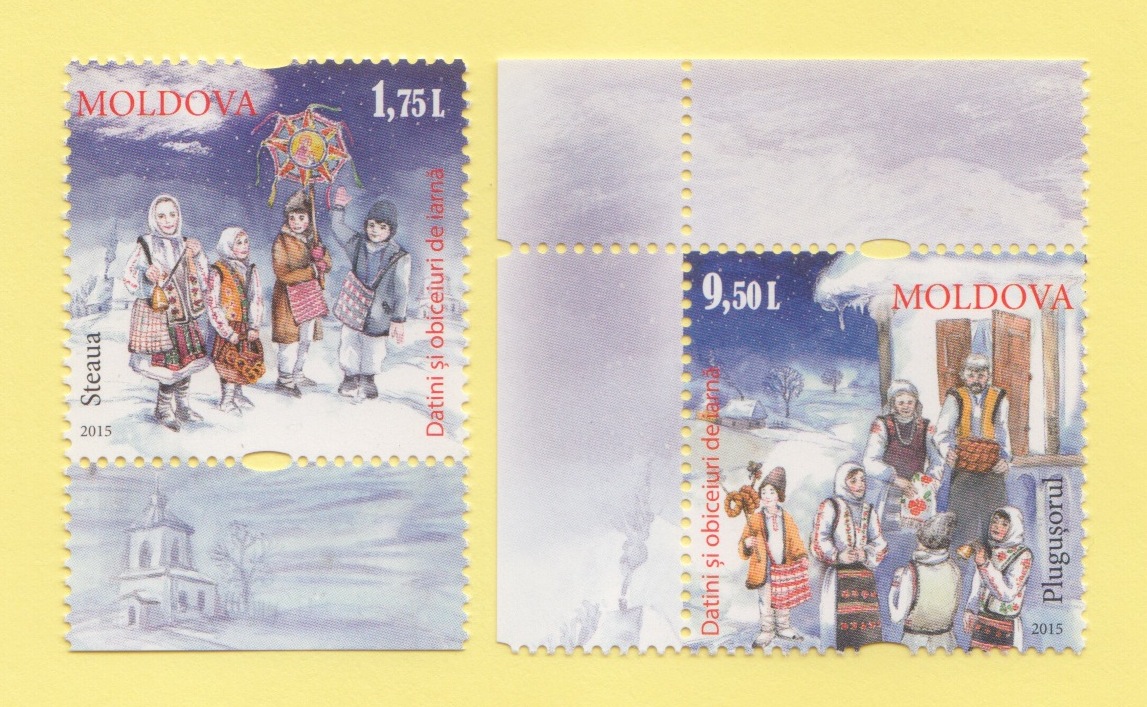
Moldova - Winter Customs and Traditions 2015


Technical Details:
Date of Issue: 4 December 2015
Width: 34.0 mm
Height: 34.0 mm
Denomination: 1.75 MDL, 9.50 MDL
Number in Set: 2 (show set)
Layout/Format: Sheet of 8
Perforations: 13 by 13
Stamps Designer: Iurie Palkov
Printer: Printing House Nova Imprim Chisinau Moldova
Stamp Issuing Authority: Ministére de la technologie de l’information et des communications Republique de Moldova

1.75 Moldovan Leu - Winter National Traditions and Customs - The Star (Steaua)
9.50 Moldovan Leu - Winter National Traditions and Customs - The Plough (Pluguşorul)

The Post of Moldova has already issued several sets of stamps in the past devoted to winter traditions and popular celebrations ("sărbători de iarnă") in the country and sometimes also in neighboring Romania.

On December 4, 2015, a new nice series (2 stamps) about that theme of winter popular customs and traditions ("datini şi obiceiuri de iarnă") was issued, in particular traditional processions, "Pluguşorul" and "Steaua", performed in Moldovan villages at this period of Christmas and New Year.

These two stamps, each printed in sheet of 8 stamps, are included on the nice FDC below (designed by Iurii Palkov, also the author of the stamps) with cancellation from Chişinău (MD-2012), issued only in 400 copies.

"Pluguşorul" (literally "the little plough"), on the L 9.50 stamp (print run : 300,000) is a very old secular custom referring to farming works. Groups of children and teenagers carrying a pluguşor, a small wooden stylized plough symbolizing fertility, are going from house to house, wearing masks, holding whips and bells and reciting poems glorifying farm work.
In the houses, they're being offered money and ring biscuits made from bread (present on the stamp, the illustration on the envelope and the postmark).

The other stamp (L 1.75, print run : 300,000) evokes the religious connotation tradition called "Steaua" ("Star") devoted to the birth of Christ. A procession of children brandishing a Steaua are going from house to house, where they sing Christmas carols.

During the period of Lent, children prepare this procession especially in making this star-shaped item (also featured on the stamp, the illustration on the envelope and the postmark), with in its center, an icon of the Virgin and Child, decorated with fir branches, ribbons, bells and various other colored accessories.

Moldova - Traditional Rituals and Customs (I) & (II) 2013


Technical Details:
Date of Issue: 20 June 2013
Width: 46.0 mm
Height: 27.5 mm
Layout/Format: Sheet of 10
Perforations 14 by 14.5
Stamp Designer: Simion Zamsa
Printer Printing House Nova Imprim Chisinau Moldova
Stamp issuing authority Ministére de la technologie de l’information et des communications Republique de Moldova

Traditional Rituals and Customs:
1.75 Moldovan Leu - Cleaning of Wells
1.75 Moldovan Leu - Paparuda - A Rain Ritual

-------------------------------------------------------------------------------------------------------------------------


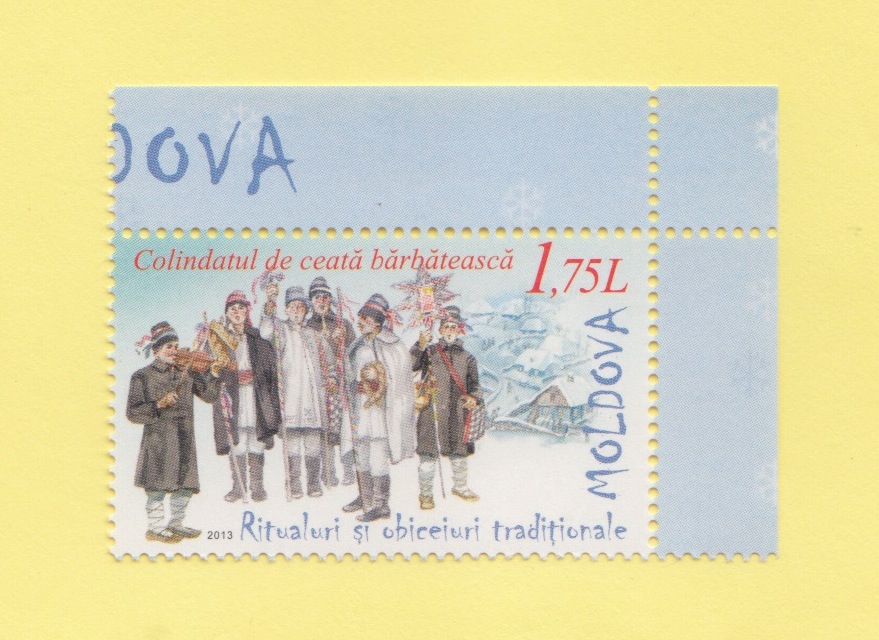
Technical Details:
Date of Issue: 22 November 2013
Width: 46.0 mm
Height: 27.5 mm
Layout/Format: Sheet of 10
Perforations: 14 by 14.5
Stamp Designer: Simion Zamsa
Printer: Printing House Nova Imprim Chisinau Moldova
Stamp Issuing Authority: Ministére de la technologie de l’information et des communications Republique de Moldova

Traditional Rituals and Customs:
1.75 Moldovan Leu - A band of Carolers

Moldova - Christmas Ritual 2009


Moldova - Traditional Blouses, Elements of National Costume 2015


Tehnical Details:
Date of Issue: 24 June 2015
Width 34.0 mm
Height 34.0 mm
Denomination 1.75 MDL, 11.00 MDL
Number in set: 2 (show set)
Layout/Format: Sheet of 8
Perforations: 13 by 13
Stamp Designer: Alexandr Kornienco
Printer: Printing House Nova Imprim Chisinau Moldova
Stamp Issuing Authority: Ministére de la technologie de l’information et des communications Republique de Moldova

1.75 Moldovan Leu - Elements of National Costume (Beginning of XX Century)
11.00 Moldovan Leu - Elements of National Costume (1925)

On June 24, 2015 the Post of Moldova has released a beautiful series (2 stamps) dedicated to one of the female national costume elements, the traditional blouse called "ie".

These two stamps (print run : 250,000 each), designed by Alexandr Kornienko, are included on the official FDC below (design: Maria Maximenco, print run : 300) with a cancellation from Chisinau (Office No. 9).

To note the FDC postmark, featuring some embroidery elements of this blouse, as well as the other two cachets, a conventional hand postmark (with a blue ink) and a special cancellation mentioning that June 24 is celebrated as the Universal Day of that blouse ("Ziua universală a iei") !

I guess that this Universal Day is also celebrated in neighboring Romania since this type of blouse is also popular in this country.

The two examples of "ie" blouses depicted on these two stamps respectively date from the early 20th century (L 1,75) and 1925 (L 11).

This element of the Moldovan national costume is very old and also similar to the existing blouses in some Slavic countries (Serbia, Bulgaria...).

This blouse, on white background, is made up of three parts including more or less elaborate embroidery (altiţă, increţ and râuri).

Moldova - Folk Dances 2010


Technical Details:
Date of Issue: 18 September 2010
Width: 46.0 mm
Height: 27.5 mm
Denomination: 0.85 MDL, 5.40 MDL
Number in Set: 2 (show set)
Layout/Format: Sheet of 10
Perforations: 14 by 14
Stamp Designer: Alexei Colabneac
Printer: Enterprise d'Etat editorial-polygraphique Tipografia Centrala Chisinau Moldova
Stamp issuing Authority; Ministere du developpement de l'information, Republique de Moldova

0.85 Moldovan Bani - Traditional Dances II - Moldoveneasca
5.40 Moldovan Leu - Traditional Dances II - Calusarii

Moldova - Folk Dances, Joint Issue with Azerbaijan 2015


Technical Details:
Date of Issue 16 October 2015
Width: 46.0 mm
Height: 27.5 mm
Denomination 1.75 MDL, 11.00 MDL
Number in set: 2 (show set)
Layout/Format: Sheet of 10
Perforations: 14 by 14.5
Stamp Designer: Oleg Cojocari
Printer Printing House Nova Imprim Chisinau Moldova
Stamp issuing authority Ministére de la technologie de l’information et des communications Republique de Moldova

Folk Dances - Joint issue Republic of Moldova and Republic of Azerbaijan:
1.75 Moldovan Leu - Traditional Dance of Moldova
11.00 Moldovan Leu - Traditional Dance of Azerbaijan

Saturday, August 11, 2018

Moldova - Ethnicities of Moldova, The Romani People 2018


The Romani (also spelled Romany /ˈroʊməni/, /ˈrɒ-/), or Roma, are a traditionally itinerant ethnic group, living mostly in Europe and the Americas and originating from the northern Indian subcontinent, from the Rajasthan, Haryana, Punjab and Sindh regions of modern-day India and Pakistan. A DNA study conducted by Indian and Estonian research facilities shows that the Roma/Romani/Gypsy and Sinti people originate from the so-called “Untouchable” Dalit community from India.

Date of Issue: 20 April 2018 
Theme: Traditional Crafts and Costumes
Designer: Oleg Cojocari
Printer: Nova Imprim, Chişinău

Thursday, August 9, 2018

Mongolia - Culture and Art 1961


Date of Issue: 16 September 1961
With scenes of achievment and progress of sector of culture and art for 40 years since people's revolution.

Size: 43x33mm , 33x43mm
Printing: Intaglio
Size of Seal: 12; 11 1/2

Romania - Traditional Folk Costumes, Joint Issue Romania-Poland 2013


Technical Details:
Issue Date: 11 September 2013
Designer: M.Dabrowska
Process: Offset
Colours: 4 colours
Size: 52x 42 mm, 75 x 108 mm
Values: 8.10 Lei

About Joint stamp issue Romania – Poland: Traditional Folk Costumes

The 25th of January 2013 marked 20 years since signing the Treaty on friendly relations and cooperation between Romania and the Republic of Poland, occasion on which Romfilatelia introduces into circulation the joint stamp issue Romania - Poland with the theme Folk Art - Traditional Folk Costumes.

Folk art is the natural expression of the rural community’s life and aspirations, revealing the sensitivity and life horizon thereof. In the general framework of folk art, the costumes are real “identity cards” of the inhabitants of different geographical areas, being developed following a long creation process and maintaining values of the tradition and culture of numerous generations.

The Romanian costume from Bistrita-Nasaud area denotes an optimism plastically expressed by the contrast between the white fabric of the shirts and the strong red of the embroideries. Spectacular and specific to the area are the men’s vests with “canaci”, decorated with successions of polychrome silk tassels and the long sheepskin coat worn by the women, embroidered with floral motifs and lining leather applications and large silk tassels. The hats decorated with a disk-shaped peacock feather, a symbol of the lads and paunitele (peahens), an adornment specific to the girls, are unique in the country. The latter consists in two bead-embroidered circles attached above the ears and surrounded by peacock feathers.

The Polish costume from Krakow area has bright colours and joins beautiful, strong shades of red and blue to black and white. The women wear skirts lavishly decorated with flowers, embroidered vests and beads, especially red. Unmarried girls may wear flower crowns with ribbons, while married women wear head scarves. Men wear blue vests with embroideries and tassels, pants with vertical white and red stripes and red hats with ribbons and peacock feathers. A precious accessory of the costume is represented by the tall boots worn by both men and women.

The stamp of the joint issue illustrates both the Romanian folk costume from Bistrita-Nasaud area, and the Polish one from Krakowarea. The costumes reproduced on the postage stamp distinguish through the peacock feather, a characteristic joint element, the hats with the disk-shaped peacock feather being a symbol of the lads in both folk cultures. The very bright colours and the floral decorations are accompanied by the pride of each pair wearing them.

The perforated souvenir sheet margin reproduces the logo of the Polish and Romanian friendship designed by the Polish illustrator Jacek Doszyn, whose work won the competition organized at the beginning of 2013 by the Polish Institute in Bucharest under the patronage of the Romanian Ministry of Foreign Affairs and of the Embassy of the Republic of Poland in Romania. The logo is designed to accompany and highlight all the events organised over 2013 on the occasion of the 20th anniversary since signing the Treaty on friendly relations and cooperation between Romania and the Republic of Poland.

Romania - 20th Century Fashions 2003


Technical Details: 
Issue Date: 13 December 2003
Designer: Simona Bucan
Process: Tiefdruck
Colours: 6 Colours
Size: 33 x 48 mm
Values: 2 x 4,000 Lei; 2 x 21,000 Lei

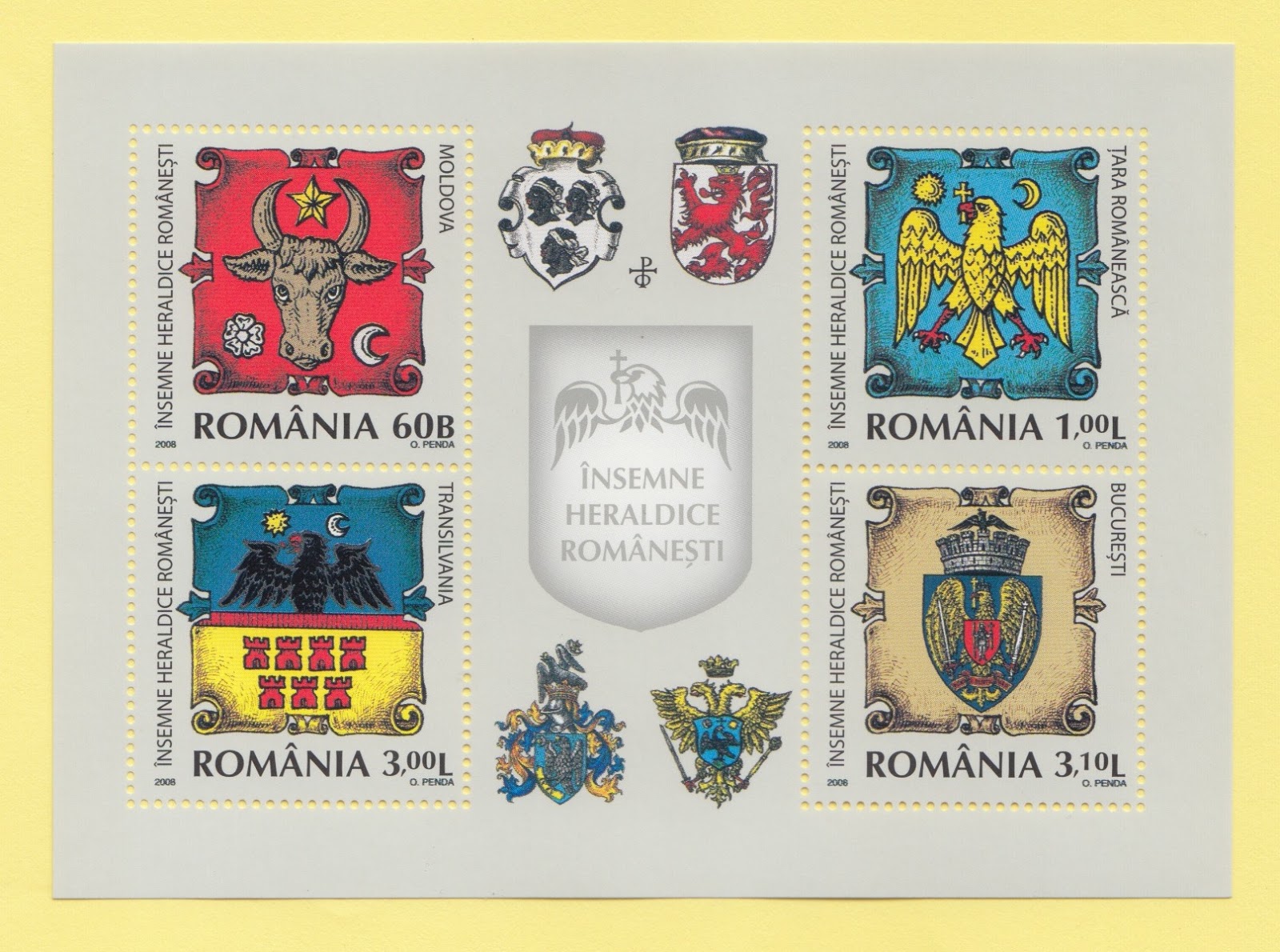
Romania - Romanian Heraldic Symbols 2008


Technical Details:
Issue Date:04 September 2008
Designer:Octavian Ion Penda
Process:Offset
Colours:5 Colours
Size:36 x 36 mm, 126 x 90 mm, 117 x 147 mm (stamp size: 42 x 52 mm)
Values:0.60LEI, 1.00LEI, 3.10LEI, 3.00LEI, 6.00LEI

About Romanian Heraldic Symbols


Used as a historical source, heraldry is an important mean of putting theoretical principles into practice, interpreting and researching the evolution of a country’s coats of arms, of a domain, a city or a family. The denomination of heraldry derives from the Latin term used during the Middle Ages: heraldus = herald. During the Medieval period, heralds were the messengers of the war but they would also make the presentations of fighters during jousting competitions and their armorial bearings. The coat of arms was a conventional symbol, characteristic for the state, city, family, individual, etc. The oldest Romanian coats of arms representing Wallachia, Moldavia, and Transylvania bear the seal of Occidental influence.

For history lovers and equally for collectors of heraldic symbols, Romfilatelia introduces into circulation the postage stamp issue “Romanian Heraldic Symbols”, accomplished according to an original graphic concept signed by the famous artist Octavian Ion Penda.

The stamp with the face value of Lei 0.60 depicts the heraldic symbols of Moldavia, based on sigillary and monetary springheads. The first representation is found on the backside of the grosses, coins struck during the reign of Petru I Musat, Moldavian ruler (1375-139), as well as his sigillum from 1387. The Moldavian coat of arms shows the bull head with a 5-ray star on its forefront between its antlers, flanked by a rose on the right side and a crescent on the left. This is also illustrated on a seal from 1430 belonging to Alexander the Good (Alexandru cel Bun). This heraldic representation of the Moldavian coat of arms can also be seen on religious monuments and historical documents.


The stamp with the face value of Lei 1.00 presents the heraldic symbols of the region of Wallachia. Ever since its creation, the main element of the symbol was the eagle, accompanied by the sun and the moon. The image of the coat of arms of Wallachia, highlighted on the seal of Voivode Mircea the Elder (Mircea cel Batran) on a document dating since 1390, is considered to be the oldest and the most accurate representation of the symbol. If the initial coat of arms presents the eagle with folded wings, it later on suffered some visible modifications such as a richer plumage with unfolded wings, on the edge of taking off, as envisaged on the seal of Patrascu cel Bun in 1557.


The stamp with the face value of Lei 3.00 shows the heraldic symbols of the region of Transylvania. At the end of the 16th century, certain printed works showed the printed images of a cut shield with an eagle in the upper part and seven mountain ranges in the lower one, tended by crenellated towers. Along the time, the mountain ranges disappeared from the heraldic representation of the region of Transylvania but the red towers on golden fields were preserved in the upper part, together with the eagle flanked by the sun and the moon. Bearing in mind that the coat of arms of Transylvania suffered, in time, no noticeable modification, after the accomplishment of the Great Unification on December 1st, 1918, its elements were incorporated in the Romanian coat of arms.


The stamp with the face value of Lei 3.10 illustrates one of the variant of the coat of arms of the Romania’s capital, Bucharest. Created in 1930 by the de Heraldic Consulting Commission, the symbol was used until 1948. After 1989, the City Hall of the Municipality of Bucharest decided to give the city its ancient coat of arms. The emblem represented the golden eagle holding a cross in its beak, bearing the steel Romanian crown on its head. The central part shows Saint Great Martyr Dumitru – military saint, protector of the city of Bucharest. The eagle has a silver sword in its right claw and a golden scepter in its left one. The motto accompanying it is My Country and my right.


The souvenir sheet of the postage stamps issue also presents other coats of arms and seals used in the city of Bucharest between 1864 and 1888.The stamp of the souvenir sheet has the face value of Lei 6.00.

Romania - New Year Customs 2016


Technical Details:
Issue Date: 21 December 2016
Designer: Victor Telibasa
Process: Offset
Colours: 4
Size: Stamps size: 48 x 33 mm
Minisheet size: 120 x 110 mm
Values: 2.20 Lei, 2.50 Lei; 8 Lei; 15 Lei

About New Year Customs

Formerly, December was called verbatim the “Knitting needle” month, and “Sheepskin Coat” month, the month of “Snow” or “St. Andrew’s” month.

In the world of the Romanian village the traditions and customs from bygone times are the unwritten national treasure and folk wisdom, which unite the pre-Christian and Christian practices. Some of them have been forgotten, but others continue up to this day and we can seek their origin in ancient times when, in general, a moment that marked a beginning had a powerful symbolic importance.

The list of Romanian traditions and customs includes in addition to carols, dances with masks, processions, folk theatre and dances specific to the end of the year. Of all these, Romfilatelia presents within the philatelic issue New Year Customs, four postage stamps that render some of the traditions of the end of the year, essences of our spiritual wealth.

“Plugusorul” (literal translation – little plow) is a Romanian custom practiced since ancient times on New Year’s Day. This agrarian tradition, which is originally a sacred ritual manifestation of the wishes to have rich harvests, has to do with the work to obtain bread.

Also known by other names like “plow” or “ploughmen”, plugusorul has a symbolic character, originated by a magical incantation.

Children are the first to start plugusorul and begin to walk among the houses, receiving in exchange for their wishes of a good year, knot-shaped breads, fruit or money. The troop leader is marked by a brass and tin covered cane, decorated with colorful tassels, representing the mark of authority.

An agrarian custom, structured after carols, Riding with the “buhai” (a special drum caused to boom by pulling on a tuft of hair attached to it) is a tradition kept for centuries in Romanian villages. The buhai custom is practiced on New Year’s Eve, between dusk and midnight.

The object itself is a churn with one of the ends covered by a stretched piece of sheepskin, from the center of which hangs a horsehair mane, which produces a solemn, strange and unmusical sound, reminiscent of a bull’s roar.

Sometimes the buhai is adorned with ram’s horns wrapped in colorful paper, and tassels.

The groups of well-wishers wear traditional costumes adorned with hats, whips and bells, being fondly received by the hosts, who reward them with apples, nuts, pretzels and knot-shaped breads.

Another ancient custom that takes place in the New Year’s evening is the Bear or dance, a popular dance with masks with an omen characteristic, consisting of disguised well-wishers. Powerful, unpredictable and cruel, the bear is an animal revered since ancient times. In Romanian folklore, bears are empowered with different protective abilities, therapeutic and weather changing.

The masked costume is handmade from the fur of a whole animal, and the head is adorned with two red tassels.

The Bear dance is the bringer of fertility and the sounds of the whistle, drums and bells will result in raising the heat from the earth and so the soil will be more productive.

The Goat dance is an ancient custom still retained by Romanians, which is part of the traditions of winter. On New Year’s Day, through the folk theatre that the Goat dance presents going through a cycle of “transformations” (death, burial, mourning and resurrection) we actually participate in a dramatic ritual intertwined with elements of worship.

According to Romanian traditions, going along with the goat, as well as receiving the well-wishers in every home, brought Christians good luck and prosperity in the household, being also an important custom for farmers who felt the Goat dance was a calling to the divine force for attracting rich crops. An anciently worshiped animal, the goat was associated to the cult of fertility.The ritual of this dance symbolizes the burial of the old year and the re-birth of the new year.

New Year’s custom, going around with the Sorcova, is practiced especially by children. The etymology of the word “sorcova” comes from the Bulgarian word “surov”, which means “green” and refers to the budding green branch that the well-wishers of old would use.

For the well-wishers, the sorcova stick is used instead of a magic wand and has the capacity to transmit health and youth to the one being wished upon.

These New Year customs are practiced in the belief that in the coming year, people will be healthier and will have the abundance of their barns, herds and orchards.

We wish you healthy, peaceful New Year with the hope for a better future!

Romania - Romania in the UNESCO Intangible Cultural Heritage 2014


Technical Details: 
Issue Date: 07 August 2014
Designer: Mihai Vamasescu
Process: Offset
Colours: 4 Colours
Size: 72 x 33, 124 x 90 mm
Values: 3.10 Lei, 6 Lei, 9.10 Lei

About Romania in the UNESCO Intangible Cultural Heritage

The Intangible Cultural Heritage includes oral traditions and expressions, having the language as its main vector, performing arts, social practices, rituals and festive events, knowledge and practices concerning nature and the universe, and the skills necessary to produce traditional crafts.

The list of the UNESCO Intangible Cultural Heritage was officially created in 2008, and was the result of the Convention for the Safeguarding of the Intangible Cultural Heritage, signed in Paris on 17 October 2003.

Romfilatelia dedicates the present issue of postage stamps to this special area, proudly promoting four of the Romanian traditional customs and manifestations, inscribed on the list of the UNESCO Intangible Cultural Heritage: the Calus ritual dance, nominated and accepted in November 2008, the Doina, inscribed in October 2009, the craftsmanship of Horezu ceramics, inscribed in December 2012, and the Men’s group Colindat, Christmas time ritual, the most recently inscribed on the list, in December 2013.

The Calus ritual dance, present since ancient times both in Moldavia and Transylvania, is performed nowadays in Muntenia, Oltenia and Ardeal (the sub-region of Orastie). This Romanian dance is traditionally performed the week before the Pentecost, being considered to have healing effects. Yet, there are historic documents mentioning the dance being performed on other occasions too, as it was the case of the dance performed by the soldiers of ruler Mihai Viteazul, called “the caluseri”, who were led by captain Baba Novac, for the celebration organized by Sigismund Bathory in 1599, at Piatra Caprei, close to Alba Iulia. The Calus is related to the worship of an ancient equine god, known in the popular tradition of the Dacians as Calus, Calut or Calucean. The motifs on the dancers’ costume have names that recall the god’s name, the dance movements symbolising the trample and the behavior of the horse.

The Doina is one of the Romanian representative literary products that enrich the folk heritage along with fairy tales, ballads, and many other popular creations. The literary species of doina is a lyrical chant meant to express a wide range of feelings (of nostalgia, sadness or love) characterized by extraordinary depth, that can be sung with an instrumental accompaniment.

The Craftmanship of Horezu ceramics is a unique traditional craft, from the northern part of Valcea County, practiced both by men and women, the manufacturing process being divided between them. Men select and extract the soil, which is then cleaned, cut and wetted, kneaded, trampled and mixed, becoming thus the clay body from which the famous red pottery of Horezu is produced. The women are those who decorate the objects using specific techniques and tools to draw traditional motifs. Their handicraft and talent to combine decorations and colours define the personality and uniqueness of this type of ceramics. The colours are vivid and include dark brown, red, green, blue and the “Horezu ivory”, being used to depict motifs such as the fish, the snake, the rooster, the tree of life, the oak leaf, etc.

Men’s group Colindat, Christmas time ritual, practiced in Romania and the Republic of Moldavia, was inscribed on the list of the UNESCO Intangible Cultural Heritage on the occasion of the 8th session of the Intergovernmental Committee for the Safeguarding of the Intangible Cultural Heritage that took place in Baku, Azerbaidjan, in March 2013. This is an old tradition characteristic of the Romanian culture. Its Latin origin was analysed many times, being universally accepted. This ritual has accompanied the Romanian people for centuries, guiding its life according to the laws of popular ethics and aesthetics. It encompasses important values of the musical, literary and choreography folklore, which have been retained through orality.

Monday, July 30, 2018

Moldova - Local Coats of Arms I, Definitive Stamps 2015


Technical Details: 

Date of Issue: 07 March 2015
Subject: Localities Armories
Width: 27.5 mm
Height: 23.0 mm
Layout/Format: Sheet of 50
Perforations: 14.5 by 14
Printer: Printing House Nova Imprim Chisinau Moldova
Stamp Designer: Nicolae Sîrbu

Stamp issuing authority: Ministére de la technologie de l’information et des communications Republique de Moldova

The first six values of a definitive series devoted to the coats of arms of country's major cities.

0.10 Moldovan Bani - Armory of Căușeni (Print Run: 1,000,000)
0.25 Moldovan Bani - Armory of Hîncești (Print Run: 500,000)
1.00 Moldovan Leu - Armory of Ungheni (Print Run: 500,000)
1.20 Moldovan Leu - Armory of Orhei (Print Run: 600,000)
3.00 Moldovan Leu - Armory of Bălți (Print Run: 300,000)
5.00 Moldovan Leu - Armory of Chișinău (Print Run: 300,000)

Moldova - Local Coats of Arms II, Definitive Stamps 2017


Technical Details:
Date of Issue: 10 February 2017
Subject: Localities Armories
Width: 23 mm
Height: 27.5 mm
Layout/Format: Sheet of 50
Perforations: 14 by 14.5
Printer: Printing House Nova Imprim Chisinau Moldova
Stamp Designer: Maria Maximenco
Stamp issuing authority: Ministére de la technologie de l’information et des communications Republique de Moldova

The first six values of a definitive series devoted to the coats of arms of country's major cities.

0.10 Moldovan Bani - Armory of Briceni City (Print Run: 1,000,000)
0.25 Moldovan Bani - Armory of Rezina City (Print Run: 1,000,000)
1.00 Moldovan Leu - Armory of Sângerei City (Print Run: 1,000,000)
1.20 Moldovan Leu - Armory of Florești City (Print Run: 1,000,000)
1.75 Moldovan Leu - Armory of Ialoveni City (Print Run: 1,000,000)
3.00 Moldovan Leu - Armory of Leova City (Print Run: 950,000)

Thursday, July 26, 2018

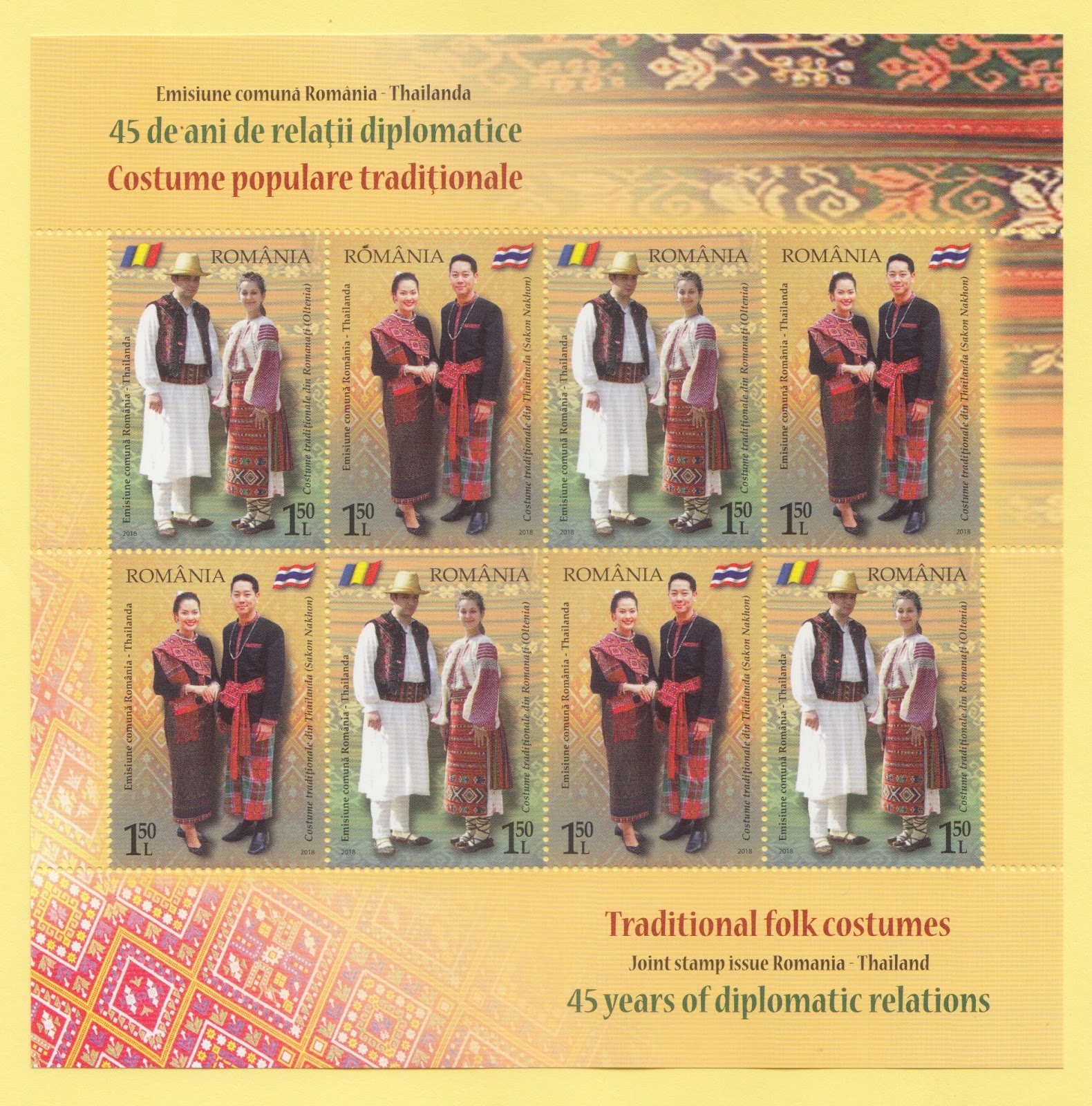
Romania - Traditional Costumes, Joint Issue With Thailand 2018


Technical Details:

Issue Date: 31 May 2018
Designer: Mihail Vămășescu
Process: Offset
Colours: 4 Colours
Stamp Size: 33 x 48 mm, 
Minisheet Size: 156 x 156 mm
Values:1,50 L; 1,50 L

JOINT STAMP ISSUE ROMANIA – THAILAND 45 YEARS OF DIPLOMATIC RELATIONS
Continuing the series of postage stamp issues dedicated to diplomatic relations, on the anniversary of the bilateral relations between Romania and the Kingdom of Thailand, settled on the 1st of June 1973, Romfilatelia introduces into circulation the joint stamp issue Romania-Thailand, 45 years of diplomatic relations, with the topic Traditional Folk Costumes.
The new issue will be available on ThursdayMay 31th2018,  in Romfilatelia’.
The Romanian stamp, with the face value of Lei 1.50, illustrates the folk costumes of Oltenia region, specific to Romanati area, from the end of the 19thcentury. The traditional folk costume of Phutai ethnic group, from the northeast of the country, is reproduced on the stamp issued by the Thailand Postal Administration.
The traditional costume, illustrated on the stamps of the issue, represents, for each people, an integral part of the local history and civilization, a living testimony that has passed to the generations, over the centuries, the message of the authentic artistic creation.
Romanati costume falls in the typology of Oltenian traditional costume, remarked by compositions and decorative motifs that refer to the ornamental repertoire of the Neolithic ceramics of Vadastra – the spirals on the sheepskin coats – and to the pomposity of the gold thread fabrics, from the embroidery of the women’s chemise.
Women’s garment consists of a wavy at the collar chemise, with a decoration on the sleeve in tripartite system (“altita” – wide embroidery, wrinkles, rivers) on the chest, back and legs. The refinement of the chemise is given by the chromatic relationship between the cherry and the silver metallic thread. The tissue apron is associated with the folded up “valnic”. The garment also contains wool socks and bovine leather sandals.
The men’s costume consists of a summer straw hat, an embroidered shirt adorned with “coltisori”, trousers, socks and sandals. The loom woven belt and the doublet decorated with rosettes on the entire surface, in vivid colors, complete the costume.
The traditional folk costume of Phutai ethnic group, in north-eastern Thailand, Sakon Nakhon Province, is specific to the countryside. The man wears a long cloth and a cotton, long-sleeved, navy-colored shirt, edged with red embroidery and a belt, in harmony with the costume of his partner.  The woman wears a cotton, navy blue skirt, decorated with woven embroidery, and a simple, long-sleeved shirt of the same color. The costume is completed by a red embroidered scarf, worn on shoulders and silver jewellery  necklace, bracelets and earrings.
The postage stamp issue is completed by a First Day Cover, as page composition there were used a sheet of 32 stamps and a minisheet of 8 stamps with illustrated border (4 sets).
------
About Joint Stamp Issue Romania - Thailand 45 Years Years of Diplomatic Relations
On the anniversary of the bilateral relations between Romania and the Kingdom of Thailand, settled on the 1stof June 1973, Romfilatelia introduces into circulation the joint stamp issue Romania-Thailand, 45 years of diplomatic relations, with the topic Traditional Folk Costumes. The Romanian stamp, with the face value of Lei 1.50, illustrates the folk costumes of Oltenia region, specific to Romanati area, from the end of the 19th century. The traditional folk costume of Phutaiethnic group, from the northeast of the country, is reproduced on the stamp issued by the Thailand Postal Administration.

The Kingdom of Thailand is known for its natural beauties, being visited annually by millions of tourists. It is also one of the oldest Asian states, where ancient civilization have developed. The first Thai Kingdom was founded in 1278, named Siam, a name that lasted until 1939, when the state was renamed Thailand. More than 67 million people live in the Asian country, from seven ethnic groups: thai (75%), Chinese (14%), Mon, Khmer, Lao, Malay, Indians. The inhabitants are 95% Buddhists. Thailand is also called “The country of smiles”, due to the hospitality encountered by the tourists.

The most important Thai city is the capital of Bangkok, a growing financial and economic center, but also one of the largest ports in South Asia. The city has many UNESCO World Heritage sites, including 300 Buddhist temples and the Royal Palace. The most modern Thai resorts are in Hua Hin region, which has a 3 km long beach, with spectacular views. Hikers can choose the Isaan region, known for its special landscapes.

In north-eastern Thailand, there is the Sakon Nakhon region, a place full of history, famous for its Buddhist temples, secluded in wooden areas and preferred by ascetics for meditation.

The region is also appreciated for handicraft products, made of cotton and silk. The capital of the region, also called Sakon Nakhon, is an important Buddhist culture center with five stupas(Buddhist funeral monuments).

The traditional costume, illustrated on the stamps of the issue, represents, for each people, an integral part of the local history and civilization, a living testimony that has passed to the generations, over the centuries, the message of the authentic artistic creation.

Romanati costume falls in the typology of Oltenian traditional costume, remarked by compositions and decorative motifs, that refer to the ornamental repertoire of the Neolithic ceramics of Vadastra – the spirals on the sheepskin coats – and to the pomposity of the gold thread fabrics, from the embroidery of the women’s chemise.

Women’s garment consists of a wavy at the collar chemise, with a decoration on the sleeve in tripartite system (“altita” – wide embroidery, wrinkles, rivers) on the chest, back and legs. 

The refinement of the chemise is given by the chromatic relationship between the cherry and the silver metallic thread. The tissue apron is associated with the folded up “valnic”.

The garment also contains wool socks and bovine leather sandals.

The men’s costume consists of a summer straw hat, an embroidered shirt adorned with “coltisori”, trousers, socks and sandals. The loom woven belt and the doublet decorated with rosettes on the entire surface, in vivid colors, complete the costume.

The traditional folk costume of Phutaiethnic group, in north-eastern Thailand, Sakon Nakhon Province, is specific to the countryside. The manwears a long cloth and a cotton, long-sleeved, navy-colored shirt, edged with red embroidery and a belt, in harmony with the costume of his partner.

The womanwears a cotton, navy blue skirt, decorated with woven embroidery, and a simple, long-sleeved shirt of the same color. The costume is completed by a red embroidered scarf, worn on shoulders and silver jewellery –necklace, bracelets and earrings.

Romfilatelia thanks the “Dimitrie Gusti” National Village Museum of Bucharest and the Thailand Postal Administration for the support granted for the achievement of this postage stamp issue.