IT'S NOT JUST A HOBBY


Friday, October 21, 2011

Thailand - Thai Philatelic Exhibition, Traditional Dances 2011


Date of Issue: 04 August 2011

Design 1: The Hero of Likay Song Khrueang Performance in a dance posture called Sod-Soi-Mala
Design 2: The Heroine of Likay Song Khrueang Performance in a dance posture called Naep-Wai-Nai-Ok
Design 3: The Hero of Likay Luk Bot Performance in a dance posture known as preparing for battle
Design 4: The Heroine of Likay Luk Bot Performance in a dance posture called Cheep-Na-Cheep-Lang

Denomination: Thailand Baht 5.00
Designer: Mr.Thaneth Ponchaiwong (Thailand Post Company Limited)

Printer: Thai British Security Printing Public Company Limited, Thailand
Printing Process: Lithography (Glitter Ink)

Likay is a Thai traditional musical folk drama. The performance on stage mostly speaking, signing, dancing, and acting the postures in harmony with the tune played by Pi Pat Band, the Thai traditional orchestra. According to historical evidence in the reign of King Rama V, a religious chanting was performed in the royal cremation ceremony of Queen Sunanda Kumariratana in 1880 by a group of Moslem sitting in circle with the Rammana drum playing at the center. This performance was called the Djikay song, which later distored to be Yikay and Likay respectively.

Likay Song Khrueang initiated in Siam by Phraya Phetpani, who set up the first Likay theatre or 'Wik' by developing the chanting of Moslem ('Suat Khaek') to be the popular part of the show, known as "Awk Khaek". In this part, a performer in Indian style costume came on stage for chanting and telling the sypnosis of the storyline, and the main story began next. It was increasingly popular throughout the country so that many more Wik of Likay had been set up at that time. Adapted from courtier's costumes, the performer dressed up with colorful blouse, white socks, sparkling accessories, and headdress called "panchuret-yot" before the costumes were changed to be simpler during the World War II since it was difficult to import the materials from abroad. Only round-necked and short-sleeved shirt, loincloth, breechcloth, head cloth or head ring were used instead of elegant attires. The new stories were plotted for the audiences to enjoy the more variety of Likay stories. This new face of Likay was widely known as Likay Luk Bot.

Sunday, October 16, 2011

Indonesia - Traditional Textile of Indonesia 2011 (#3)

MS without Overprint + Perforation
MS with Overprint + Perforation
MS with Overprint + Non Perforation

Technical Details:
Issued on 02 October 2011
Theme: Traditional Textile of Indonesia
Stamp Size: 41.06 x 25.31
Perforation: 12.75 x 13.50
Color: Separation & Invisible Ink
Paper: Tullis Russel
Gum: PVA
Printing Process: Offset
Printer: AMG Security Printing
Designer: De-Er

IDR 2500 - Songket Melayu, Riau
IDR 2500 - Songket Mentok, Bangka Belitung
IDR 2500 - Batik Mega Mendung, West Java
IDR 2500 - Tenun Sora Langi, West Sulawesi
IDR 2500 - Tenun Tolaki, South East Sulawesi
IDR 2500 - Tenun Tanimbar, Maluku
IDR 2500 - Batik Papua, Papua
IDR 2500 - Batik Papua Barat, West Papua

IDR 5000 - Tari Topeng, West Java (SS)

Indonesia is the largest archipelago country in the world with more than 17,500 large and small islands scattered along the 4800KM between Asia and Australia. Therefore, Indonesia has the largest diversity of art and culture compared to any part of this world. Every ethnic groups in Indonesia have its own characteristics in their traditional clothing which, of course, they are equipped with traditional unique cloth and being a wonderful cultural heritage.

Kain Tenun (woven cloth) are made with developed warp ikat technique and it is being a characteristics of population in Nusa Tenggarra, Kalimantan, Sulawesi regions and also in some areas in Sumatera; Kain Songket (Songket Cloth) has been growing in most areas in Sumatera, Kain Batik (Batik Cloth) has been attached to the identity of the Javanese; The sulam and embroidery art techniques are widely used in West Sumatera, that eventually spread to other parts of Indonesia, traditional cloth treasure is still thrive in Indonesia until the present day.

Indonesia traditional cloth has a high cultural value, especially from the point of aesthetics, symbolic meaning and has the philosophy that underlies its construction. The diversity and uniqueness of decorative woven cloth clearly reflected in the elemnets associated with the veneration of ancestors and the natural grandeur. Each region has distinctive features in the ornamental range associated with social-cultural function of the area. Within each family or religious rituals, a piece of woven fabric is almost always a very important part.

The history of Batik in Indonesia began to develop in the Sultanate of Mataram XVIII, then in the Sultanate of Yogyakarta and Surakarta era. Batik initially made in the palace to meet the demand for the king and his family and his followers clothing. As many of the king's courtiers lived outside the palace, the art of Batik was brought by them out of the palace and they produced it in their own places. Then, batik that used to be wear only by the royal family, developed into a popular folk clothes. For the Javanese, a piece of batik is not just a piece of cloth for clothing, but it used in some level of life of the royal family members started from a baby was born until the moment they left this world, also in dance, drama, and fashion arts.

Compared to other traditional types of cloth, batik is the most widely received cultural influence from China especially in ornament pattern. Chinese style decorative patterns such as dragon, phoenix, gold kepeng, butterflies, bats, peony flowers, or a clump of bamboo liked the most. The ornament pattern are used mostly in the batik from the coastal area that are along the northern coast of Java island. Lots of Chinese descent who are involved in this industry and become a famous batik businessman.

Saturday, September 24, 2011

Uruguay - Definitive Stamps 2010


Technical Details:
Country/ Post: Uruguay
Date of Issue: 20 October 2010
Primary theme: Economy & Industry, Agriculture & Food (Food & Cooking)
Width: 30.0 mm
Height: 42.0 mm
Layout/Format: self adhesive sheet of 25
Perforations: Imperforate
Stamp issuing authority: Administración Nacional de Correos
Illustrator: Carlos Menck Freire
Printer: Sanfer SRL

7.00 Uruguayan Pesos - Caramel Maker (Circulation: 200000)

Uruguay - Definitive Stamps 2010


Technical Details:
Country/ Post: Uruguay
Date of Issue: 19 August 2010
Primary theme: Economy & Industry, Mankind
Width: 30.0 mm; 42.0 mm
Height: 42.0 mm; 30.0 mm
Layout/Format: self adhesive sheet of 25
Perforations: Imperforate
Stamp issuing authority: Administración Nacional de Correos
Illustrator: Carlos Menck Freire
Printer: Sanfer SRL

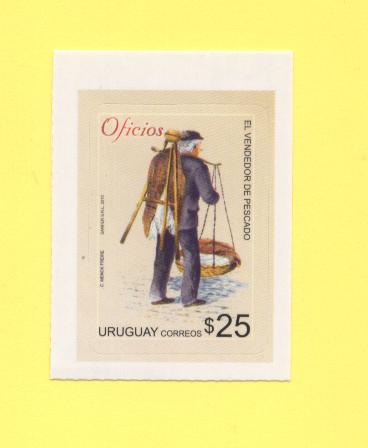
25.00 Uruguayan Pesos - The Fishmonger (Circulation: 200000)

Uruguay - Definitive Stamps 2010


Technical Details:
Country/ Post: Uruguay
Date of Issue: 10 August 2010
Primary theme: Economy & Industry, Mankind
Width: 30.0 mm; 42.0 mm
Height: 42.0 mm; 30.0 mm
Layout/Format: self adhesive sheet of 25
Perforations: Imperforate
Stamp issuing authority: Administración Nacional de Correos
Illustrator: Carlos Menck Freire
Printer: Sanfer SRL

17.00 Uruguayan Pesos - The Leader (Circulation: 200000)
30.00 Uruguayan Pesos - The Ice Cream Man (Circulation: 200000)


Uruguay - Definitive Stamps 2010


Technical Details:

Country/ Post: Uruguay
Date of Issue: 27 May 2010
Primary theme: Economy & Industry, History of Peoples
Width: 30.0 mm
Height: 42.0 mm
Layout/Format: self adhesive sheet of 25
Perforations: Imperforate
Stamp issuing authority: Administración Nacional de Correos
Illustrator: Carlos Menck Freire
Printer: Sanfer SRL

5.00 Uruguayan Pesos - Craftsment - Seller of Trinkets (Circulation: 200000)
The Turk: Trinket Seller
It was a typical street vendor, carrying their boxes universes, it seems impossible that they could fit so many things.
They sold everything, there was nothing they could not deliver within the genre of cheap merchandise.
From the patchouli forged forks, until the rosary with her ​​crucifix.
Very high perished trumpeted by then reduced to trace amounts.
Many of them have made fortunes selling these trinkets, others left for the campaign and not a few of them were killed to steal their trinkets and carrying money.
The figure of Turkish Weekly was pulled from the literary and artistic ~ La Alborada ~ October 19, 1902, number 240 (Central Street)

10.00 Uruguayan Pesos - Craftsment - Shoemaker (Circulation: 200000)
The shoemaker or cobbler formerly called also was a trade that was transmitted by tradition or by circumstances of life, from grandparents to parents and parents to children.
The knowledge was passed down from generation to generation.
Cobbler's nickname was commonly put it into their own hands and helping a few utensils, arranged and composed shoes, utensils were the editor, the coast, the marker, picador, scorer, kickstand, hinge, donkey, brazier , cerate, razor, washcloth, etc ...today .... very difficult to find them.
Before it was customary to pay the shoemaker to make ends meet. A family had to repair the shoes of several of its members for a period of time, usually one month, and at the end of it, as if it were a salary, paid the shoemaker for his services. Currently, most of them perform other tasks such as selling shoes, arrangement of locks, keys etc. making...

Uruguay - Definitive Stamps 2009


Technical Details:
Country/ Post: Uruguay
Date of Issue: 27 November 2009
Primary theme: Economy & Industry, Agriculture & Food (Food & Cooking)
Width: 30.0 mm
Height: 42.0 mm
Layout/Format: self adhesive sheet of 25
Perforations: Imperforate
Stamp issuing authority: Administración Nacional de Correos
Illustrator: Carlos Menck Freire
Printer: Sanfer SRL

8.00 Uruguayan Pesos - Greengrocer

Uruguay - Definitive Stamps 2008


Technical Details:
Country/ Post: Uruguay
Date of Issue: 07 December 2008
Primary theme: Economy & Industry, Agriculture & Food (Food & Cooking)
Width: 30.0 mm
Height: 40.0 mm
Layout/Format: self adhesive sheet of 25
Perforations: Imperforate
Stamp issuing authority: Administración Nacional de Correos
Illustrator: Carlos Menck Freire
Printer: Sanfer SRL

8.00 Uruguayan Pesos - Pastry Cook (Circulation: 100000)
Today the Post issued a stamp Uruguayan more that will become part of the ongoing series we call ~ Crafts ~ and we have decided to issue from October last year, in tribute to the services most frequently performed in the past, but some only exist in memory of Uruguayans who had the honor to see them walking our streets or entering their facilities.
In this regard, since 6 October, shipments distributed in our country and abroad are reporting for images of The Peanut Vendor ~ ~ ~ the organ ~ ~ ~ The Apothecary, The Sharpener ~ ~ ~ ~ The Barber and ~ The Baker ~. From now on permanent series reverence for these workers, will be honored another job ~ ~ The Pastera designed by the painter Menck Freire, who also created the stamps above.

The history of pasta and therefore by their manufacturer with pulp mills, has been much discussed: according to some was a mixture of knowledge they had of Europeans (mainly Italians), the Chinese made noodles and tomatoes brought from America resulting in the creation of more varieties of dishes, as well as the shape, thickness and flavor of these.
The controversy over the true origin of pasta, from Marco Polo travel to Mount Vesuvius, with delightful anecdotes as enjoy a good homemade pasta.
Over the centuries, XI and XII, appears for the first time in Italy, dried pasta brought by the Arabs, just in Sicily, then under his control. It was a thin tube called pasta ~ ~ itrya.
In the middle of the sixteenth century were carried pasta cooks France Catherine de Medici and recommended by the court physician, Paul Jacques Malouin, a member of the Academy of Sciences and professor of the College of the second half France. eighteenth century, appeared in France a new profession of vermicelliers ~ ~ that using a device with holes, they transformed the dough into thin wire-like worms. In Italian vermi worm says ~ ~ and hence the name ~ ~ vermicelli, which is synonymous with the word ~ ​​~ spaghetti, Neapolitan word first appears in the middle of last century.
The pulp was also responsible for an important culinary breakthrough. By the time the spaghetti became the most popular food of the Neapolitans, they were eaten with bare hands because the bondholders, who had only two teeth, were used to roll up.
In the United States pasta were introduced by none other than Thomas Jefferson, who also imported the first machine to make spaghetti.
In terms of processing methods were also progressing with the passage of time. initially drawing only reserved for women, then industrial processing of the paste begins in the nineteenth century, more precisely in Naples in 1830. The mixing was done in troughs, container and wood rectangular extrusion press rough wood, drying the noodles are made in the sun. Subsequently, the invention of the hydraulic press using steam and drying by artificial means were history of current methods.
Disclosure outside the Italian borders, is also part of the history of pasta.
All countries north of the Alps, willingly accepted their consumption. Especially from industrial products, and who liked children and also they were cheaper.
After the Chinese, Italian is the most successful in the world.and surprisingly parallel development of stuffed pasta.
Fresh pasta, bought or handmade, have become popular and have reached every home, and more and more chefs from all countries that compete with the Italian specialists in pasta.
Our country has not been an exception to this rule, with Italian immigrants came and with them their customs, delicious meals with the family together, enjoying the delicious homemade pasta of the mamma.


Uruguay - Definitive Stamps 2007


Technical Details:
Country/ Post: Uruguay
Date of Issue: 18 November 2007
Primary theme: Economy & Industry, Agriculture & Food (Food & Cooking)
Width: 30.0 mm
Height: 41.50 mm
Layout/Format: self adhesive sheet of 25
Perforations: 11 by 11
Stamp issuing authority: Administración Nacional de Correos
Illustrator: Carlos Menck Freire
Printer: Imprimex

5.00 + 2.00 Uruguayan Pesos - The Baker (Circulation: 1000000)

El Correo Uruguayo through philately and its products, plays a role in dissemination of our social, cultural and historical.

In that sense, day after November 18, 2007 has been outstanding seal ~ The Baker ~ which becomes part of the series Crafts, which has five other reasons, the Peanut Vendor ~ ~ ~ the organ ~ ~ the Apothecary ~, ~ ~ and ~ the Sharpener the Barber ~, pretending to pay tribute to those workers whose jobs, in some cases only stay in the memory of the Uruguayans.

With the seal of the series Crafts ~ ~ The Baker just a tribute to the craft itself, the Post Uruguay committed to social causes, in solidarity and commits to the fantastic work being done in the Colonies of Psychiatric Care ~ Dr. Etchepare ~ and ~ Bernardo Dr. Santin Carlos Rossi ~.

In this sense, the label is now issued, with a circulation of one million stamps have a face value of $ 5 and a bonus of $ 2, meaning it, that all Uruguayans who purchase the stamp of the baker, in shops Uruguayan Mail from around the country, either to deposit an item, to collect or give away this beautiful stamp will be donated to the Colonies and Rossi Etchepare two Uruguayan pesos.

Uruguay - Definitive Stamps 2007


Technical Details:
Country/ Post: Uruguay
Date of Issue: 06 October 2007
Primary theme: Economy & Industry, Agriculture & Food (Food & Cooking)
Width: 42.0 mm ; 30.0 mm
Height: 30.0 mm ; 42.0 mm
Layout/Format: self adhesive sheet of 25
Perforations: 12 by 12
Stamp issuing authority: Administración Nacional de Correos
Illustrator: Carlos Menck Freire
Printer: Imprimex

1.00 Uruguayan Pesos - Peanur Seller (Circulation: 500000)
7.00 Uruguayan Pesos - Knife Grinder (Circulation: 200000)
10.00 Uruguayan Pesos - The Organist (Circulation: 100000)
25.00 Uruguayan Pesos - The Barber (Circulation: 50000)
50.00 Uruguayan Pesos - The Druggist (Circulation: 100000)

Saturday, September 10, 2011

Alderney - Centenary of British Red Cross Uniforms 2011


SPECIFICATION:
Date of issue: 28 July 2011
Designer: Robin Carter
Printer: Joh Enschede
Values: 26p, 47p, 48p, 52p, 61p, 65p
Process: Offset Lithography
Stamp sizes: 37.7mm x 28mm
Paper: 110gsm unwatermarked & PVA Adhesive
Perforation: 13.75 x 14.25
Sheet: 10
Cylinder: A

BACKGROUND
The British Red Cross is part of the International Red Cross and Red Crescent Movement, the world's largest independent humanitarian network.

The International Red Cross and Red Crescent Movement began in 1863, inspired by a Swiss businessman, Henry Dunant. He had been appalled at the suffering of thousands of men who were left to die due to lack of care after the Battle of Solferino in 1859.

Dunant proposed the creation of national relief societies made up of volunteers who were trained in peacetime to provide neutral support in times of war. In response to his vision the founding charter of the Red Cross was drawn up in 1863.

Following the outbreak of war between France and Prussia in July 1870, Colonel Robert Loyd-Lindsay wrote to The Times newspaper calling for a National Society to be formed in Britain. On 4 August 1870, a resolution was passed that "a National Society be formed in this country for aiding sick and wounded soldiers in time of war and that the said Society be formed upon the Rules laid down by the Geneva Convention of 1864".

In 1905 the Society was reconstituted as the British Red Cross, which was granted its first Royal Charter in 1908 by HM King Edward VII and Queen Alexandra.

In May 1919 the League of Red Cross Societies (now the International Federation of Red Cross and Red Crescent Societies) was established and extended the role of national Red Cross societies from its focus on wartime relief to incorporate "the improvement of health, the prevention of disease, and the mitigation of suffering throughout the world".

In the UK, the British Red Cross has provided emergency relief following events such as the Lockerbie air disaster (1988) and the devastating summer floods of 2007. Working as part of the Movement, it has provided relief to the victims of international conflicts and disasters, including the Haiti earthquake in 2010.

With special thanks to the British Red Cross Museum and Archives.

36 p - Female VAD uniforms circa 1915
As part of the Voluntary Aid Detachment (VAD) scheme, British Red Cross volunteers were given official uniforms such as the red dress and stiff cults worn by Nursing Commandants. The first World War saw changes in uniform to make them easier to keep clean in combat conditions.

47 p - Male VAD uniforms 1915
The Male VAD uniform was issued in British Army khaki green during the First World War. Women ambulance drivers wore a badge made up of the Red Cross emblem and the Maltese Cross of the Order of St.John, in a double circle and enclosing the letters V.A.D.

48 p - Nurses uniforms 1966-1978
Changes in the design of nurses' uniforms were more gradual between the two world wars. Around 1925 an embroidered Red Cross emblem was added to the centre of the head veil. The Second World War saw the Red Cross nurses' uniform change to a short-sleeved, round collared dress with a drawstring waist.

52 p - Changes reflect practical requirements and fashion trends 1981-2001
The 1960s saw more changes to the uniform, reflecting practical requirements and fashion trends. Head veils were replaced by disposable paper caps and dresses became shorter. In the 1980s an adaptable 'mix and match' clothing range was introduced, more suited to the growing health and social care role of the British Red Cross.

61 p - Uniforms change to practical wear 2001
In 2001 the Red Cross uniform was replaced by work wear described as 'pratical clothing, fit for purpose', including polo shirts and fleeces. A new roundel was introduced to be worn on clothing to give greater visibility to the Red Cross emblem.

65 p - B.R.C work wear 2011
In 2009 a new range of British Red Cross work wear was introduced, bringing the first major change in clothing colour since 1911, from navy blue to red, white & grey. The formal uniforms remains navy blue.

Friday, September 2, 2011

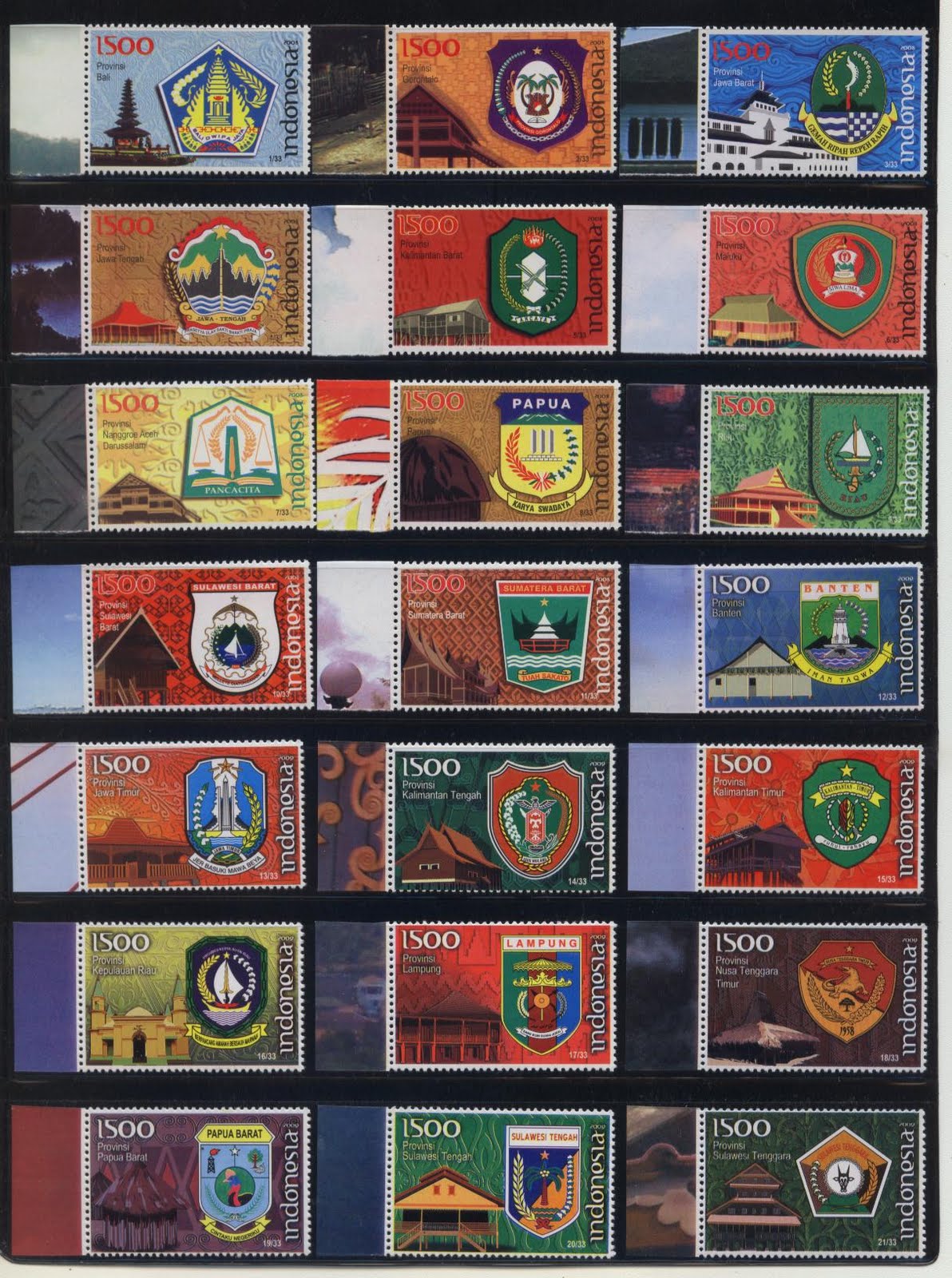
Indonesia - Provincial Emblems 2008, 2009, 2010


Total: 33 pieces
Denomination: 1500 Indonesia Rupiah


Norwegia - Football Club's Coat of Arms


Special Stamps
Self Adhesive


Slovenia - Indepedence & Coat of Arms of Slovenia 1991-1992


Declaration of Independence: 1v (5 Slovenian Tolarjev)
Date of Issue: 26 June 1991
Drawing: Grega Košak
Design: Grega Košak
Motive: Tender plan of Slovene Parliament Building made by architect Jože Plečnik
Print: DELO - TISKARNA d. d., Ljubljana
Technique: offset
Sheet: 25
Paper: muflep 90g, gummed
Size: 30 x 42 mm
Cog: 101/2 x 101/2 mm
Cogging: line
Illustration: Grega Košak


Coat of arms of Slovenia:
The Slovenian coat of arms consists of a red bordered blue shield on which there is a stylised white mount Triglav. Under Triglav there are two bending lines that represent the sea and rivers, and above Triglav there are three golden, six-pointed stars, forming a triangle. The stars are taken from the coat of arms of the counts of Celje.

State coat-of-arms of the Republic of Slovenia: 4v
(6, 20, 50, 100 Slovenian Tolarjev)
Date of Issue: 26 December 1991
Design: Srečko Knafelc, državni grb: Marko Pogačnik
Motive: State coat-of-arms of the Republic of Slovenia
Print: DELO - TISKARNA d. d., Ljubljana
Technique: 4-colour offset
Sheet: 25
Paper: muflep 90g, gummed
Size: 25,6 x 34,5 mm
Cog: 14 x 14 mm
Cogging: line

State coat-of-arms of the Republic of Slovenia: 4v
(1, 4, 5, 11 Slovenian Tolarjev)
Date of Issue: 12 February 1992
Design: Srečko Knafelc, državni grb: Marko Pogačnik
Motive: State coat-of-arms of the Republic of Slovenia
Print: DELO - TISKARNA d. d., Ljubljana
Technique: 4-colour offset
Sheet: 50
Paper: muflep 90g, gummed
Size: 25,6 x 34,5 mm
Cog: 14 x 14 mm
Cogging: line

State coat-of-arms of the Republic of Slovenia: 1v
(1 Slovenian Tolarjev)
Date of Issue: 13 February 1992
Design: Srečko Knafelc, državni grb: Marko Pogačnik
Motive: State coat-of-arms of the Republic of Slovenia
Print: DELO - TISKARNA d. d., Ljubljana
Technique: 4-colour offset
Sheet: 50
Paper: muflep 90g, gummed
Size: 25,6 x 34,5 mm
Cog: 14 x 14 mm
Cogging: line

State coat-of-arms of the Republic of Slovenia: 1v
(5 Slovenian Tolarjev)
Date of Issue: 06 March 1992
Design: Srečko Knafelc, državni grb: Marko Pogačnik
Motive: State coat-of-arms of the Republic of Slovenia
Print: DELO - TISKARNA d. d., Ljubljana
Technique: 4-colour offset
Sheet: 50
Paper: muflep 90g, gummed
Size: 25,6 x 34,5 mm
Cog: 14 x 14 mm
Cogging: line

State coat-of-arms of the Republic of Slovenia: 4v
(2, 4, 11, 15 Slovenian Tolarjev)
Date of Issue: 16 March 1992
Design: Srečko Knafelc, državni grb: Marko Pogačnik
Motive: State coat-of-arms of the Republic of Slovenia
Print: DELO - TISKARNA d. d., Ljubljana
Technique: 4-colour offset
Sheet: 50
Paper: muflep 90g, gummed
Size: 25,6 x 34,5 mm
Cog: 14 x 14 mm
Cogging: line


Indonesia - Folk Dances 1986


Issued on 23 June 1986

Folk Dances:
140 Indonesia Rupiah - Legong Kraton Dance
350 Indonesia Rupiah - Barong Dance
500 Indonesia Rupiah - Kecak Dance


Nauru - Flowers, Nature, Culture, Map 1973


Issued on 31 January 1973
Fifth anniversary of independence.

1c - Ekwenababae
2c - Kauwe Iud
3c - Rimone
4c - Denea
5c - Erekogo
7c - Ikimago
8c - Catching Flying Fish
10c - Nauruan 'Itsibweb' ball game
15c - Nauruan Wresterling
20c - Snaring Frigate Birds
25c - Nauruan girl with flower
30c - Men catching Nodody Birds
50c - Frigate birds
1D - Map of Nauru, Artifacts


Monday, August 29, 2011

Tuesday, July 19, 2011

Portugal - Traditional Costumes 2007


This stamps issue consists of traditional costumes.

Technical Details:
Country/ Post: Portugal
Date of Issue: 28 February 2007
Primary theme: Mankind (Clothes & costumes)
Width: 40.0 mm
Height: 30.6 mm
Denomination: 0.30 €
Number in set: 14 (show set)
Layout/Format: Mini Sheet of 10 of 10 designs; Mini Sheet of 4 of 4 designs.
Perforations: 13 by 13.75
Stamp issuing authority: CTT Correios de Portugal SA
Printer: Cartor Security Printing

0.30 Euro - Regional Dress - Minho, Lavradeira
0.30 Euro - Regional Dress - Minho, Noiva
0.30 Euro - Regional Dress - Tras-os-Montes, Capa de Honras
0.30 Euro - Regional Dress - Tras-os-Montes, Pauliteiro
0.30 Euro - Regional Dress - Douro Litoral, Camisola de Pescador (Fisherman shirt)
0.30 Euro - Regional Dress - Beiras/Tras-os-Montes, Coroça
0.30 Euro - Regional Dress - Estremadura, Saias da Nazaré
0.30 Euro - Regional Dress - Ribatejo, Campino
0.30 Euro - Regional Dress - Algarve, Camponesa
0.30 Euro - Regional Dress - Alentejo, Capote

0.30 Euro - Regional Dress - Acores, Capote e Capelo
0.30 Euro - Regional Dress - Beira Litoral, Camponês
0.30 Euro - Regional Dress - Madeira, Viloa
0.30 Euro - Regional Dress - Ribatejo, Camponesa

Sunday, July 17, 2011

Indonesia - Traditional Textiles of Indonesia 2011 (#2)

MS with out Overprint + Perforation
MS with Overprint + Perforation

Technical Details:
Issued on 06 July 2011
Theme: Traditional Textile of Indonesia
Stamp Size: 41.06 x 25.31
Perforation: 12.75 x 13.50
Color: Separation & Invisible Ink
Paper: Tullis Russel
Gum: PVA
Printing Process: Offset
Printer: AMG Security Printing
Designer: De-Er

IDR 2500 - Tenun Aceh, Nanggroe Aceh Darussalam
IDR 2500 - Tenun Pandai Sikek, West Sumatera
IDR 2500 - Batik Basurek, Bengkulu
IDR 2500 - Songket Palembang, South Sumatera
IDR 2500 - Batik Madura, East Java
IDR 2500 - Tenun Sambas, West Kalimantan
IDR 2500 - Tenun Bentenan, North Sulawesi
IDR 2500 - Batik Masambo, West Nusa Tenggara

IDR 5000 - Karapan Sapi, East Java (SS)


Indonesia is the largest archipelago country in the world with more than 17,500 large and small islands scattered along the 4800KM between Asia and Australia. Therefore, Indonesia has the largest diversity of art and culture compared to any part of this world. Every ethnic groups in Indonesia have its own characteristics in their traditional clothing which, of course, they are equipped with traditional unique cloth and being a wonderful cultural heritage.

Kain Tenun (woven cloth) are made with developed warp ikat technique and it is being a characteristics of population in Nusa Tenggarra, Kalimantan, Sulawesi regions and also in some areas in Sumatera; Kain Songket (Songket Cloth) has been growing in most areas in Sumatera, Kain Batik (Batik Cloth) has been attached to the identity of the Javanese; The sulam and embroidery art techniques are widely used in West Sumatera, that eventually spread to other parts of Indonesia, traditional cloth treasure is still thrive in Indonesia until the present day.

Indonesia traditional cloth has a high cultural value, especially from the point of aesthetics, symbolic meaning and has the philosophy that underlies its construction. The diversity and uniqueness of decorative woven cloth clearly reflected in the elemnets associated with the veneration of ancestors and the natural grandeur. Each region has distinctive features in the ornamental range associated with social-cultural function of the area. Within each family or religious rituals, a piece of woven fabric is almost always a very important part.

The history of Batik in Indonesia began to develop in the Sultanate of Mataram XVIII, then in the Sultanate of Yogyakarta and Surakarta era. Batik initially made in the palace to meet the demand for the king and his family and his followers clothing. As many of the king's courtiers lived outside the palace, the art of Batik was brought by them out of the palace and they produced it in their own places. Then, batik that used to be wear only by the royal family, developed into a popular folk clothes. For the Javanese, a piece of batik is not just a piece of cloth for clothing, but it used in some level of life of the royal family members started from a baby was born until the moment they left this world, also in dance, drama, and fashion arts.

Compared to other traditional types of cloth, batik is the most widely received cultural influence from China especially in ornament pattern. Chinese style decorative patterns such as dragon, phoenix, gold kepeng, butterflies, bats, peony flowers, or a clump of bamboo liked the most. The ornament pattern are used mostly in the batik from the coastal area that are along the northern coast of Java island. Lots of Chinese descent who are involved in this industry and become a famous batik businessman.

Saturday, June 18, 2011

Mexico - Traditional Dances, Joint issue with India 2010


Issued on 15 December 2010
Mexico – India – Joint Issue:- India and Mexico, both vibrant and pluralistic democracies, established diplomatic relations in 1950 and completed 60 years. To commemorate the completion of 60 years of diplomatic relations, a Miniature sheet of two stamps was released by Mexico depicting the Kalbelia dance of Rajasthan, India and Jarabe Tapatio, National dance of Mexico.

Kalbelia dance of Rajasthan:
The Kalbeliyas, is a snake-charmer community from Rajasthan, which performs the Kalbeliya dance. They rely heavily on this dance performance for their living. The Kalbeliya women dancers wear long, black coloured, drindled-skirts heavily worked with embroidery and light-coloured thread along with small pieces of mirrors. This costume draws the attention in a somewhat strange way.

The dance is usually performed by a group of two women standing in the center of the stage. After this pair, another pair of women come & dances in the same way. As the women dancers move in a circle, while dancing, their body sway acrobatically, leaving an impression that they are made up of some flexible material like rubber. The beat of the dance increases in tempo and also there is an increase in their pace of the dance. This dance performance leaves viewer as exhausted as the dancer. The overall performance consists of many fearful actions performed by dancers. The performance relies heavily to the music of `been` and `duff`. The actual fun of their performance can be enjoyed at the gatherings somewhere around the festival of Holi.

The dancers are required to constantly decrease the tempo of their gyrations and move to the corners to catch their breath while two other dancers would spin around to take their places in the center. The specialty of this dance is that the dancers perform it in a beautiful synchronized rhythm that for a moment the audience feels they are the same dancers that continue throughout the performance.

Kachhi Ghodi Dance Kachhi Ghodi Dance
It is believed that the Kachhi Ghodi dance is originated from the bandit regions of Shekhawati. Generally, the dance is performed for the entertainment of the bridegroom`s party. Dancers are ready with elaborate costumes that resemble them as if they are riding on a dummy horse. It is a vigorous type of dance. It also uses mock fights and the brandishing of swords, nimble sidestepping and pirouetting to the music of drums. During the performance, a ballad singer sings & exploits of the bandit Robin Hoods of Rajasthan. Men in elaborate costumes ride the equally well-decorated dummy horses. However, they hold naked swords in their hands and move rhythmically on the beating of drums and fifes.

Jarabe Tapatio, National dance of Mexico:
The Jarabe Tapatío dance in its standardized form was first choreographed by the Mexican, in the early twentieth century to celebrate a government-sponsored fiesta that commemorated the successful end of the Mexican Revolution.

Since then, it has become a folk dance popular throughout Mexico and the Southwestern United States. It serves as a symbol of the national pride and honor of the Mexican people.

The dance tells the story of love and courtship. It can be performed either by a couple or a group of couples. A charro, dressed in the traditional charro suit, a three-piece suit composed of a vest, jacket, and pants bearing silver buttons down the seam, makes initial courtship gestures to la china (wearing the traditional China Poblana outfit). It looks almost like a mariachi band's attire. They flirt throughout the beginning of the dance, during which time the man attempts to woo the woman with his zapateado (stamping and tapping) and his machismo. Just as he has impressed the woman, he becomes drunk with glory, and is shooed away as a borracho (an inebriate), but ultimately, he succeeds in conquering the china, throwing his hat to the ground and kicking his leg over his partner's head as she bends down to pick it up. The two do a triumphant march to a military tune called a diana, and the dance ends with a romantic turn or the couple hiding their faces behind the man's sombrero in a feigned kiss.

Saturday, May 14, 2011

Morocco - Traditional Costumes 2005


Booklet Pane of 10 (Self Adhesive):

6.00 Morocco Dirhams - Two Women
6.00 Morocco Dirhams - Ait Mouhad
6.00 Morocco Dirhams - Costume Saharaoui Derraa
6.00 Morocco Dirhams - Two Women
6.00 Morocco Dirhams - Citadin
6.00 Morocco Dirhams - Costume Saharaoui Melhfa
6.00 Morocco Dirhams - Costume Tata Women
6.00 Morocco Dirhams - Costume Tata Man
6.00 Morocco Dirhams - Meknassa
6.00 Morocco Dirhams - Mokhazni du Roi

Friday, April 22, 2011

S.M.O.M - Uniform Military 2008


COSTUMES AND UNIFORMS OF THE SOVEREIGN MILITARY ORDER OF ST JOHN HOSPITAL OF JERUSALEM OF RHODES AND OF MALTA

Issue date: November 13, 2008
Values: € 0.60 Nine combined block corresponding to a total € 5.40
Subject: costumes and uniforms of the Knights of Jerusalem from the twelfth to the seventeenth century.
Size: mm. 40 x 48
Perforation: 14
Circulation: twelve thousand complete sets
Sheet: a complete set consists of nine stamps
Printing: offset. I.P.Z.S. SPA - Roma
Paper: fluorescent non-watermarked

Wednesday, April 13, 2011

Angola (Portuguese Colony) - Coat of Arms 1963


0.15 Centavos - Vila de Sanza-Pombo
0.20 Centavos - Vila de Santo Antonio do Zaire
0.25 Centavos - Vila de Ambriz
0.40 Centavos - Vila de Ambrizete
0.60 Centavos - Vila de Catete
0.70 Centavos - Vila de Quibaxe
1.00 Escudos - Vila de Maquela do Zombo
1.20 Escudos - Vila de Bembe
1.50 Escudos - Vila de Caxito
1.80 Escudos - Vila do Dondo
2.50 Escudos - Vila de Damba
4.00 Escudos - Povoavao de Cuimba
6.50 Escudos - Vila de Negage
7.00 Escudos - Povoacao de Quitexe
8.00 Escudos - Povoacao de Mucaba
9.00 Escudos - Povoacao de 31 de Janeiro
11.00 Escudos - Povoacao de Nova Caipemba
14.00 Escudos - Vila de Songo
17.00 Escudos - Povoacao de Quimbele
25.00 Escudos - Povoacao de Noqui
35.00 Escudos - Povoacao de Santa Cruz
50.00 Escudos - Vila General Freire

Angola (Portuguese Colony) - Coat of Arms 1962


0.05 Centavos - S.Paulo da Assuncao de Luanda
0.10 Centavos - Vila de Massangano
0.30 Centavos - Vila de Muxima
0.50 Centavos - Cidade de Carmona
1.00 Centavos - E' Portugal Que Revive
1.50 Escudos - Cidade de Malanje
2.00 Escudos - Na'o Faco Mais Porque Na'o Posso
2.50 Escudos - Labor Omnia Vincit
3.00 Escudos - Na'o Perdoei a Fadiga, Despesa ou Aflicao
3.50 Escudos - Cidade de S.Salvador do Congo
5.00 Escudos - Cidade de Luso
7.50 Escudos - Cidade de S.Filipe de Benguela
10.00 Escudos - Cidade do Lobito
12.50 Escudos - Cidade da Gabela
15.00 Escudos - Cidade de Sa' da Bandeira
17.50 Escudos - Cidade de Silva Porto
20.00 Escudos - Cidade de Nova Lisboa
22.50 Escudos - Cidade de Cabinda
30.00 Escudos - Cidade de Serpa Pinto

Mozambique (Portuguese Colony) - Coat of Arms 1961


0.05 Centavos - Descoberta e Soberania Portuguesa
0.15 Centavos - Vila de Chibuto
0.20 Centavos - Cidade de Nampula
0.30 Centavos - Terra da Boa-Gente
0.50 Centavos - Esta Ilha Pequena, Que Habitamos
1.00 Escudos - Vila de Matola
1.50 Escudos - E Aqui Pusemos um Padrao
2.00 Escudos - Vila de Mocuba
2.50 Escudos - Querendo e Que se Vence
3.00 Escudos - Vila Cabral
4.00 Escudos - Vila de Manica
4.50 Escudos - Vila Perry
5.00 Escudos - Vila de S.Tiago de Tete
7.50 Escudos - Porto Amelia
10.00 Escudos - Vila de Chinde
20.00 Escudos - Vila de Joau Belo
50.00 Escudos - Cidade da Beira

Cape Verde (Portuguese Colony) - Coat of Arms 1961


0.05 Centavos - Cidade da Praia
0.15 Centavos - Vila de Nova Sintra
0.20 Centavos - Vila da Ribeira Brava
0.30 Centavos - Vila de Assomadi
1.00 Escudos - Vila do Maio
2.00 Escudos - Labor Omnia Vincit Improbus
2.50 Escudos - Vila de Santa Maria
3.00 Escudos - Vila das Pombas
5.00 Escudos - Vila de Sal-Rei
7.50 Escudos - Vila do Tarrafal
15.00 Escudos - Vila Maria Pia
30.00 Escudos - Cidade de S.Filipe

India (Portuguese Colony) - Coat of Arms 1958


Heraldic Arms of Famous Men:

0.20 réis - D. Vasco da Gama
0.60 réis - Lopo Soares de Albergaria
0.90 réis - D. Francisco de Almeida
1.00 Rupias - Nuno da Cunha
1.00 tangas - Garcia de Noronha
4.00 tangas - D. Afonso de Albuquerque
5.00 tangas - D. Joao de Castro
11.00 tangas - D. Luis de Ataide