GOOD DAY FRIENDS!
THIS BLOG ONLY SHOW MY THEME COLLECTIONS: COSTUMES, DANCES, CULTURES, FOLKLORES, ORIGINAL INHABITANT, UNIFORM MILITARY, & COAT OF ARMS...
IF YOU WANT TO SWAP WITH ME, PLEASE DON'T HESITATE TO CONTACT ME AT jefferson_sie@yahoo.com
BEST WISHES,
JEFFERSON
Traditional Costumes from Riau, The womens Melayu Riaunese wear baju kurung (shirt), songket sarong, and gold jewerly. The jewerly such as bracelets, pending (pins), hair buns are usually used to showing status in the society. The men's costume are teluk belanga (headdress), tanjak (head covers), sampin (cloth), keris (creese), and selop (sandals) as a footwear.
Traditional Costumes from West Sumatra (Sumatra Barat), Minangkabaunese have many varieties traditional costume which its using always related to special occasion. The men wear a loose shirt and a wide trouser complemented by Saluak Batimba (head cloth), Kaciak (chest cloth), and Karih (traditional knife) slipped in front of the body. The women wear traditional coostume Bundo Kanduang that contained of Tengkuluk (head cover), Baju Kurung (special dress), Kodek (a chignon), Salempang (a shawl), and jewelry.
Traditional Costumes from North Sumatra (Sumatra Utara), Ulos clothes, traditional woven cloth from Batak (North of Sumatra), is believed contained a magic power and considered as amulet that can give a protection for a user. Recently ulos is put on in the daily living but there are special ulos that put on in the special occasion only i.e: Ulos Jugia, Sadum, Ragi, Hotang, Ragidup, and Runjat. Batak Tobanese put on the ulos as a headdress combined with white shirt and sarong, meanwhile the women hanging the ulos on the shoulder combined with gold terrace necklace.
Traditional Costumes from Daerah Istimewa Aceh (D.I. Aceh),Now as Nanggroe Aceh Darussalam Traditional costume from Aceh have many styles. One of them, for a men only, are baje meukasah which well known as Aceh Besar's ritual dress, trouser cekak musang, sarong songket, and meukutop (Muslim Headdress).The Rencong (traditional knife) is slipped into belt, appearing a hero images. The women's dresses, with colorful and specific pattern follow the men's likewise pants cekak musang combine with sarong ija pinggang.The jewelry such as Kalung Bahru (a necklace), Taloesusun Lhee (chest accessories), Taloe Keuing (a belt), Gleung Pucok Reubang (a bracelet) are put on complementary traditional costumes.
Tattoo Art: 12 Sene: Tattooing Instruments 18 Sene: First Stage of Tattooing 27 Sene: Progressive Stage of Tattooing 1.00 Tala: Tattoo When Completed
There are not many Polynesian words that have entered the English language, but perhaps the most widely used is tattoo. Exactly where and when the word "tattoo" originated is open to debate, but it is certain that it was a corruption of the polynesian word tatau, picked up by the early European sailors exploring the Southern Ocean.
The presence of "britches" upon Samoan males, was commented upon in many ships logs of the early explorers, and were sketched by many of the artists that were taken along on these voyages of discovery. Where the Samoans aquired this skill is not known, but there is a folk tale that explains that it was brought to Samoa by two Fijian women. Unfortunately during the course of their journey they made a mistake in the song they were singing. Rather than singing "Tattoo the women and not the men" they started singing "Tattoo the men and not the women". When they arrived in Samoa the first few villages they arrived at were not interested in their skill, but eventually a chief recognised their artistic abilities and they taught the villages their trade and showed them how to make the tools they needed.
There is another story which explains that originally tattoos were painted upon the skin, but a Samoan adventurer who travelled to the kingdom of the spirits learnt the art of true tattooing. He was treated very well by its inhabitants but they found his painted body decorations a pale immitation of their own tatoos. He learnt the art of tattooing, and when he returned to Samoa he introduced the use of hammers and sharpened bone or teeth for tattooing.
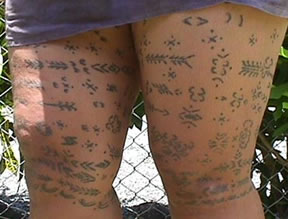
Traditional Samoan tattooing of the pe'a, body tattoo, is an ordeal that is not lightly undergone. It takes many weeks to complete, is very painful and used to be a necessary prerequisite to receiving a matai title; this however is no longer the case. Tattooing was also a very costly procedure, the tattooer receiving in the region of 700 fine mats as payment. It was not uncommon for half a dozen boys to be tattooed at the same time, requiring the services of four or more tattooers. It was not just the men who received tattoos, but the women too, although their designs are of a much lighter nature, resembling a filigree rather than having the large areas of solid dye which are frequently seen in mens tattoos. Nor was the tattooing of women as ritualised as that of them men
The whole process was highly ritualised with songs to be sung and tabus being placed on those that were undergoing the ordeal. Some of the first European visitors to Samoa commented upon the tattoos being of religious significance but this seems to have been disputed by anthropologists (both professional and amateur) who arrived later. It is interesting to note that most of the motifs of animal origin are animals which were considered to be sacred by different families.
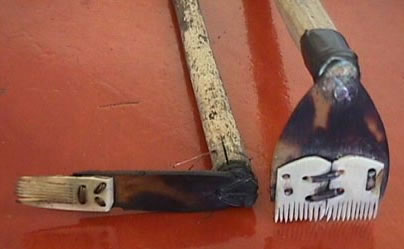
SamoanTattooing Instruments
The Samoantattooing instruments I acquired in Apia are almost identical to the same tools I've studied at the Suva Museum in Fiji, which lends credence to the legend of the women bringing the art across the ocean to Samoa. I say almost, because the Fijians preferred to use human bone for the construction of the teeth on the striker; the Samoans usually used boar tusk. The ancient Fijians did love their human flesh as is evidenced by the specialty forks and platters reserved for the human feast and the human bones stuck in the forks of trees after dinner.
The instruments of the tufuga, the so-called au, resemble hoes but are of varying width. The comb-like serrated part of it, which comes into contact with the human skin, is always made of bone. The preferred materials for this purpose are human bones but if there are none available, horse or ox bones are used.
The toothed part of the implement which pierces the human skin is connected to the actual handle by a toe which usually consists of tortoise-shell and sometimes of bone. The handle is made of cane or wood. The parts of the implement are tied together with cocoanut fiber. The bone and tortoise-shell parts in drilled in various places. A complete set of tattooing instruments consists of eight to twelve implements, depending on the artist.
A short wooden mallet is used for the insertion of the instruments into the skin.
The Samoans tattooed the nose as a punishment for a serious crime and it was equal to having an ear cut off.
The Samoan Tattoo
The Samoan tattoo is called a pea’a on the men and a malu on the women. The pea’as encompassed the entire area from above the waist to below the knee, and were usually done in one go, taking perhaps a week or two. The teeth of the hoe-like striking instrument were carved longitudinally from the incisors of the wild boar, which in turn was affixed to a piece of turtle shell. The teeth were sharpened with a piece of coral, and if not kept sharp will cause a lot of tissue damage. I have witnessed a fair amount of scarring in Samoan tattoos but some of the areas they tattoo! Behind the knee! Inside the crack of the butt cheeks! No wonder! Before the advent of antibiotics in the 1940’s there was an alarming rate of infection, some actually leading to the death of the tattooed, fortunately that is no longer a problem.
Europeans first saw the Samoan Islands in 1722. The first Europeans who set foot on Samoan soil were members of a 1787 French expedition who had a close look at natives and reported that "the men have their thighs painted or tattooed in such a way that one would think them clothes, although they were almost naked."
When missionaries arrived, tattooing was one of the customs that they tried to suppress. One missionary wrote: "Tattooing is among the works of darkness and is abandoned wherever Christianity is received." The Samoans saw Christianity as something they could add to their culture, not as something to replace it. For young Samoan men, tattooing was a rite of passage from boyhood to maturity. A young man who was not tattooed was considered still to be a boy. He could not marry; he could not speak in the presence of grown men; and he was obliged to perform menial tasks. The fact that he sometimes attended Sunday services held by missionaries was no reason to give up tattooing!
Tattooing in Samoa was never abandoned as it had been in many other Polynesian lands. The act of tattooing is highly respected in Samoa.
Stages of Tattooing
In theory it should be possible to complete a pe'a in 10 days; 5 sessions with a day in between each to let the inflamation subside, and on the tenth day, the removal of the taboo which has been placed on the person being tattooed. However this is never the case because the pain and the damage to the skin is too great. The five stages are well defined and outlined below.
I. O le Taga Tapulu (back and small of the back)
In the first session the height to which the tattoo will rise is decided (Ano le Tua), this is always such that the top of the design will show above the lavalava. Then the va'a, pula tama and pula tele are outlined and the design filled in.
The aso fa'aifo run all the way round from the back to the groin and the ivitu runs down between the buttocks to the anus.
II. O le Taga Fai'aso (the posterior)
The aso fa'aifo are completed around to the abdomen and the 'asolaititi are finished. Next to be added are the saemutu, which vary in number depending upon social status. A matai will have four an orator three and anyone else would have two. It appears that this distinction is not strictly adhered to today. Below the saemutu it is possible to find a wide range of devices, although traditionally there were meant to be two thin lines 'aso e lua. Beneath these another band the 'aso taliitu is added, which goes all around the top of the thigh. Where it meets the 'ivimutu at the anus it is called tafaufile, where it covers the perineum it is called tasele, where it covers the scrotum it is called tafumiti and the area over the penis is called tafito. Needless to say this is very painful.
III. Taga Tapau
The lausae, an area of solid tattooing, is added to the thighs beneath the aso e lua.
IV. Taga o Fusi ma Ulumanu
The fourth session is the tatooing of the ulumanu, from the center of the thigh up to the inner groin. In addition the fusi is added, this being a ribbon extending from the perineum and widening to the width of a hand behind the knees.
V. 'Umaga (the end)
The final sessions invloves the tatooing of the abdomen and the navel, the area that covers the navel being called the pute, and is apparently the most painful part of the whole process.
During the who of the process the tattooer, tufuga is assisted by upto six helpers all of whom wish to become masters themselves. One will be responsible for the mixing of the dyes, another is responsible for wiping away the blood, another for dipping the instruments into the dye and receiving instruments that have been used, another cleans and sharpens the teeth of the combs and another will hold the skin tight.
Young women would sit around the person being tattoo, holding them down to stop them moving to much and thus damaging the tattoo, and massaging the head. In addition they will sing a song to try and keep him occupied and keep his mind from the pain in case he starts to complain or cry, which was considered disgraceful behaviour and unfitting for a man.
Below is a song sung repeatedly by women to the men being tattooed.
Friend, stop your wailing and moaning, That is not the pain of a sick person. That is the pain of a novice! Relax your body like giving up, Give in, o chief!
Chorus:Ah, you suffer beneath the blows, Ah, till you fall asleep, And you are not tired nor weary of it!
Soon you will receive your pretty chains of adornment As yet they are seperate and not joined; The necklace is still in pieces and not quite finished. Give in, o chief!
But soon in the evening You will look at your tattoo Comparable to a fresh ti leaf. Give in, o chief!
Ah, if it were a burden I would carry it for you in my love. O be quiet and give in, I will withdraw when the blows have fallen Give in, o chief!
The stylet and the hammer strike, The colour is applied so that it may adhere. Give in, o chief!
Like water flows your blood, Ah, I feel pity for your condition. Give in, o chief!
But this is the custom ages old, You constantly moan, but I sing. Women must bear children, Men must be tattooed. And the tattooer will be struck by the trade wind. Give in, o chief!
The necklace may break, the string may break But you tattoo will not break. This necklace of yours is permanent And will go into the grave with you Give in, o chief!
Motifs Used In Samoan Tattoos
I. Togitogi (dots) These are normally found in the tattoos on womens hands.
II. Aso (thin cross beam) This is normally used when tattooing a man's back.
III. Fa'avaetuli (like the leg of a golden plover) These are normally used in womens tattoos.
IV. Fa'aanufe (worm-like) Generally used in womens tattoos
V. Fa'alaupaoga (like the leaves of a Pandanus tree)
VI., VII. Aso Fa'avaetuli (like the leg of a golden plover)
VIII., IX. Atualoa Used when tattooing the front of mens legs.
X. Fa'amuli'ali'ao
XI. Fa'a'upega (net-like) Used in men around the groin.
XII. Aso Fa'avaetuli (like the leg of a golden plover)
Cocos (Keeling) Islands Administered by: 22 Cent The British Government 1857 22 Cent The Government of Ceylon 1878, 1942-1946 22 Cent The Straits Settlements 1886 22 Cent The Colony of Singapore 1946 22 Cent The Australian Government 1955
In 1609 Captain William Keeling was the first European to see the islands, but they remained uninhabited until the nineteenth century, when they became a possession of the Clunies-Ross Family. Slaves were brought to work the coconut plantation from Indonesia, the Cape of Good Hope and East Asia by Alexander Hare, who had taken part in Stamford Raffles' takeover of Java[citation needed] A Scottish merchant seaman named Captain John Clunies-Ross, who had also served under Raffles in the takeover, set up a compound and Hare's severely mistreated slaves soon escaped to work under better conditions for Clunies-Ross. The workers were paid in a currency called the Cocos rupee a currency John Clunies-Ross minted himself and which could only be redeemed at the company store.[2]in 1811.
On April 1, 1836, HMS Beagle under Captain Robert FitzRoy arrived to take soundings establishing the profile of the atoll as part of the survey expedition of the Beagle. To the young naturalist Charles Darwin, who was on the ship, the results supported a theory he had developed of how atolls formed. He studied the natural history of the islands and collected specimens. His assistant Syms Covington noted that "an Englishman (he was of course Scottish) and HIS family, with about sixty or seventy Mulattos from the Cape of Good Hope, live on one of the islands. Captain Ross, the governor, is now absent at the Cape."
The islands were annexed to the British Empire in 1857. In 1867, their administration was placed under the Straits Settlements, which included Penang, Malacca and Singapore. Queen VictoriaClunies-Ross family in 1886. The Cocos Islands under the Clunies-Ross family have been cited as an example of a nineteenth century micronation. granted the islands in perpetuity to the
During World War II, the cable station was once again a vital link. Allied planners noted that the islands might be seized as a base for German raider cruisers operating in the Indian Ocean. Following Japan's entry into the war, Japanese forces did occupy neighbouring islands. To avoid drawing their attention to the Cocos cable station and its islands' garrison, the seaplane anchorage between Direction and Horsburgh islands was not used. Radio transmitters were also kept silent, except in emergencies.
After the Fall of Singapore in 1942, the islands were administered from Ceylon (Sri Lanka), and West and Direction Islands were placed under Allied military administration. The islands' garrison initially consisted of a platoon from the British Army's King's African Rifles, located on Horsburgh Island, with two 6-inch (152 mm) guns to cover the anchorage. The local inhabitants all lived on Home Island. Despite the importance of the islands as a communication centre, the Japanese made no attempt either to raid or to occupy them and contented themselves with sending over a reconnaissance aircraft about once a month.
On the night of 8-9 May 1942, fifteen members of the garrison, from the Ceylon Defence Forcemutinied, under the leadership of Gratien Fernando. The mutineers were said to have been provoked by the attitude of their British officers, and were also supposedly inspired by anti-imperialist beliefs. They attempted to take control of the gun battery on the islands. The Cocos Islands Mutiny was crushed, although they killed one non-mutinous soldier and wounded one officer. Seven of the mutineers were sentenced to death at a trial which was later alleged to have been improperly conducted. Four of the sentences were commuted, but three men were executed, including Fernando. These were to be the only British Commonwealth soldiers to be executed for mutiny during the Second World War.[4]
On December 25, 1942, the Japanese submarineI-166 bombarded the islands but caused no damage.[5]
Later in the war, two airstrips were built and three bomber squadrons were moved to the islands to conduct raids against Japanese targets in South East Asia and to provide support during the reinvasion of Malaya and reconquest of Singapore. The first aircraft to arrive were Supermarine Spitfire Mk VIIIs of No. 136 Squadron RAF. They included some Liberator bombers from No. 321 (Netherlands) Squadron RAF (members of exiled Dutch forces serving with the Royal Air Force), which were also stationed on the islands. When in July 1945, No. 99 and No. 356 RAF squadrons arrived on West Island they brought with them a daily newspaper called Atoll which contained news of what was happening in the outside world. Run by airmen in their off-duty hours, it achieved fame when dropped by Liberator bombers on POW camps over the heads of the Japanese guards. In 1946 the administration of the islands reverted to Singapore.
Transfer to Australia
On November 23, 1955, the islands were transferred to Australian control under the Cocos (Keeling) Islands Act 1955 (an Australian Act) pursuant to the Cocos Islands Act, 1955 (a UK Act).[6] In the 1970s, the Australian government's dissatisfaction with the Clunies-Ross feudal style of rule of the island increased. In 1978, Australia forced the family to sell the islands for the sum of AU$6,250,000, using the threat of compulsory acquisition. By agreement the family retained ownership of Oceania House, their home on the island. However, in 1983 the Australian government moved to dishonour this agreement, and told the former last ruler, John Clunies-Ross, that he should leave the Cocos. The following year the High Court of Australia ruled that resumption of Oceania House was unlawful, but the Australian government ordered that no government business was to be granted to his shipping company, an action which contributed to his bankruptcy. John Clunies-Ross lives in exile in Perth, Australia, but his successors still live on the Cocos.
Technical Details: Date of Issue: 24 August 2002 Denomination :30 Cent; 50 Cent Stamp Size: 40mm x 30mm Sheet Content :20 Stamps Miniature Sheet Denomination: RM2.00 Miniature Sheet Size: 70mm x 100mm Stamp Size in Miniature Sheet: 40mm x 30mm Perforation: 14 Sheet Content: 20 Stamps Paper: Watermarked, Phosphor Coated Printing Process: Lithography
Malaysian Unity
Although Malaysian come from diverse backgrounds, there is a unique unity in its diversity. Indeed, the ethnic Malays, Chinese, Indians as well as the numerous indigenous people from a fascinating potpourii of a multi-cultural and multi-racial population who greatly value peace and properity.
Although each race maintains its individuality in terms of traditions and community structures, the overall cultural mosaic is well intergrated to create a contemporary Malaysia, rich in its diverse heritage.
An urban neighborhood, consisting of various communities living together harmoniously, exchanging, and sharing, among other things, knowledge, with one another, is hardly an uncommon sight. Men, women, and children of different races often get together for conversation, companionship, and friendly competitive sports. Amidst all of this is, the respect and tolerance each race has for the others' racial and religious practices.
One of the most intersting form of cultural and racial interaction among Malaysians is the 'open house' policy during religious festivals. All communities will 'open the doors' to their friends and neighbors of different ethic backgrounds, effectively breaking down cultural and racial barriers, thus cultivating greater understanding amongst all races.
The tradition of tolerance practiced by the people of Malaysia has resulted in great progress for the country. Malaysia is truly fine example of unity.
College of Arms Quincentenary: 16 p Arms of The College of Arms 20 1/2 p Arms of Richard III. Founder 28 p Arms of The earl Marshal 31 p Arms of The City of London
Heraldry
Heraldry is the name which came to be given to a system of hereditary symbolism and identification which sprang up in western Europe during the twelfth century and was developed thereafter by the heralds.
The College of Arms, situated within the City of London, dates from 1484 when King Richard III granted the Kings of Arms, Heralds, and Pursuivants their first Charter of Incorporation.
The present establishment of the College of Arms comprises three Kings of Arms. six Heralds and four Pursuivants, generically called Officers of Arms or Heralds, and there is a staff of scriveners, artists, researchers, and secretaries. The thirteen Officers of Arms are part of the Royal Household under the Earl Marshall, The Duke of Norfolk, who is not himself a member of the corporation. In practice, the day to day business of the College is presided over by Garter Principal King of Arms.
Apart from their duties on royal and state occasions, the heralds trace ancestry, draw up family trees, deal with peerage law and all matters concerning official heraldry and insignia in England, Wales, and Northern Ireland and in all Commonwealth countries of which Her Majesty The Queen is Head of State. In Scotland, however, Lord Lyon King of Arms is the Sovereign's representative in all matters heraldic and genealogical.
Heraldry has its root firmly planted in medieval history, but it is not just a colorful relic of the days of chivalry: it moves with the times and is a living art and science, especially in Great Britain where the Heralds still devise and the Kings of Arms, pursuant to royal authority, grant, and assign armorial bearings to eminent men and women and worthy corporations.
The Most Ancient & Most Noble ORDER of the THISTLE Tercentenary of the Revival 18 p Arms of the Lord Lyon - King of Arms 22 p Arms of His Royal Highness - The Duke of Rothesay 31 p Arms of The Royal Scottish Academy of Painting, Sculpture & Architecture. 34 p Arms of The Royal Society of Edinburgh
1st set(1985): 2.00 A lady of rank, Tang dynasty (618-907 A.D.) -flowery cap, silk cloak and gauze gown. 5.00 Palace woman, Sung dynasty (960-1280 A.D.) -short-sleeved jacket, pendants on the sash. 8.00 Lady of rank, Yuan dynasty (1280-1368 A.D.) -high headdress, cloak with train. 11.00 A Ming dynasty beauty (1368-1644 A.D.)-front-fastened jacket, skirt.
2nd set:(1986) 2.00 Scorpion-Tail Tuft and Embroidery Costume, Lady of Shang (1766-1122 B.C.) 5.00 Circuitous Robe, Lady of Warring States (403-221 B.C.) 8.00 Assembly and Silkworm Dress for Empress of Later Han Dynasty (25-221 A.D.) 10.00 Flying Ribbon and Falling Strip Dress, Lady of Wei and Tsin (221-420 A.D.) .
3rd set(1987): 1.50 Early Ching Dynasty Han Woman\'s Long Tunic and Skirt. 3.00 Costume of the Wife of a Ching Dynasty Manchu Bannerman. 7.50 Early Republican Period Manchu-style Chi-Pao. 18.00 Early Republican Period Jacket and Skirt.
4th set(1988): 2.00 Shang Dynasty Noble with Tall Hat 3.00 Warring States Ruler in Flowery Garment 7.50 Wei-Chin Period Official with Writing Brush in Hair 12.00 Northern Dynasties (502-581 A.D.) Official with Hanging Brush on Hat
5th set(1990): 2.00 The Official Costume with Lung-Kuan Hat and Collar, Sui and Tang Dynasties (589-907) 3.00 The Robe with P\'u-Tou Hat and Pan-Ling Collar, Tang and Sung Dynasties (618-1280) 7.50 The Costume of Wa-Leng Hat and Queue-Line Robe, Chin and Yuan Dynasties (1115-1368) 12.00 The Costume of Black-Gauze Hat and the Robe with Crane Patch, Ming Dynasty (1368-1644)
Issued in 1985-1991, by Post of Formosa(Taiwan), Rep of China. Complete 6 sets of Traditional Chinese Costume series Stamps. From 6-1 to 6-6. 12 pieces show Traditional male Chinese Costume & 12 pieces show Traditional female Chinese Costume. 1st set(1985): 2.00 A lady of rank, Tang dynasty (618-907 A.D.) -flowery cap, silk cloak and gauze gown. 5.00 Palace woman, Sung dynasty (960-1280 A.D.) -short-sleeved jacket, pendants on the sash. 8.00 Lady of rank, Yuan dynasty (1280-1368 A.D.) -high headdress, cloak with train. 11.00 A Ming dynasty beauty (1368-1644 A.D.)-front-fastened jacket, skirt. 2nd set:(1986) 2.00 Scorpion-Tail Tuft and Embroidery Costume, Lady of Shang (1766-1122 B.C.) 5.00 Circuitous Robe, Lady of Warring States (403-221 B.C.) 8.00 Assembly and Silkworm Dress for Empress of Later Han Dynasty (25-221 A.D.) 10.00 Flying Ribbon and Falling Strip Dress, Lady of Wei and Tsin (221-420 A.D.) . 3rd set(1987): 1.50 Early Ching Dynasty Han Woman\'s Long Tunic and Skirt. 3.00 Costume of the Wife of a Ching Dynasty Manchu Bannerman. 7.50 Early Republican Period Manchu-style Chi-Pao. 18.00 Early Republican Period Jacket and Skirt. 4th set(1988): 2.00 Shang Dynasty Noble with Tall Hat 3.00 Warring States Ruler in Flowery Garment 7.50 Wei-Chin Period Official with Writing Brush in Hair 12.00 Northern Dynasties (502-581 A.D.) Official with Hanging Brush on Hat 5th set(1990): 2.00 The Official Costume with Lung-Kuan Hat and Collar, Sui and Tang Dynasties (589-907) 3.00 The Robe with P\'u-Tou Hat and Pan-Ling Collar, Tang and Sung Dynasties (618-1280) 7.50 The Costume of Wa-Leng Hat and Queue-Line Robe, Chin and Yuan Dynasties (1115-1368) 12.00 The Costume of Black-Gauze Hat and the Robe with Crane Patch, Ming Dynasty (1368-1644) 6th set(1991): 2.00 Winter Court Hat and Mang Robe, Ching Dynasty (1644-1911) 3.00 Summer Court Hat and Surcoat, Ching Dynasty (1644-1911) 7.50 Official\'s Winter Overcoat, Ching Dynasty (1644-1911) 12.00 Common Hat and Traveling Robe, Ching Dynasty (1644-1911)
From what I have read (an Encyclopedia Americana flag article written by Whitney Smith) the coat of arms is an eagle holding a cross in its beak and an olive branch and sceptre in its claws. On top of the eagle is a shield "per fess" (split in half horizontally) red on top and blue below, with a stylized ox head over all between a rose and a crescent. The eagle is from the old Romanian coat of arms and ultimately from Byzantium; the ox head represents the old province of Bessarabia; the cross is obviously Christian; the sceptre and olive branch are probably for sovereignty and peace; as for the flower and crescent, I have no idea.
Near the bison's head are situated, not a rose and a crescent. Why such strange design? Because, as I know, this is an astral symbol of the sun and the moon taken from Dacian coins (Daci were ancestors of the Moldovans and Romanians in ancient times). Also, the octagonal star above the bison's head is the Dacian symbol of wisdom. The three parts of the eagle's tail represent three part of the Republic of Moldova: Gagauzia (or Gagauz Eri as it calls itself) in the south, the central region as the biggest part, and the breakaway Dniestr region (Transnistria in Romanian or Pridnestrov'e in Russian). And if you compare our coat of arms and the Romanian coat of arms you can see that the Romanian eagle has a sword but our eagle has an olive branch (it's also a difference between the two nations).
The coat of arms of Moldova consists of a stylized eagle holding a cross in its beak and a sceptre and an olive branch in its claws. According to the author of the coat of arms, the eagle symbolizes the Latin origin of the people.[1]
The chest of the eagle is protected by a shield that bears the traditional insigns of Moldavia: an aurochs head with the sun among its horns. It also contains two rhombi (the ears), a five-petal flower and a moon in a crescent phase. Everything on the shield has one of the three traditional colours: red, yellow, blue.
The coat of arms appears in the centre of the flag of Moldova.
1.00 Somoni - Tajik National Holidays "Navruz" - Growing Wheat - Symbol of Navruz Holiday 0.50 Somoni - Tajik National Holidays "Navruz" - Dancing Girls with Doiras in Their Hands 1.00 Somoni - Tajik National Holidays "Navruz" - Dancing Girls & Juno Nicolai Flower
Date of Issue: 29 August 2002 Primary Theme: Holy Days & Celebrations Size: 28mm x 40mm Denomination: 0.50 & 1.00 TJS Layout/ Format: Miniature Sheet of 3 of 3 Designs Number in Set: 3 Perforations: 14.10 x 14.10 Stamp Issuing Authority: 'Markazi Marka' State Enterprise Ministry of Communications Printer: Publishing House of Printing Belarus
The Culture of Saint Lucia is a nice blend of French and English heritage with that of the Africans. The enslaved African community of the Caribbean has been able to built up a rich culture that epitomizes their warmheartedness and liveliness. Numerous festivals, carnivals, music concerts and dance parties held throughout the year show the richness of the Culture of Saint Lucia. Saint Lucia was once a British Colony. Hence English is the official language of this island nation while Creole, a form of French dialect, is a secondary language. Culture and Tradition in Saint Lucia is influenced by Christianity as most of the citizens are Catholic.
Although Christians dominate the country but people of Saint Lucia respect others' religion. The Festivals in Saint Lucia are more of a social event than a religious one. Their cosmopolitan Culture of Saint Lucia has created a secular atmosphere. The cultural festivals in St Lucia include La Rose and La Marguerite. La Rose represents the Rosicrucian order while the other one is for Freemasons. Christianity being the major religion in the country Christmas inevitably is the country's biggest festival that is celebrated across the nation. During Christmas people greet each other heartily and a series of parades and cultural events and shows take place in various part of the country.
Music and dance are part and parcel of Saint Lucia's culture. The blend of European and Caribbean folk music has enriched the Culture and Traditions of Saint Lucia. Some of the popular music Festivals in Saint Lucia are Lucia Carnival Parade of the Bands and International Jazz Festivals. These festivals are held to promote the practice of music and spread the essence of Caribbean music all over the world. From western classical to various folk music genres such as calypso, zouk, soca and reggae the music played by Caribbean artists is sure to cast a spell over the audience. A vibrant folk dance form of St Lucia, Quadrille is also performed in these festivals.
The rich Cultural Heritage of Saint Lucia is manifested through these festivals and events. These festivals also serve as the platform for upcoming musicians and artiste of the country. They also create a cultural bond between people and thus carrying forward the tradition and Culture of Saint Lucia.
0.15 Cents Tourism: Chak-Chak Band
0.45 Cents Tourism: Folk Dancing
0.80 Cents Tourism: Steel Band
1.00 Dollars Tourism: Limbo Dancer
The Culture & People of St. Lucia
St. Lucia's culture has evolved from the intermingling of the many different groups of people who have participated in its history. Each has brought different beliefs and traditions, all of which are reflected in the life of the island today. A visitor is likely to drive on the British side of the road to an Indian restaurant in a French town, greeted all along the way in Creole patois.
One of the most accessible expressions of St. Lucia's rich cultural heritage is its cuisine. The fertile, volcanic soil of the island yields an enormous supply of produce, and the island is one of the leading banana exporters in the Caribbean, with six different varieties available. In addition to bananas, St. Lucia's abundant tropical fruits include mangoes, papayas, pineapples, soursops, passionfruit, guavas, and coconuts. Local chefs combine the island's fresh produce with a wide variety of equally fresh seafood to create tantalizing curries, Creole-style entrees, and pepperpot stews. Callaloo soup, made from a leafy green similar to spinach, is the national dish. The island's outstanding cuisine has recently gained international recognition by garnering several gold medals in the regions most prestigious culinary competitions.
But St. Lucia's culture extends far beyond the table, as the island has long held a reputation for its intellectual and artistic talents. St. Lucia has produced two Nobel Prizewinners: the late Sir W. Arthur Lewis, who won the Nobel Prize for Economics in 1979, and poet Derek Walcott, who won the 1992 Nobel Prize for Literature. To understand as well as enjoy St. Lucia's culture is largely a matter of gaining some sense of the various peoples who have contributed to it. The first of these were the Arawaks and the Caribs, Amerindian peoples indigenous to the entire Caribbean. They were expert hunters, farmers, fishermen, and skilled artists. Their primary crops were cassava, yams, sweet potatoes, all of which still play a central role in the island's food. The Amerindians were decimated by the arrival of the Europeans, and only a small number of St. Lucians can still trace their roots back to this group. Some of the few particular aspects of Amerindian culture that survive include farina and cassava bread, fish-pots and other local craft items. Some villages still practice the ancient art of fishing in dug-out canoes.
The next group to arrive on the shores of the island were the Europeans, primarily the British and the French. Though the Europeans didn't settle St. Lucia in large numbers, they had an incalculable impact on the island's history and culture. The British and French influences seem to weigh equally, despite the fact that the French lost the island in 1814. To St. Lucia's complex cultural mosaic, the British contributed their language, educational system, and legal and political structure. French culture is more evident in the arts--music, dance, and Creole patois, which stands alongside the official language of English.
At the same time that the Europeans were bringing their own cultures to St. Lucia, African culture was becoming established through the arrival of slaves for European plantations and, later, indentured labourers. Their descendants constitute the largest percentage of the island's population, and their proud heritage has had an enormous impact on St. Lucia's character as a nation. African traditions have survived the repressions of slavery and servitude to become the strongest element in St. Lucian culture today.
After the abolition of slavery, East Indians came to St. Lucia as indentured servants. Most worked in the large sugar factories in the Cul-de-Sac, Roseau, and Mabouya valleys and in Vieux Fort, where there is still a significant East Indian community. In comparison to other immigrant groups, their numbers were small. Although their traditional culture has almost disappeared, the East Indians have had a notable and lasting influence on the island's fine cuisine.
Technical Details: Date of Issue: 20 October 1975 Denomination: 0.25, 0.50, 0.75, 1.00, 1.50, 2.00 Overall Size: 3.91 cm x 2.90 cm Printing Size: 3.56 cm x 2.54 cm Number per Issue Sheet: 35 Color: Multicolor Perforation: 13 x 13 Watermark: Printed on Unwatermarked Adhesive Coated Paper Printing Process: Photogravure Number of Printing: 0.25 = 5,000,000.- 0.50 = 3,000,000.- 0.75 = 3,000,000.- 1.00 = 2,000,000.- 1.50 = 2,000,000.- 2.00 = 2,000,000.- Design & Printed: India Security Press Dances of India on Stamps
India has an unparalleled antiquity of dance traditions. Each regions has evolved a distinctive style of music and dance at different levels of society. There are thus tribal, folk, village and classical dances in each region of India. The history of these dances can be traced back to the civilization of Mohenjo-Daro and Harappa: their community can be observed in their rich variegated manifestations in different States of India. From amongst these innumerable dances styles have emerged siz major dance forms, which are today known as classical dances of India. These dance styles are supported by literary and sculptural evidence and their history can be reconstructed from the poetic hymns of the Vedas and lyrics of the regional languages. Most of these styles draw their textual sanction from the Natyasastra written between the 2nd century B.C and 2nd century A.D. In the course of time each of these styles followed other texts written between the 8th and 17th century A.D. All these styles, however, have a common division of dance into pure or abstract dance and mime on the one hand and Tandeva and Lasya on the other.
0.25 Rupee - Bharata Natyam Bharata Natyam developed in South India in its present form about two hundred years ago. While its poses are reminiscent of sculpture of the 10th century A.D. onwards, the thematic and musical content was given to it by musicians of the Tanjore courts of the 18th-19th centuries. It is characterized by straight lines, diagonals, triangles which are basic motifs for executing movements, as also patterns of floor choreography.
0.50 Rupee - Odissi Odissi is a close parallel of Bharata Natyam. It developed from musical play (sangita-nataka) and the dances of gymnasiums known as the akharas Sculptural evidence relating to the dance goes back to 2nd century B.C. From, the 12th century onwards there are inscriptions, manuscripts, and other records which speak of the prevalence of Orissi dance styles of ritual dances of temples and entertainments of the village squares.
0.75 Rupee - Kathak Kathak from North India is the urban sophisticated style full of virtuosity and intricate craftsmanship. Commonly identified with the court traditions of the later Nawabs of Northern India, it is really an amalgam of several folk traditions; the traditional dance-drama forms prevalent in the temples of Mathura and Brindavan known as the Krishna and Radha Lilas and the sophistication of court tradition.
1.00 Rupee - Kathakali Kathakali from Kerala is classical dance drama. It is quite different from any of the forms described above. Unlike the others, it is dramatic rather than narratives in character. Different roles are taken by different characters; the dancers are all men or were so, till recently. It takes epic mythological themes as its content and portrays them through an elaborate dramatic spectacle which is characterised by an otherworldly quality, a supernatural grandeur, a stylised over-size costume to give the impression of enlarging human proportions and a mask like make-up on the face which is governed by a complex symbolism of colour, line, and design.
1.50 Rupee - KuchipudiClosely related to Bharata Natyam is the dance style which is prevalent in Andhra Pradesh. It is sometimes called Kuchipudi, after the name of the village, or Bhama Kalapam (the story of Bhama, a consort of Khrisna). In this style there is a thin line of demarcation between dance-drama traditions of Bhama Kalapam and the solo-Kuchipudi. While the basic stance, the foot contacts and the general pattern of treating the human form is very close to Bharata Natyam, the style is freer and to that extent less austere than Bharata Natyam.
2.00 Rupee - Manipuri Manipuri is a lyrical dance form from the eastern region of India. Although many forms of ritual, magical, community, and religious dances were known to Manipur before the advent of Vaishnava faith in the 18th century, the dances today known as Manipuri and specially its Rasa evolved as a result of the interaction of the Vaishnava cult and the several highly developed forms of ritual and religious dances which were prevalent in the area from times, immemorial.




![[Coat of arms of Moldova]](http://flagspot.net/misc/md%29.gif)





 Posts
Posts


