Sunday, February 12, 2023
Brazil 2011 - Diplomatic Relations Brazil-Belgium
Technical Details:
Date of Issued: 29 October 2011
Width: 44.00 mm
Height: 26.00 mm
Denomination: 2.55 BRL
Set of 4
Format: Mini Sheet
Perforations: 11.5 x 11.5
Issuing Authority: Empresa Brasileira de Correios e Telegrafos
Printer: Casa da Moeda do Brasil
a. Carnaval
b. Acarajé de iansã, no Ilê Oxumaré - Carybé
Republic of China (Taiwan) 1999 - Taiwanese Opera
Technical Details:
Date of Issued: 15 October 1999
Dimension of stamps: 40 mm x 30 mm
Size of souvenir Sheet (mm.)
Printer: China Color Printing Co.,Inc., R.O.C.
Designer: Lee Kuang-Chi
Sheet Composition: 20 (5 x 4)
Print Color: Colorful
Process: Deep etch offset
Paper: Phosphorescent Stamp Paper
Perforation: 11½ x 11
To increase R.O.C. citizens' understanding of Taiwanese opera and to celebrate Taiwanese culture, the Directorate General of Posts is releasing a set of Taiwanese Opera postage stamps, which is the first of a series of postage stamps on Chinese regional opera.
Each stamp will pay homage to one of four separate elements of Taiwanese opera:
(1) the noise, festivity and excitement associated with the performances;
(2)the contribution these operas make in passing down the island's traditional arts legacy;
(3) their demonstration that women can do everything men can (since women play all the parts, female and male);and
(4) and their plots, which reflect the absurdity of real life. The and their plots, which reflect a absurdity of real life.
The stamps will have denominations of NT$5.00, NT$6.00, NT$10.00 and NT$25.00.
The stamps will feature:
(1) a festively adorned stage with a crowd gathered around it,
(2) a scene of interaction among troupe members in antique garb that conveys the legacy they are passing down,
(3) an actress, made up and dressed as a man, playing a male character; and
(4)another actress playing the role of a clown. The Directorate commissioned Ming Hwa Yuan Taiwanese Opera Company to plan the stamps.
The tunes of Taiwanese opera originated from the chin-ke tunes that were popular in Jangzhou, Fukien, and were brought to Taiwan by Chinese settlers in the late Ming and early Ching dynasties. Later, ke-tsai-chen developed, which was accompanied. by musical instruments such as yue-chin, er-hu and san-hsien (all of which are string instruments). Whenever people were not busy with farm work, they would gather in plazas where rice was dried or in plazas in front of temples, where they would recite, sing and act scenes using every-day vocabulary and simple movements and facial expressions. This kind of improvisation was called lo-ti-sao. It put little emphasis on make-up and costumes, and the stage was simply the ground between four bamboo poles. This was an inchoate version of Taiwanese opera. The choreography, music and costumes of Taiwanese opera have been heavily influenced by Peking opera. Taiwanese opera contains pleasing displays of martial arts, and its lyrics are easy to understand. During folk celebrations, processions and festivals held after great harvests and in honor of local deities, troupes are often asked to put on shows indoors or out. After 1956, Taiwanese operas have also been performed in theaters and turned into films, as well as being broadcast on television and radio.
Dimension of stamps: 40 mm x 30 mm
Size of souvenir Sheet (mm.)
Printer: China Color Printing Co.,Inc., R.O.C.
Designer: Lee Kuang-Chi
Sheet Composition: 20 (5 x 4)
Print Color: Colorful
Process: Deep etch offset
Paper: Phosphorescent Stamp Paper
Perforation: 11½ x 11
To increase R.O.C. citizens' understanding of Taiwanese opera and to celebrate Taiwanese culture, the Directorate General of Posts is releasing a set of Taiwanese Opera postage stamps, which is the first of a series of postage stamps on Chinese regional opera.
Each stamp will pay homage to one of four separate elements of Taiwanese opera:
(1) the noise, festivity and excitement associated with the performances;
(2)the contribution these operas make in passing down the island's traditional arts legacy;
(3) their demonstration that women can do everything men can (since women play all the parts, female and male);and
(4) and their plots, which reflect the absurdity of real life. The and their plots, which reflect a absurdity of real life.
The stamps will have denominations of NT$5.00, NT$6.00, NT$10.00 and NT$25.00.
The stamps will feature:
(1) a festively adorned stage with a crowd gathered around it,
(2) a scene of interaction among troupe members in antique garb that conveys the legacy they are passing down,
(3) an actress, made up and dressed as a man, playing a male character; and
(4)another actress playing the role of a clown. The Directorate commissioned Ming Hwa Yuan Taiwanese Opera Company to plan the stamps.
The tunes of Taiwanese opera originated from the chin-ke tunes that were popular in Jangzhou, Fukien, and were brought to Taiwan by Chinese settlers in the late Ming and early Ching dynasties. Later, ke-tsai-chen developed, which was accompanied. by musical instruments such as yue-chin, er-hu and san-hsien (all of which are string instruments). Whenever people were not busy with farm work, they would gather in plazas where rice was dried or in plazas in front of temples, where they would recite, sing and act scenes using every-day vocabulary and simple movements and facial expressions. This kind of improvisation was called lo-ti-sao. It put little emphasis on make-up and costumes, and the stage was simply the ground between four bamboo poles. This was an inchoate version of Taiwanese opera. The choreography, music and costumes of Taiwanese opera have been heavily influenced by Peking opera. Taiwanese opera contains pleasing displays of martial arts, and its lyrics are easy to understand. During folk celebrations, processions and festivals held after great harvests and in honor of local deities, troupes are often asked to put on shows indoors or out. After 1956, Taiwanese operas have also been performed in theaters and turned into films, as well as being broadcast on television and radio.
Saturday, February 11, 2023
Mongolia 2015 - Dashichoiling Monastery
Technical Details:
Date of Issued: 14 December 2015
Face value: 2400 (Stamp Set); 2600 (Sheet)
Size Stamp: 50mm x 35mm
Face value: 2400 (Stamp Set); 2600 (Sheet)
Size Stamp: 50mm x 35mm
Size Sheet: 40x60mm, 110x150mm
Printing: Offset Lithography
Republic of China (Taiwan) 1997 - Chinese Martial Arts
Designer: Wong Lui - sang
Process: Deep Etch Offset
Printer: China Color Printing Co., Inc., R.O.C.
To publicize our national legacies and help people to know more of the Chinese martial arts, this Directorate especially used Shaolinquan, Form and Will Boxing, Taijiquan, and Eight Diagrams Boxing as subject matter for a set of four Chinese Martial Arts postage stamps. These stamps, in denominations of NT$5.00, 5.00, 9.00 & 19.00, were designed by the Informational and Research Center of Chinese Martial Arts, National College of Physical Educational and Sports.
Chinese martial arts are very rich in content and profound in nature. From ancient times up to the present, the arts. whether utilized to cultivate one's mind, to protect one's life, or to build up one's body, or to defend the country, have been significantly correlated to the society, army, religion, and culture. Characterized by locality, martial arts. in its broadest sense, include the use of different ways of boxing, the employment of various swords, the guidance to happy life, and traditional medicine. The designs for this set of martial arts stamps are four kinds of very popular boxing practiced by the Chinese people to build up their bodies or protect themselves.
China 1962 - Chinese Folk Dances
The 18 stamps mounted overleaf depicting Chinese folk dance of various nationalities were released by the Ministry of Posts and Telecommunications of the People's Republic of China and exquisitely printed in multicolour. Dimension: 28.5mm x 38.0mm. Perforations: 12½. Ungummed.
First Series: 15 October 1962 = Han/ Mongolian/ Chuang/ Tibetan/ Yi/ Uygur
- 4 Fen: Flower Drum Lantern of the Hans
- 8 Fen: Ordos Dance of the Mongolians
- 10 Fen: Catching Shrimp Dance of the Chuangs
- 20 Fen: Fiddle Dance of the Tibetans
- 30 Fen: Friend Dance of the Yis
- 50 Fen: Tambourine Dance of the Uighurs
China 1963 - Chinese Folk Dances
Second Series: 15 June 1963 = Buyi/ Kazak/ Oregen/ Gaoshan/ Maio/ Korean
- 4 Fen: Weaving Cloth Dance of the Puyis
- 8 Fen: Couple Dance of the Kazakhs
- 10 Fen: Olunchun Dance of the Olunchuns
- 20 Fen: Labour Dance of the Kaoshans
- 30 Fen: Reed Pipe Dance of the Miaos
- 50 Fen: Fan Dance of the Koreans
China 1963 - Chinese Folk Dances
The 18 stamps mounted overleaf depicting Chinese folk dance of various nationalities were released by the Ministry of Posts and Telecommunications of the People's Republic of China and exquisitely printed in multicolour. Dimension: 28.5mm x 38.0mm. Perforations: 12½. Ungummed.
Third Series: 30 June 1963 = She/ Bai/ Yao/ Li/ Va/ Dai
- 4 Fen: Wedding Ceremony Dance of the Yus
- 8 Fen: "Encircling the Mountain Forest" of the Pais
- 10 Fen: Long Drum Dance of the Yaos
- 20 Fen: "Third Day of the Third Month" of the Lis
- 30 Fen: Knife Dance of the Kawas
- 50 Fen: Peacock Dance of the Tais
Third Series: 30 June 1963 = She/ Bai/ Yao/ Li/ Va/ Dai
- 4 Fen: Wedding Ceremony Dance of the Yus
- 8 Fen: "Encircling the Mountain Forest" of the Pais
- 10 Fen: Long Drum Dance of the Yaos
- 20 Fen: "Third Day of the Third Month" of the Lis
- 30 Fen: Knife Dance of the Kawas
- 50 Fen: Peacock Dance of the Tais
Republic of China (Taiwan) 1965 - Chinese Folklore
Technical Details:
Date of Issue: 01 December 1965
Design: Wen Hsueh - ju
Dimension of Stamp: 28mm x 38.5mm
Perforation: 12½
Sheet Composition: 10 x 5
Printer: Printing Bureau of the Ministry of Finance, Japan
Process: Photogravure
Paper: Photogravure Stamp Paper
1.00 Yuan - Firecracker
4.50 Yuan - Dragon Dance
Friday, February 10, 2023
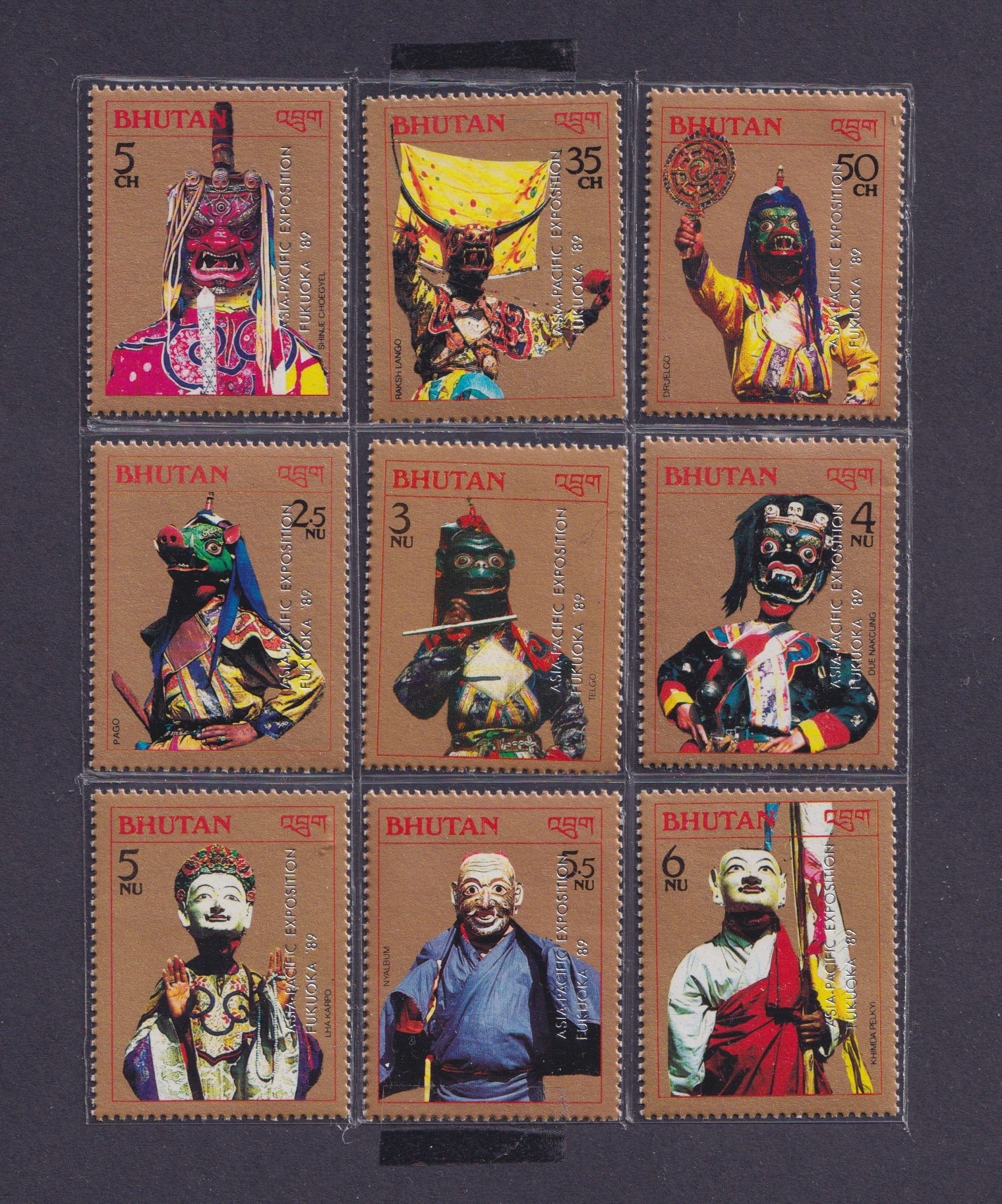
Bhutan 1989 - The Judgement of Death Mask Dance (Overprinted "ASIA-PACIFIC EXPOSITION FUKUOKA '89")
Overprinted Stamps of Bhutan – Masks 1985 – FUKUOKA Overprints
Bhutan issued a set of nine stamps on Mask Dance of the Judgement of Death on 27 April 1985. These stamps were overprinted with “Asia-Pacific Exposition Fukuoka 89” and issued on 17 Mar 1989. The Overprints were in two languages Japanese and English.
The Japanese overprints in white are listed below.
5Ch- Shinje Choegyel
35 Ch – Raksh Lango
50 Ch -Druelgo
2.5 Nu – Pago
3 Nu -Telgo
4 Nu -Due Nakcung
5 Nu – Lha Karpo
5.5 Nu – Nyalbum
6 Nu -Khimda Pelkyi
Manama 1971 - British Military Uniform
Date of Issue: 20 February 1971
Perforation: 13½
2nd Greek Infantry 1813
King's Hussars 1813
Royal Navy 1805
Rifle Regiment 1807
Brunswick Black Corps 1809
93rd Highlanders 1810
King's German Legion 1812
Regiment of Dragoons 1812
Sunday, February 5, 2023
China 1962/ 1963 - Chinese Folk Dances
First Series: 15 October 1962 = Han/ Mongolian/ Chuang/ Tibetan/ Yi/ Uygur
- 4 Fen: Flower Drum Lantern of the Hans
- 8 Fen: Ordos Dance of the Mongolians
- 10 Fen: Catching Shrimp Dance of the Chuangs
- 20 Fen: Fiddle Dance of the Tibetans
- 30 Fen: Friend Dance of the Yis
- 50 Fen: Tambourine Dance of the Uighurs
Second Series: 15 June 1963 = Buyi/ Kazak/ Oregen/ Gaoshan/ Maio/ Korean
- 4 Fen: Weaving Cloth Dance of the Puyis
- 8 Fen: Couple Dance of the Kazakhs
- 10 Fen: Olunchun Dance of the Olunchuns
- 20 Fen: Labour Dance of the Kaoshans
- 30 Fen: Reed Pipe Dance of the Miaos
- 50 Fen: Fan Dance of the Koreans
Third Series: 30 June 1963 = She/ Bai/ Yao/ Li/ Va/ Dai
- 4 Fen: Wedding Ceremony Dance of the Yus
- 8 Fen: "Encircling the Mountain Forest" of the Pais
- 10 Fen: Long Drum Dance of the Yaos
- 20 Fen: "Third Day of the Third Month" of the Lis
- 30 Fen: Knife Dance of the Kawas
- 50 Fen: Peacock Dance of the Tais
Tuesday, January 3, 2023
Kyrgyzstan 2022 - National Costumes Of The Kyrgyz People
Technical Details:
Date of Issued: 04 November 2022
About Traditional Clothing of Kyrgyz People
Three different stamps showing the traditional clothing of Krygz people.
Date of Issued: 04 November 2022
About Traditional Clothing of Kyrgyz People
Three different stamps showing the traditional clothing of Krygz people.
Subscribe to:
Posts (Atom)