IT'S NOT JUST A HOBBY


Thursday, January 20, 2022

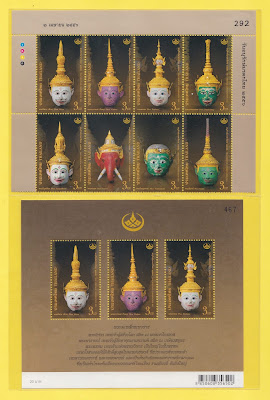
Thailand 2014 - Thai Heritage Conservation Day, Khon Masks


Issue Name : Thai Heritage Conservation Day 2014 Commemorative Stamps
Issue Date : 02 April 2014
Perforation : n/a
Denomination : 3 Baht (8 Designs)
Size : 30 x 48 mm. (Vertical-measured from perforation to perforation)
Printer : Thai British Security Printing Public Company Limited, Thailand

3 Thai Baht - Tosakanth
3 Thai Baht - Kumbhakarn
3 Thai Baht - Pipek
3 Thai Baht - Thut
3 Thai Baht - Khorn
3 Thai Baht - Trisian
3 Thai Baht - Samanakkha
3 Thai Baht - Indrajit
3 Thai Baht - Tosakanth (SS)

Thailand 2013 - Thai Heritage Conservation Day, Khon Masks


Issue Name : Thai Heritage Conservation Day 2013 Commemorative Stamps
Date of Issued : 02 April 2013
Perforation : n/a
Denomination : 3 Baht (8 designs)
Details : Thai Masked Play Conservation, One of Thai Heritages
Quantity of stamps: X00,000 pieces per design
Sheet Composition: 16 stamps per sheet
Printing Process: Lithography, Multi-colour
Designer: Miss Euamphorn Supharoekchai (Thailand Post Co., Ltd.)
Souvenir Sheet Price: 20 Baht
Souvenir Sheet Quantity: -- sheets
FDC Price: 45 Baht
FDC Quantity: -- covers
Size : 30 x 48 mm. (Vertical-measured from perforation to perforation)
Printer : Thai British Security Printing Public Company Limited, Thailand
Design: Illustrating Khon Masks supported by Office of Performing Arts, Department of Fine Arts

Khon or Thai masked play is the elegant and splendid Thai classical theatrical arts displaying the adventurous fighting drama dubbed by poem recitation together with Thai traditional orchestra in the background. The story is predominantly Ramayana praising honor of the Brahman God Rama. Most prayers must wear masks for the roles of demons (Yaksha) and monkeys, except for the male and female dancers. For this year's Thai Heritage Conservation Day, the first postage stamp series includes the Khon masks of devines (Deva) .

3 Thai Baht - Phra Shiva
3 Thai Baht - Vishnu
3 Thai Baht -  Brahma
3 Thai Baht - Phra Parakontap
3 Thai Baht - Phra Panjasikorn
3 Thai Baht - Phra Kanes
3 Thai Baht - Phra Vishnukam
3 Thai Baht - Phra Indra

3 Thai Baht - Phra Shiva (SS)
3 Thai Baht - Vishnu (SS)
3 Thai Baht -  Brahma (SS)

Algeria 1942-1945 / 1943 / 1946 - Coat of Arms


Algeria 1942-1945 - Coat of Arms
Algeria 1943 - Not Issued Stamp Overprinted
Algeria 1946 - Overprinted "RF" & Surcharged
looking for


Algeria 1947-1949 /1956-1958 - Coat of Arms


Liechtenstein 1984 - People at Work


Oman 2021 - Omani Women Costumes


Technical Details:
Date of Issued: 21 October 2021
Paper: White Bright
Printing Process: Offset
Printing Press: Oriental Security Printing Solutions - Bahrain
Values: 100, 200, 200, 500 Baisa
Number of Stamps: 24,000
Number of SS: 3,000
Size of Stamp: 3 x 5 cm
Stamps Designer: Shamsa Saud al-Ghatrif

Oman Post issued a collection of postage stamps depicting Omani women costumes.
The traditional Omani women attires reflect the rich cultural heritage of Oman and its originality. Omani women dress shows vibrant colours and styles and is always fashionable and simple and sometimes decorated with distinctive silver and gold threads. There are numberous styles of Omani women dress which differs from one governorate to the other including Suri dress, Dhofari dress, and Balushi dress, etc.

Traditional women's fashion in the Sultanate of Iraq of Oman represents the Omani community and its origin, distinguished by its beautiful colors, shapes and elegance, the series includes 4 stamps of Omani women's fashion: Omani, Suri, Zafari, and Balushi.
Designed by Omani designer: Nora Karim

Trinidad & Tobago - Tobago Heritage Festival


Date of Issued: 15 July 2005

1.00 Trinidad & Tobago Dollar - Bele
2.50 Trinidad & Tobago Dollar - Dancing The Jig
3.75 Trinidad & Tobago Dollar - Goat Race
4.50 Trinidad & Tobago Dollar - Harvest Festival
5.25 Trinidad & Tobago Dollar - Drumming Festival
15.00 Trinidad & Tobago Dollar - Traditional Tobago Wedding (SS)

Angola 2001 - Traditional Dances & Costumes


Date of Issued: 12 November 2001

11 Kz - Massembe LUANDA
11 Kz - Ovambo Efundula CUNENE
17 Kz - Macolo Batuque UIGE
18 Kz - Humbi Puberdade NAMIBE
18 Kz - Mukixi LUNDA TCHOKWE
36 Kz - Carnaval Juvenil LUANDA (SS)


Tanzania 2003 - Traditional Dances of East Africa


300 Tanzanian Shilingi - Nyamwezi Dance (Hiari Ya Moyo) Tabora
500 Tanzanian Shilingi - Luo Dance (Arutu) Kisumu Kenya
600 Tanzanian Shilingi - Pemba Dance (Kyaso) Zanzibar
800 Tanzanian Shilingi - Baganda Dance (Mbutu) Kampala Uganda
1,000 Tanzanian Shilingi - Masai Dance 


Belize 1993 - Christmas, Local Customs


Date of Issued: 03 November 1993
Perforation: 14.5 x 14

0.25 Belize Dollar - Boom and Chime Band
0.60 Belize Dollar - John Canoe
0.75 Belize Dollar - Cortez Dance
2.00 Belize Dollar - Maya Musical Group 

Aruba 1996 - UPAEP, Regional Costumes


Issue Date: 25 March 1996
Designed by: B Nouel
Printed by: J Enschede & Sons
Print Process: Lithography
Perforations:13.0 x 14.0

North Korea 2000 - Pongsan Mask Dance


Bongsan Talchum is the 17th Important Intangible Cultural Properties of Korea. It could be characterized as a Korean dance performed while wearing a mask, miming, speaking and even sometimes singing. Bongsan Talchum is not just dances performed by masked dancers but also include significant dramatic content with masked characters portraying people, animals and sometimes supernatural beings.

These folk dramas reflect the frustrations felt by the lower classes towards the Confucian literati Yangban, due to the latter's treatment of the commoners, show the life of the common man and process social problems such as monks who ignore their precepts and men who cast off their old wives.

The Bongsan Mask Dance is a traditional performance describing Korean people's rough but healthy emotions with dance movements. Masks show an outstanding arrangement of black, white, blue, red and yellow. Performers could conceal their social status behind the masks. Dancers make movements by bending their arms and stretching them again, while holding their long sleeves. They jump high as well and extend the motions with their whole body. Their movements are strong, but cheerful and rhythmical as well. Music is played on wind and string instruments as well as percussions. Dancers perform behind the masks with their bold and impressive movements.

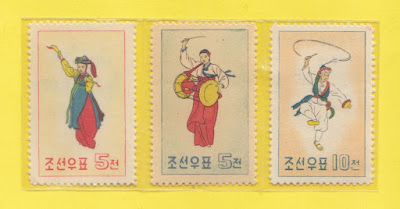
North Korea 1960 - Korean National Dances


Bolivia 2015 - Traditional Dances


1.00 Bolivianos - Cueca Chapaca
The cueca is a couple dance in which the two dance partners move toward and in a semi-circle around each other. The cueca thus acts as a mating dance. The dancer and the dancer each carry a handkerchief in her right hand, with which they emphasize their movements and the Balzcharakter of dance.
The cueca is also referred to as the national dance of Bolivia and is widely used accordingly. Depending on the state cueca Paceña, cueca Chuquisaqueña, cueca Potosina, cueca Cochabambina, cueca Tarijeña and cueca Chapaca be distinguished. The triple rhythm is indeed strong in all these dance variants of the same but vary the pace and style by county. The Cuecas from La Paz, Chuquisaca and Potosí are the most elegant and slowest during the cueca Tarijeña and the cueca Chapaca be danced very fast. The cueca Chapaca heard as well as the Chacarera to gaucho folklore of the Gran Chaco, which extends over Bolivia, Argentina, Paraguay and Brazil. Despite the stylistic differences, there is a basic structure to changes and positions, with the cueca all types can be danced. DC is also toying with the handkerchief. In the Bolivian plateau, the cueca "Viva mi patria Bolivia" is seen as the unofficial national anthem.

2.00 Bolivianos - Llamerada
Llamerada is a popular dance of Bolivian origin. It is a representation of the llama muleteers who went from the highlands altiplano to the valleys to exchange products, using the llama as a means of transporting products. It is also a remembrance of the task of herding llamas and has historical religious value as a ritual of good fortune.
This dance is meant to represent the Highland llama holders and breeders. Therefore, the dancers (male) traditionally hold a little llama in their left hand while rotating the "honda" in their right. Some claim that the Llamerada is a very old, even Inca dance[citation needed], an argument mainly based on the fact that llama herding has been very important to the indigenous peoples of the Andes for centuries and the Inca Empire encompassed parts of Bolivia. There is very little known about how the actual version emerged; even the costumes have changed a lot during the last few decades. The headdress used at present is said to represent the traditional headdress of Aymara leaders (in both sides of Lake Titicaca) and in fact it resembles the headdress of the "Mama Talla", the wife of an Aymara Community leader.

2.50 Bolivianos - Tinku
Tinku, a Bolivian Aymara tradition, began as a form of ritualistic combat. In the Quechua language, it means “meeting-encounter". During this ritual, men and women from different communities will meet and begin the festivities by dancing. The women will then form circles and begin chanting while the men proceed to fight each other; rarely the women will join in the fighting as well. Large tinkus are held in Potosí during the first few weeks of May.
The story behind this cultural dance is that long ago, the colonial hacendados set fights between indigenous campesinos for their amusement[citation needed]. Pututu trumpets were used by the Indians in order to call for a Tinku encounter, as well as to assemble the peons when the hacendado required of their presence. Tinku dance costumes are colorful and decorative. Women wear a dress, abarcas, and a hat and men wear an undershirt, pants, jacket, sandals (abarcas), and hard helmet like hats. Even though the people were slaves, they loved to dance, and would often fight, but never really hurting each other.
Because of the rhythmic way the men throw their fists at each other, and because they stand in a crouched stance going in circles around each other, a dance was formed. This dance, the Festive Tinku, simulates the traditional combat, bearing a warlike rhythm. The differences between the Andean tradition and the dance are the costumes, the role of women, and the fact that the dancers do not actually fight each other. The Festive Tinku has become a cultural dance for all of Bolivia, although it originated in Potosí.

Tonga 2001 - Traditional Dances


Date of Issued: 04 April 2001
Perforation: 13¼

0.40 Tonga Seniti - Ma'ulu'ulu Dance
The māʻuluʻulu is a traditional Tongan dance, performed by a group of seated men and women; stylistically, the dance form is a direct successor of the ancient Tongan ʻotuhaka having been synthesized with the Samoan Māuluulu which was imported during the 19th century.
The performers sit down in a row on the ground, crosslegged, usually the right leg over the left. If possible men and women alternate. To the left and/or right is/are the nafa (see below), behind them stand the langituʻa, the singers. On informal occasions the dancemaster may walk around, clapping his hands to keep up the rhythm and to encourage the performers. On formal occasions, like a presentation to the king, the dancemaster also stands in the back. Only when the dancemaster is the chief Malukava, he is allowed per tradition to be in front.
If there are many dancers, often the case when a school performs, up to 500 at a really huge occasion, they sit in staggered rows. The dancers of front row (which gets the most attention and therefore sits the best dancers or the ones with the highest social status) sit on the ground. The second row on a low bench, the next row on a higher bench, and so forth. The last row usually stands, or if that is still not enough, they may stand on benches and tables. If the dance is an effort of a local community, young and old perform. The youngest children then cutely sit at the ends of the rows.
In the ʻUiha tradition the arrangement is different: the women sit on the ground in the frontrow(s) but the men stand behind them and act more as in a lakalaka.
Like the ʻotuhaka, the māʻuluʻulu consists usually of a sung and a silent part. It starts with the beating of the nafa, huge drums made from discarded 200 litre, iron, fuel drums, covered with a leather skin. The nafa-master can make a whole show of it, hitting the drums with his two decorated sticks almost performing a dance himself. Once he has calmed down and he, and his helpers have settled down in a continuous beating of the drums, the tafua starts. This is the silent part of the performance in which the dancers are performing all the typical haka (dance gestures) of the main dance, as whether they want to show them off before you would be distracted by the singing later. In semi-formal performances this is the moment that the public, which has become māfana (excited), can come forward to put fakapale on the dancers they fancy to be the best or close family. On really formal performances this is not allowed, on really informal performances, often fundraising, the fakapale goes on about for the whole dance, which unfortunately distracts a lot. When the tafua is over the nafa usually stops and singing starts. Like all other Tonga dances, the gestures do have some relationship with the words, but are largely symbolic. Like in the ʻotuhaka the haka are supposed to be performed close the body, haka nounou (short armed) as opposed to the lakalaka. However the Vavaʻu tradition allows much wilder and wider arm movements. The lyrics of the song is usually made for the occasion, praising the object into the skies. A silver jubilee of a school, a birthday of the king, and so on. The music is very limited. There are about 10 different tunes which can be used in a māʻuluʻulu, so that to the untrained ear they all sound much alike. Once the song is over another tafua follows. At this time the tempo of the dance has been increased feverishly, and so has the excitement of the public.
A māʻuluʻulu takes around 15 minutes to complete. But it may have taken the performers 2 or 3 months to memorise the sequence of gestures. For a school there are daily sessions at the end of the class hours, for a community it will fill all their free nights, often combined with a faikava.

0.55 Tonga Seniti - Meʻetuʻupaki Dance
The meʻetuʻupaki (meʻe tuʻu paki: dance standing [with] paddles) is an ancient Tongan group dance, already reported by early European navigators like captain Cook. This dance has been traditionally designed for men although women may take part if there are not enough men. The meʻe tuʻu paki resembles a kind of war dance; albeit, it is done with little symbolic paddles as opposed to arms.
The dress for this dance invariably is a large sheet of ngatu wrapped around the body from chest to ankles. A girdle of leaves around the waist (sisi) is often added.
The movements are largely with the paddles in the hand, but the proper addition of the small and subtle movements with the head and legs make the difference between a good and poor performance. The paddles are not used for row like gestures, but are rotated around, moved to left and right or up and down. The dancers start in one row, maybe two if there are many, but from time to time split up the rows in what seems chaotic movements, yet at the end they come back again in perfect unison.
It is usually the dance master who operates a little slit drum (lali) to keep the beat, while the dancers themselves sing the song, possibly with assistance of others. The beat is always slow in the beginning, but goes faster and faster when the end approaches to excite the dancers and the public.
The words of the songs are in a largely unintelligible language, although some sailor terms can be distinguished. As there is also a version of the meʻetuʻupaki in Futuna, called tapaki even though different, a link in that direction seems to be most likely. The theory is that the meʻetuʻupaki was composed somewhere in the 12th to 16th century by an internationally oriented poet on ʻUvea to honour the Tuʻi Tonga empire. When the Tuʻi Tonga Kauʻulufonua I (Kauulufenua-fekai, K. the wild, in Futunan) had lost some decisive battles, which heralded the end of the empire and of the political function of the Tuʻi Tonga, he was forced to give meʻetuʻupaki to Futuna, where the parts are still guarded as secrets. In addition the Futunans declared that from now on the Tuʻi Tonga title should be inferior to any Futunan title, and if ever a Tongan boat would make it to their island, it would be destroyed and offered to the gods. (This still happened in the 19th century as recorded by William Mariner (writer). A Tongan proverb: vete fakafutuna (take apart in the Futunan way), still refers to something to be dismantled completely.
There is also a theory that the meʻetuʻupaki was a kind of Tongan passport of olden times. When a boat from Tonga arrived on one of the conquered islands the crew was invited to show their typical dance to prove that they came from Tonga and not from somewhere else. As they then still had their paddles in their hand, using them in a dance seem quite straight forward.

0.80 Tonga Seniti - Tauʻolunga Dance
The tauʻolunga is a traditional Tongan dance. It is a combination of the Samoan Taualuga and the Tongan ula. The type of dance is comparable with (some) Hawaiʻian hula or the Tahitian ʻaparima.
The tau'olunga is a dance for single young women, especially for them to show off on their wedding day. It is rare--but not impossible--for a married couple or an older woman to do a tau'olunga. It is also rare to see a man perform the dance, but he can mimic the dancing girl's movements in an exaggerated manner to make her beauty more striking by comparison. Despite these rare cases, the tau'olunga can be danced at any special occasion. Often it is performed by a small group of girls, up to 10 or so, but can also be performed individually. The assistance of older women is usually limited to only handclaps on the rhythm of the music. This role is called the tuʻulafale.
It is usual for a girl to start the dance, then parents, cousins, family members or friends come on the stage to put money notes on her oiled skin, and then join her in the tuʻulafale. The prizemoney (fakapale) is a reward for the girl, unless, as often is the case, the dance is performed as part of a fundraising or for a special occasion. It is common for the money to go towards the person being celebrated. For birthdays, the money would go to the person whose birthday they are celebrating. For weddings, it will go to the wedding couple. For a graduation, it will go to the person graduating etc.
The tauʻolunga mainly consists of a series of hand movements, which interpret the meaning of the selected song. However, most of the movements are so stylised that only experienced practitioners will understand their meaning. Many of the typical gestures (haka) are standardised and have their own name. The movement of the head also plays a significant role: the head and eyes should follow the hands on important movements, otherwise they are to be directed to the public. The eyes are never to glance away from the viewers. From time to time, little nods within one beat (teki) or two beats (kalo) must be made with the head. The girl must smile throughout her performance.
The movements of the body and the legs are less important. They have to follow hands and head. Shaking the hips, as elsewhere in Polynesia, is forbidden. Most of the time the legs are standing still, knees must be together and bent (taulalo). Some small steps--never large--or a turn around can be performed. Overall, the girl's movements should be graceful and soft, as should be her whole body.
A unique feature of any Tongan dance, not found elsewhere in Polynesia, is the rotational movements of the hands and wrists in many of the haka.
A tauʻolunga girl is usually dressed in a wrap around dress, either made from ngatu with traditional designs; a mat (kie) from handwoven pandanus leaves; a piece of cloth covered with green leaves, grass, fragrant flowers or shells; any shiny piece of cloth, decorated with sewn-on traditional patterns; or even a grass skirt. Every type of costume (teunga) has its own proper name. The dress reaches from just above the breasts down to the knees (or sometimes past the knee), leaving her arms and legs bare. As long skirts are the traditional apparel for Tongan girls, this is an occasion to show off her legs. If they are fair, the better.
Putting oil on her exposed skin parts so that they shine enhances her beauty even more in the Tongan mind. Around her middle she wears a belt (kafa) also usually made from leaves and fragrant flowers. Wristlets and anklets (vesa) may be worn, ranging from simple bands of cloth or ngatu to elaborate belts of leaves and flowers again. Around her neck she wears a black ribbon with a white cowry shell on it or not (puleʻoto). On her head she wears a little crown (tekiteki), which will enhance her head movements during the dance, consisting of feathers or some light plant material.
The more natural materials are used for her whole dress the better it is. Unfortunately plastic is slowly making its inroads nowadays.
Many technical motifs of the tauʻolunga are derived from the ancient Tongan ula / faʻahi-ula / fahaʻiula. The original ula was a group dance of young chiefly daughters who, on the rhythm of a quite monotonous song, made a series of postures beautiful to look at. The formalization of the dance as a distinct genre followed the introduction of the Samoan "taualuga" during the early 19th century and its institution among Tongan aristocratic circles (especially those associated with the Tu'i Kanokupolu lineages). The postures originally emphasized finger and hand motifs (following Samoan stylistics), until 1950 when queen Sālote personally integrated the distinctly Tongan wrist flourishes and lakalaka leg transitions into her song "Manu ʻo Palataisi" (Bird of Paradise), leading to the technical composition and format of the contemporary Tongan tauʻolunga.

2.70 Tonga Pa'anga - Faha'iula Dance
The ula (dance) is an ancient Tongan group dance, already reported by early European navigators like captain Cook. It is also known as fahaʻi-ula (split dance), which may be degenerated to fahaʻiula. Traditionally it is performed after an ʻotuhaka. It is still danced nowadays, although less popular than its descendant the tauʻolunga.
The name split dance comes from the habit that the performers split up in two (or more) groups, one entering the stage from the left, the other from the right] until the two meet in the centre and merge into one or more rows. The performers are always girls, it is rare that boys will join.
The dance movements are in essence very simple and limited. Most of the work, making supple, beautiful posures, is done by the hands and the head. The body remains quite stiff, and except for an occasional step or a kneeling, the legs are not much used either.
The dress of the girls is like that of the tauʻolunga, although the red dress is here most popular.

Chile 2000 - Religious Festivals


Samoa 2001 - Siva Afi, Fire Knife Dancing


The history of the Polynesian performances that inspire our fire knife dance at Rock-A-Hula! Siva afi, or fire knife dancing is a tradition rooted in Samoan culture that incorporates the Samoan weapon nifo oti, or war knife. Our tribal performers twirl the weapon and showcase other acrobatic tricks that will have you on the edge of your seat as they literally set the stage on fire!

The fire knife dance dates back to the ancient Polynesian demonstration of ailao, which was a Samoan warrior's display of strength using a war club and was typically performed at ceremonial processions. Until the introduction of metal, the war club was originally carved with serrated edges and jagged "teeth," features that distinguished this unique weapon. Later, the club evolved into a machete wrapped in towels on both ends with a portion of the blade exposed, and is the tool that is commonly seen in today’s dances. It wasn’t until 1946, that a Samoan-American knife dancer, Freddie Letuli, added fire to the dance.

These days, dancers can be seen balancing the prop on their feet and even placing the fire on their tongue! At Rock-A-Hula our fire knife dancers, Lafo Brown and Chief Tui, use a modern version of the nifo oti and are sure to light up your evening for an awe-inspiring performance.

Singapore 1968 - Definitives, Folk Dances


First Definitive Issue

The Republic’s first definitive stamps, issued in 1968 and 1969, depict the traditional dances, masks, costumes and musical instruments of the Chinese, Indians and Malays. The rich colours of this beautiful set of 15 hand-painted stamps capture the essence of the local cultural scene in the 1960s.

With racial unrest having occurred just four years earlier, these stamps were a timely and deliberate reminder that racial harmony would always be a cornerstone of the new Republic.


Angola (Portuguese Colony) 1961 - Angolan Women Hairstyles


Albania 2007 - Traditional Costumes


Saturday, June 26, 2021

Cambodia 2020 - Scenes of The Reamker Epic


Technical Details:
Date of Issue: 28 September 2020 (planned)
Date of Issue: 15 December 2020 (indeed)
Denomination:
2000 R
2500 R
3000 R
4000 R
6000 R (SS)
Quantity: 5,000 pieces
Printer: Vietnam Printing
Designer: Cambodia Post

Monday, May 3, 2021

Monday, May 18, 2020

Israel 1971 - Israel Theater


Technical Details:
Date of Issue: 16 February 1971
Method of Printing: Photogravure
Perforation: 14 x 13.25

0.50 Israeli Shekel - The Israel National Opera - Samson and Delilah
0.50 Israeli Shekel - 25th Anniversary of The Cameri Theatre - Inn of the Ghosts
0.50 Israeli Shekel - Inbal Dance Theatre - A Psalm of David

Greece 1979 - EUROPA, Post and Telecommunication


Technical Details:
Date of Issue: 12 May 1979
Size: 24 mm x 40 mm
Printed: ASPIOTI-ELKA Graphic Arts Ltd
Designer: P. Gravalos, B.Constantinea
Printing Method: Multi Coloured Offset

The set will include two stamps, linked together and depicting postmen of the Post Office in Crete, from an old post card.

4 Drachmae - Postman of foot and on bicycle (1,000,000 pieces)
7 Drachmae - Mounted postman in rural area (1,000,000 pieces)

Sunday, May 17, 2020

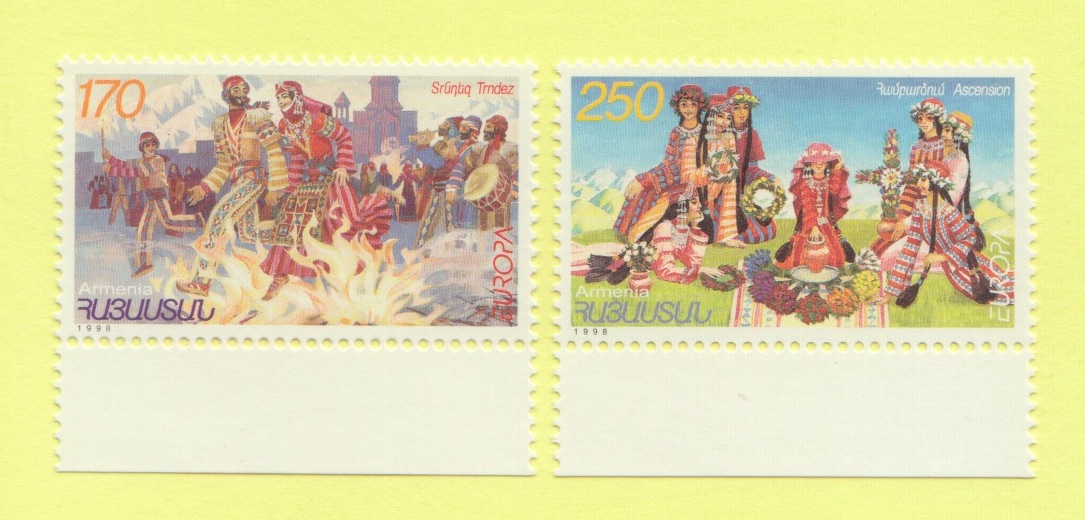
Armenia 1998 - EUROPA, National Holidays


Technical Details:
Date of Issue: 24 July 1998
Design: R. Gevondyan 
Perforation: 14¾ x 14

170 Armenian Dram:
Trndez is a big deal in Armenia—such a big deal, in fact, that HayPost, the country’s official national postal operator, issued commemorative postage stamps back in 1998, dedicated to the centuries-old tradition. The stamp features a newlywed couple hurdling over the Trndez flame, while a band plays traditional Armenian musical instruments, including the Zurna (wind instrument) and the Dhol (double-headed drum) in front of an ancient Armenian cathedral.

250 Armenian Dram:
The Feast of the Ascension is one of the ecumenical feasts (universally celebrated) of Christian churches. In the Armenian Apostolic Church it is also known as the Feast of Holy Ascension or Feast of the Ascension of Our Lord Jesus Christ.

Ascension Day marks the ascent of Jesus Christ into heaven on the fortieth day after his resurrection. The timing is clearly stated in the Acts of the Apostles, therefore every Christian church celebrates the Feast of the Ascension 39 days after Easter.

Despite being part of Oriental Orthodoxy, the Armenian Apostolic Church uses the Gregorian calendar rather then Julian. That is why Ascension Day in Armenia falls on the same day as the Feast of Ascension in Western Christian churches.

In the Armenian Church, there is another reason to commemorate Ascension Day. On this date in 1441, the throne of the Catholicos of All Armenians was returned to the Mother See of Holy Etchmiadzin in the city of Vagharshapat after a thousand years of being settled in various cities throughout the country.

Faroe Islands 1998 - EUROPA, National Holidays


Date of Issue: 18 May 1998

On 29th July every year the Faroese celebrate their national festival. It is a thousand-year-old tradition, which is actually a combination of politics and Christianity, an expression of a Christian political culture in this archipelago in the North Atlantic.

The Faroese are the only Nordic people to choose Saint Olav's mass as a national holiday and not only for religious reasons, but also political ones. Olav the Holy was a Norwegian king, not a Faroese one, yet a Faroese saint. On the anniversary of his death at the battle of Stiklestad on 29th July 1030 the Faroese express the essence of their nationality.

The Faroese call their national festival Ólavsvøka, which is the Faroese form of the Latin 'vigilia sancti Olavi'. In Danish this annual festival is called Olai-festen. Olav the saint king has always had a central place in Faroese religious and political tradition and culture.
On this day the Faroe Island's thousand-year-old parliament, Lagtinget, opens in the capital, Tórshavn. The members of Lagstinget, members of the Faroese Home Rule, the bishop and all the clergymen of the country and the highest officials walk in procession from the parliament building, Lagtingshuset, to the cathedral, and, after a special Olai service, back to Lagtingshuset, where the Speaker, the lagmand, holds the opening speech.
In olden days Lagtinget was both a legislative institution and a court of law with 36 and later 48 members. The lagmand was the chairman and the chief judge. The records of Lagtinget, in which the decisions and judgments of the court were written down, have been preserved since 1615 and are kept in the national archives in Tórshavn.

In former times the court was held on the flat rock in Tinganes. It was necessary for the lagmand to keep track of the time, because it was written in the old laws that the court had to be convened when the sun was in the east and that the court had to be in session until three o'clock. On the rock you can still see the sun dials which were carved into it.
The worsening of the climate in the 16th century made it necessary to hold the court indoors. A national court house in Tinganes, Tinghuset, is mentioned in the old protocols of Lagtinget. In 1773 the lower part of Tinganes burned down, and with it the court house. Later a new court house was built closer to the present town.

But in 1816 the old Faroese Lagting was abolished by royal decree and with it also the post of lagmand. After that there was no Faroese authority on the Faroe Islands. The country was placed under direct Danish rule.

When the Faroe Islands' Lagting was re-established in 1852 it was in a completely different form. It was to be an advisory body to the Danish authorities for the administration of the Faroe Islands. It was in this connection that the present Lagtingshus was built in 1856, then outside the town. With the Home Rule Act of 1948 Lagtinget received greater authority.
There have always been ceremonies in connection with the assembly of Lagtinget on Olai day. It is known from ancient sources that may people came to Tórshavn to witness the event. That was the beginning of Ólavsvøka as a national festival. The first church was built in Tórshavn in 1609. In 1733 the dean, Lucas Debes, wrote that every court day began with a service in Tórshavn church.

Today the Lagting procession is an integral part of the Olai festivities. It reflects the old connection between the court and church.

And the many people who watch the procession of Lagting members, clergy and officials from Lagtingshuset to the cathedral and back again expect to see this event as a natural part of the national festivity.

Saturday, May 16, 2020

Gibraltar 1998 - Europa, National Days (National Costumes)


Technical Details:
Date of Issue: 22 May 1998
Stamp Size: 30 mm x 40 mm
Stamp Values: 26p, 26p, 38p, 38p
Illustration / Photography: GPBL
Printer: Cartor security printers
Process: Offset Lithography
Colours: Multicoloured
Design: Stephen Perera

The theme elected by Post Europ for 1998 was National Days (National Costumes)

The set of 4 stamps depicti the Gibraltar national costume as worn by Miss Gibraltar at the Miss World contest every year.
Europa stamps have been issued annually since 1956. First sets representing the founding 6 members of the ECSC, European Coal and Steel Community, then by the European Conference of Postal and Telecommunications Administrations (CEPT) in 1959, (first stamps issued in 1960) and by PostEurop since 1993. Initially in 1956 a total of 13 stamps were issued with a common design from 6 different countries. A common theme of Peace and Welfare through agriculture and industry was used for 1957. The common design reappeared in 1958 and continued until 1973. From 1974 the designs reflect a common theme.

The common design idea replaced the common theme in 1984, which was the CEPT 25th Anniversary (1959-84) and shows a symbolic bridge, said to represent Liaison, Exchange and Communication. With the split of posts and telecoms providers in most countries, CEPT is no longer responsible, but the postal authorities under the guidance of PostEurop continue the Europa tradition. From 1993 all the stamps have "Europa" inserted into the design in small print. (Source Wikipedia)

German Democratic Republic 1978 - Circus


Date of Issue: 26 September 1978

German Democratic Republic, DDR 1982 - Sorbian Folktales


Technical Details:
Date of Issue: 06 July 1982
Perforation: 13 x 12½
Circulation: 3,600,000
Design: Scheuner
Printing Process: Offset Printing

10 Pfennig - "Ptaškowa Swajźba" - Birds' Wedding
The Birds’ Wedding is a custom that has its roots in the pre-Christian era where people sacrificed food to ancestors' ghosts. They expected to get favour and sympathy from the gods of nature.

In the course of time the sacrificial offerings to the ancestors altered into gift-giving to the children due to decreasing belief in ghosts' potency.

Nowadays the Birds' Wedding is celebrated by children on January 25. The reasons for this date are observations from the flora and fauna. Around about this time several bird species begin to nest and lay eggs. It is the time for people awaiting the awakening spring.

It is said the Lusatian Birds' Wedding comes from the Upper Sorbian language region in which this custom is widely spread in families.

In Lower Lusatia it is celebrated in kindergardens and schools where the children feed the birds during winter. In return for this service they can join in their wedding. That is why they put plates and bowls on the ledge. They get a piece of pastry shaped as a magpie (Sorbian: sroka)

In kindergardens the wedding is celebrated with the magpie as the bride and the raven as the groom (Sorbian: wron). The bridal couple is dressed festively, in most cases with Lower Sorbian costumes while the other children are masqueraded as birds. There is even a song about it which each child is learning in the kindergarden. On this day it is sung, of course.

In contrast, adults prefer folksy evenings with a Birds' Wedding programme executed by the Sorbian National Ensemble.

20 Pfennig - Zampern
Traditions and customs constitute moments of culmination and consciousness within the Sorbian (Wendish) culture, yet there is much more to it. The most widely celebrated customs in Lower Lusatia include Shrovetide with its accompanying activity of "Zampern" - groups in fancy dress and more or less traditional masks going from door to door, making music and noise and asking for donations of food and drink -, the Easter fire, the setting up of the Maypole and the harvest custom of cock plucking. These customs closely follow the natural cycle and, true to their pagan origins, are intended to, for example, drive the winter out or promote fertility.

The Sorbian carnival is one of the main festivals in the Lausitz region. The long winter is bidden farewell and evil spirits and demons driven away. One important element of the Sorbian carnival is the so-called custom of Zampern: costumed Zamper people go through the village accompanied by a band with pannier, basket and cashbox. The village residents offer them bacon, eggs, money and brandy. The Zapust is crowned by the traditional carnival dance and the eating of pancakes.

The numerous Easter customs in the region can also be traced back to the Sorbs. They include egg-rolling, fetching Easter water and the widespread tradition of the Easter fire. Easter riding is also celebrated in the Oberlausitz region, particularly among Catholic Sorbs.


25 Pfennig - Waleien
A well known game played by children as well as by adults is "Waleien". Most likely it has ist origins in an ancient magic spell for fertility was supposed to support the growth of fresh grass. Rolling eggs over fields and grass was supposed to have a positive influence on the growth. People dug holes, called "walka", into the ground everywhere on the courts. On Easter Sunday the children went with their beautiful adorned eggs to these places for playing "Waleien". The game is working as follows: An egg was placed at the deepest point of the hole. All players then try to hit this egg with one of theirs. In case of being successful the player was allowed to keep both eggs. Otherwise both eggs stay in the "walka". Often it happened that children lost all eggs. Then coins or buttons were used instead.

Up to the 1960s you could have seen people playing this game in Lower Lusatia but now it is very rare to find someone still practising this custom. Exceptions can be found at a few kindergardens and the Niedersorbisches Gymnasium (Lower Lusatian Grammar School) as well as in a few villages.

The "Eierspecken" or "Eierpicken" has also disappeared. In this very popular game both players had to knock the ends of two eggs together. The owner of the egg which is left intact won the other player's egg.


35 Pfennig - Painting Easter Eggs
On Easter, a Wendish or Sorbian godchild will visit his/her godparents, and receive a gift of a few beautifully painted eggs, some sweet bread, and maybe some money. The children would then take their colored eggs and play a game called Waleien with them, where they are rolled down a slope in a sort of competition. This happens every year until their confirmation, when the child gives a gift to the godparents.

You will recognize Sorbian Easter Eggs by their bright colors and beautiful symmetrical patterns. (Red is the color of love and friendship) Symbols like the Trinity, the Tree of Life and Easter symbols are also quite common. Bees symbolized industriousness, flowers for fertility. Originally, all dyes were natural, today, a little chemical help is also used.


40 Pfennig - Jańske Rejtowanje
The time around Midsummer’s Night is the nature's most powerful period. This is reflected on St. John's Day celebrations on June 24 showing. According to an old belief this day would be the most miraculous of the year. The people believed that curativeness would be caused especially by the Midsummer Night.

Nowadays you can see the "Jańske rejtowanje", a riding procession, only in Casel, a small village near Drebkau. In the middle of the 19th century it was still celebrated in several villages of Lower Lusatia. But not only the locations but also the responsible persons have changed. In former days the village's youth did the job but now it is planned and organised by a special traditions club.

The central figure is "Johann" or "Jan", a man in a fancy dress, personifying the spirit of growth and fruitfulness. You can see that since he is fully covered with flowers and greens, also wearing a crown on his head. This festivity requires substantial efforts to prepare it. Thousands of cornflowers have to be collected in order to make Jan's odd-looking costume. Already on the day before, each girl collects masses of flowers and then plaits wreaths and tendrils some metres long. The young men have to supply water lilies at the crack of dawn in order to complete Jan's crown which is already composed of roses and Carthusian Pinks. The flowers stand for people's vitality and lea's fruitfulness. Cornflowers are also used as medicinal herbs. Water lilies and reeds are signs of the vitally important water.

On the festival's forenoon the maidens begin to dress Jan. Cornflower tendrils are sewn on the garment from the neck down to the knees. Completely decorated, Jan rides from the restaurant to the festival place, accompanied by the village's fellows and a brass band. The riding procession is led by the maidens marching ahead in their white frocks trimmed with blue and red stripes. They take along a second crown which is to present Jan at evening's honouring dance. Having arrived at the festivity area, Jan and his whole attendance ride some rounds through the crowd. Now the companions have a hard job: They have to protect Jan against people making attempts to pull him down the horse in order to loot his flower decoration.


50 Pfennig - The "Bescherkind"
On Wednesday before Christmas, at the last spinning room event of the year, the girls of the village meet to dress the oldest one among them as a "Bescherkind". This Christmas tradition that has only survived in Jänschwalde. The costume's particularly elaborate head decoration is adorn with marriage garlands and three bridesmaid chaplets. To keep the Bescherkind's identity secret, she is covered with netting, ribbons and pearl strings. Two women accompany the "Bescherkind" and a small bell is rung when she arrives. Wrapped up and unable to speak, she gives sweets to the children. The parents and grandparents are touched with a rod to wish them health and good fortune.

The "Bescherkind" can often be seen in the Wendish House, in kindergardens or in schools, especially when Christmas festivities are celebrated for the children.

Wednesday, May 13, 2020

Uruguay 2020 - MERCOSUR - Moda


Technical Details:
Date of Issue: 13 May 2020
Series: “MERCOSUR-Moda” 

Size of Stamps: 30mm x 42mm 
Print Run: 15,000 (Consisting of 2 stamps)
Value: $ 95 (a stamp of $ 25 and another of $ 70, Uruguayan Pesos)
Sheets: Made up of 24 stamps
Graphic Design: Alvaro Rodríguez
Designs: Fashion Designers Gustavo Guigou / Gustavo García
Photos: Parallada / Pazos-Landarín
Models: Florencia Alba/ Sharif Dogliotti
Printing: Sanfer S.R.L.