IT'S NOT JUST A HOBBY


Thursday, December 13, 2018

Greece 2018 - 150 Years Presidential Guard


Technical Details:
Date of Issued: 12 December 2018
Dimensions: 30 X 42 mm in sheets of 25
Design: Kostas I. Spyriounis
Adaptation: Theano Venieri
Printing Method: Multicolored (Offset)
Printers: Veridos Matsoukis S.A. Security Printing

The first pages in the history of the Presidential Guard were written on 12 December 1868, when a Royal Decree was issued by King George I establishing a ceremonial and combat unit – or “Agema” – which would stand as an example to the rest of the Army, consisting as it did of non-commissioned officers who had distinguished themselves by their military virtue.

Over time, changes were made both to its name and composition, and to its mission. However, what remained unchanged was its quality.

Greece’s highest-ranking ceremonial unit comprises the elite of the Hellenic Army, distinguished by their physique, unshakeable faith in their mission and their morality, making the Presidential Guard a national symbol.

The Evzones, as they are known, are synonymous with freedom, bravery and gallantry, and it is a rare Greek who is not moved with emotion at the sight of their impressive marching step. People of all countries respond with admiration and respect if they are fortunate enough to see them, often seeking a photograph with them.

The Presidential Guard, worthily continuing its glorious 150-year history, is a proud guardian of our history, values and culture.

0,05 Euro - Presidential Guard’s Officers (Quantity: 750.000)
0,10 Euro - Pair of Evzones guarding the Monument of the Unknown Soldier (Quantity: 750.000)
0,20 Euro - Squad of Evzones at the Sacred Rock of the Acropolis (Quantity: 750.000)
1,00 Euro - Evzone in Winter Uniform (doulamas) Guarding the Monument of the Unknown Soldier (Quantity: 1.000.000)
2,00 Euro - Raising the flag at the Sacred Rock of the Acropolis (Quantity: 1.000.000)


PRESIDENTIAL GUARD (GREECE)

The Presidential Guard (GreekΠροεδρική Φρουράtranslit. Proedrikí Frourá) is a ceremonial infantry unit that guards the Tomb of the Unknown Soldier and the Presidential Mansion in AthensGreece. The unit is distinguished as the last unit of Evzones in the Hellenic Army, and is closely associated with the traditional Evzone's uniform, which evolved from the clothes worn by the klephts in the Greek War of Independence. The most visible item of this uniform is the fustanella, a kilt-like garment. In 1868–1914 and 1937–1973 (with interruptions), the guard also included a cavalry company. 

The present Presidential Guard was first established by Royal Decree on 24 December [O.S. 12 December] 1868, as an independent battalion-sized unit, called the Agema (Greek: Ἂγημα, "escort"), and comprising a staff, two Evzone infantry companies, and one cavalry company. The commander was to be a Colonel or General officer, with a Major as his deputy; the staff was further complemented by five junior officers and 15 NCOs and adjutants. Each infantry company comprised 4 officers and 115 NCOs and men, and the cavalry company 4 officers and 96 NCOs and men. All NCOs were to be of excellent conduct, with at least four years service in the Army or the Gendarmerie, literate, and at least 1,64 m in height. To add to its prestige, all NCOs and men of the Agema ranked one rank higher than their nominal rank, so that all ordinary soldiers were equivalent to a lance-corporal. In addition, it was given the right to stand always to the right (the position of honour) of all other units deployed in a line, was removed from the authority of any other military jurisdiction other than that of its commander, and was assigned 50 ordinary soldiers to take care of all menial tasks and to serve as orderlies to the officers.


HISTORY

Its composition remained unaltered during the reign of King George I (r. 1863–1913), but under his successor, King Constantine I (r. 1913–1917, 1920–1922), a Royal Decree on 21 March 1914 reorganized it as the Palace Guard (Ἀνακτορική Φρουρά), comprising just two platoons, one of Evzones, and one of Cretans. Due to the National Schism, the latter was abolished in 1916.[3]
On 24 March 1924, with King George II (r. 1922–1924, 1935–1946) having already left the country, the monarchy was abolished and the Second Hellenic Republic proclaimed. Law 4321 of 1926 established aGuard Company of the President of the Republic (Λόχος Φρουρᾶς τοῡ Προέδρου τῆς Δημοκρατίας) of c. 250 men as replacement for the Palace Guard.[3] Following the restoration of the monarchy under George II in 1935, the Presidential Guard Company was again renamed to Palace Guard and then Royal Guard (Βασιλική Φρουρά). By 1937, the Royal Guard Cavalry Company (Ἴλη Βασιλικῆς Φρουρᾶς) had also been reconstituted.
Following the German invasion of Greece in April 1941 and the onset of the occupation by the Axis powers, King George II and the government left the country, but the guard remained in Athens; numbering some 150 men, it continued to guard the Tomb of the Unknown Soldier, under the designation of Flag Guard (Φρουρά Σημαῖας) and Guard of the Unknown Soldier (Φρουρά Ἀγνώστου Στρατιώτη). It retained the name of Flag Guard even after liberation in 1944, since the issue of the monarchy was left open. Only with the referendum of 1946 was the monarchy confirmed, and King George II returned from exile, whereupon the guard reassumed the designations of Palace Guard and Royal Guard. During the Greek Civil War, its strength was increased to 300 men, being reduced after to 250.
In 1973, following the first abolition of the monarchy by the dictator Georgios Papadopoulos, the guard was renamed as the Presidential Guard (Προεδρική Φρουρά). The Guard's Cavalry Company was permanently disbanded shortly after. Following therestoration of democracy in 1974, the guard retained the name of Presidential Guard, which it bears to this day.

PRESENT

Change of the guard at theOld Royal Palace, early 20th century
The Presidential Guard is a purely ceremonial unit, charged with providing permanent ceremonial guard detachments of two Evzones each for the Tomb of the Unknown Soldier and the entrance to the Presidential Mansion, and one Evzone for its own barracks, the Georgios Tzavellas Camp, situated directly in front of the Presidential Mansion.[6] It also provides personnel for the solemn raising and lowering of the Greek flag on the Acropolis of Athens, honour guards during foreign head of state visits, and participation in military parades both inside and outside Greece, most notably during the Greek Independence Day celebrations on 25 March in New York and Chicago.[7] Detachments of the Guard have also occasionally participated in Greek Independence Day celebrations in MelbournePhiladelphia, and elsewhere.
The Guard takes precedence in all military parades. Their march style consists of normal march time, and at intervals, for several paces, striking the ground forcefully with the right foot. Their standard marching music is the "Evzonaki" ("little Evzone") (GreekΕυζωνάκι) march, played at 48 beats/min. Guards on duty perform their movements in a very slow and highly stylized manner. They switch positions with each other every fifteen minutes and remain completely motionless and at attention in the meantime. Since the Guards are required to be totally still at all times, there is one Evzone in normal fatigues uniform and police surveillance to ensure that no one approaches or harasses the Guards while on duty. The "little changes" take place every hour on the hour, and involve the two incoming and two outgoing sentries, and a supervising "Corporal of the Change". The Grand Change takes place at 11 am on Sunday mornings, and involves the whole Guard with its officers and a military band, all marching from the Guard Barracks to the Tomb for the Change, and back. The Grand Change is a popular Sunday morning spectacle for Athenians and tourists alike.
During a demonstration in front of the Parliament in 2001, a Molotov cocktail was thrown at one of the guardhouses. The wooden construction was engulfed in flames. The Evzone on guard next to it remained in place until an officer gave him the order to move. With a scorched and partly smoking uniform on one side, the Evzone did so.
In January 2010, a makeshift bomb was placed 20 meters from where the Evzones guard the Tomb of the Unknown Soldier, at Syntagma Square. Although the police informed the Evzones of the imminent threat, the Guards refused to leave their posts and remained on guard while the bomb exploded.
All Evzones are volunteers drawn from the Hellenic Army's Infantry Corps. Prospective Evzones are initially identified at the Infantry Recruit Training Centres during Basic Training; there is a minimum height requirement of 1.87 m (6' 1") to join.

UNIFORM

Ceremonial Uniforms

Evzones with the traditional full dress ceremonial uniform
Evzones with the winter everyday ceremonial uniform
Evzones with the summer everyday ceremonial uniform
The present-day ceremonial uniform consists of the following items:
  • Farion (φάριον), a scarlet fez with a long black silk tassel, with the national emblem on the front.
  • Doulamas (plural: doulamades) (ντουλαμάς, plural: ντουλαμάδες), a long tunic which is the everyday uniform. There are winter and summer versions. The basic color of the winter doulamas is navy blue and it closely resembles the service uniform worn until 1910, while the summer version is light khaki, and similar in design to the field uniform adopted by the Evzone regiments after that date.
  • Foustanella (φουστανέλα), a cotton kilt made from 30 meters (98 feet) of white cloth, with supposedly 400 pleats (Greekπιέτες) representing the 400 years of Ottoman occupation. The foustanella derives from the traditional uniform of Continental Greece.
  • Ypodetes (υποδήτης), a white shirt with very wide sleeves.
  • Fermeli (φέρμελη), the waistcoat. Various traditional designs are embroidered on it in white or gilt thread. Yellow stripes on the lower sleeves indicate the military rank of the wearer. Sergeants have two stripes andcorporals have one.
  • Krossia (κρόσσια), fringes in blue and white, the colors of the Greek flag.
  • Epiknemides (επικνημίδες), unofficially called kaltsodetes (καλτσοδέτες), the garters. They are made of black silk.
  • Periskelides (περισκελίδες), white woollen stockings, two on each leg.
  • Anaspastos (Greekανάσπαστος), inside garter which holds the periskelides in position.
  • Tsarouchia (τσαρούχια, singular: τσαρούχι), red leather clogs with black pompons (φούντες, foundes; singular: φούντα, founda). Under the sole, depending on the size, there are 60 to 120 nails. On average eachtsarouchi weighs approximately 1.5 kilos (3.5 pounds).
  • A black leather cartridge belt which has a bayonet belt holder case.
  • When it is very cold the Evzones wear a dark blue cape (κάπα). This was formerly part of the field uniform until replaced by a khaki version in 1910.
They are armed with a M1 Garand semi-automatic rifle, with bayonet.
Everyday uniform consists of the fariondoulamasstockingsgarters, and tsarouchia. Formal dress, which is worn on Sundays, on important national holidays, at the reception of foreign dignitaries and on other special occasions, consists of the farionypodetesfoustanelafermelikrossia, stockings, garters and tsarouchia.
The first king of modern Greece, Otto, often wore this uniform in public. Today, many Greek boys dress up as tsoliades on Greek Independence Day.

Island and Pontic variants

Officer flanked by Evzones in the Islander uniform
Members of the Guard can also sometimes be seen in a royal blue and red uniform based on the traditional male costume of the Aegean Islands or in a uniform based on the black traditional habit once worn by the Pontic Greeks. These variants are worn on ceremonial occasions where there is a requirement for Evzones to undertake "unarmed" duties (such as flag-raising ceremonies, commemorations), usually alongside armed Evzones dressed in the formal ceremonial uniform.
While predominantly Cretan in origin - it is sometimes, incorrectly, called the Cretan Uniform (GreekΚρητική ΣτολήKritikí Stolí) - the Island Uniform (GreekΝησιωτική ΣτολήNisiotikí Stolí) incorporates elements from various costumes of the Aegean Islands. It consists of a tassel-less fez (Greekφάριονfárion), Cretan-style coat in blue with a red vest and white shirt, the distinctive blue islander breeches (Greekβράκαvráka), Cretan-style belt with a Cretan knife and white leather thigh-high boots (Greekστιβάνιαstivánia). An Evzone wearing the Island uniform is also called a Vrakofόros (GreekBρακοφόρος, literally a "wearer of breeches").
The Pontic Uniform (GreekΠοντιακή ΣτολήPontiakí Stolí) is only worn on May 19, in commemoration of the Greek Genocide.

Officers' uniform

The uniform of the officers is closer to the original dress worn by the klephts. Its main differences are the longer foustanella, the more elaborate fermeli in tyrian purple with gold embroidery, whose sleeves are worn closed on the arms instead of being fastened to the coat, red-and-gold gaiters (τουζλούκια; touzloúkia) that cover the whole lower leg worn over red trousers, and red boots (Greekσταβάλιαstavália). Their rank is indicated below the national emblem on the farion, and they are armed with a pála, a kilij-style sword.
The uniforms (of the officers and the soldiers) are completely handmade. They are sewn and maintained by civilian personnel of the Presidential Guard in workshops in the camp.

Service uniform

The Evzones wear the regular Hellenic Army uniform when not in guard service. They are distinguished from the other Army units by an azure beret and blue embroidered patches on the shoulders which have white letters that form the words: ΠΡΟΕΔΡΙΚΗ ΦΡΟΥΡΑ (Proedriki Froura, "Presidential Guard").

Sunday, December 9, 2018

Cambodia - Traditional Khmer Dances 2014


Technical Details:
Date of Issue: 10 October 2014
Perforation: 13 1/4 : 13
Quantity: 30,000 Sets (Stamps Set)
Quantity: 500 Sets for SS (110 mm x 85 mm)
Quantity: 200 Sets for MS (90 mm x 100 mm)
Printer: Printing Vietnam

1000 Cambodian Riels -
2000 Cambodian Riels - 
3000 Cambodian Riels - 
3500 Cambodian Riels -  

Saturday, December 8, 2018

Thailand - Thai Classical Dances 1974


Technical Details:
Date of Issue: 25 June 1974
Stamp Size: 45 x 27 mm
Perforation: 14
Quantity: 3,000,000 pieces for design A; 1 million pieces each for designs B, C and D
Printer: Thomas De La Rue & Co., Ltd., England

0.75 Thailand Baht - Pha La Piang Lai
2.75 Thailand Baht - Phra Lak Phlaeng Rit
4.00 Thailand Baht - Chin Sao Sai
5.00 Thailand Baht - Charot Phra Sumen

All are human characters from the Ramakien and are dressed in brocade costumes and wearing a chadah (fig).

Cambodia - National Festivals, Traditional Costumes 1992


Date of Issue: 07 January 1992

Perforation: 12¾
Printing: Offset Lithography

150 Cambodian Riel - Chaktomuk Periode
350 Cambodian Riel - Longvek Period
1000 Cambodian Riel - Angkor Period

Tuesday, December 4, 2018

Eritrea 2010 - Eritrean National Festivals


Technical Details:
Date of Issue: 15 November 2010
Perforation: 14 x 13½
Size: 40 x 30 mm

Printing: Offset Lithography

0.05 Eritrean Nakfa - Eritrean National Festival - Affar
0.10 Eritrean Nakfa - Eritrean National Festival - Keren
0.30 Eritrean Nakfa - Eritrean National Festival - Hedareb
0.95 Eritrean Nakfa - Eritrean National Festival - Kunama
1.00 Eritrean Nakfa - Eritrean National Festival - Nara
1.50 Eritrean Nakfa - Eritrean National Festival - Rashaida
4.00 Eritrean Nakfa - Eritrean National Festival - Saho
7.00 Eritrean Nakfa - Eritrean National Festival - Tigre
8.00 Eritrean Nakfa - Eritrean National Festival - Tigrinya

Saturday, December 1, 2018

Mongolia 2018 - Mongolian Ethnicity


Technical Details:
Date of Issue: 15 October 2018
Face value: 500 Mongolian Tugriks
Size: 170 x 210
Printing: Offset Lithography

500 Mongolian Tugrik - Khalkha
500 Mongolian Tugrik - Buryat
500 Mongolian Tugrik - Uzemchin
500 Mongolian Tugrik - Kalmyk

Jersey - Christmas Jumpers 2018


Technical Details:
Issue Date: 19 November 2018
Designer: True North
Printer: Cartor Security Printing, France
Process: Offset lithography with a gold metallic ink with gloss varnish
Colours: Four Colour
Size: 36 mm  x 36 mm

About Christmas 2018 - Jersey Christmas Jumpers

Christmas jumpers, with both novelty and traditional designs, have become an increasingly popular mainstay of the British Christmas tradition. Popularised by television personalities in the 1980s, they are now highly sought-after in the build up to Christmas, worn at home as well as at schools and workplaces, often on special ‘Christmas jumper days’.

Eight stamps have been designed with a knitted background effect and cut-out neckline to give the impression of a folded jumper when applied to an item of mail.

====================

The origins of the Christmas jumper can be traced back to the brilliantly distinctive nineteenth century Scandinavian fishermen sweaters. By the middle of the 20th Century, these sweaters were popularised by skiers, who needed appropriately warm skiwear. By the 1970s, the knitwear was associated with Christmas and since then, our love for the festive jumper has only increased as the look was brought into our homes by television personalities in the 1980s. Christmas jumpers, with both novelty and traditional designs, are now a must-have in the build up to Christmas. People wear them at home as well as at schools and workplaces, often on special 'Christmas jumper days'. Even the staff at Jersey Post wear Christmas jumpers in December as part of the festive celebrations and to raise money for local charities. The charitable practice of wearing Christmas jumpers is now commonplace around the world and the largest organised charity event is the Save The Children's Christmas Jumper Day which, in 2017, raised over £4million.

Eight stamps have been designed with a knitted background effect and cut-out neckline to give the impression of a folded Christmas Jumper.

Sunday, November 25, 2018

France 2018 - Hats


Technical Details:
Issue Date: 12 November 2018
Number of Stamp: 6
Dimensions: 143 mm x 105 mm (40 x 26 mm and 26 x 40 mm)
Author: LAZAREVIC Sarah
Printing Technique: Mixed Offset Intaglio

The block represents 3 women hats & 3 man hats of French and International Models. 

Illustration and hats from ap. photos:
(Cloche Mr. Basset, Albi and Francy - Claw Fanny and Jane)
J.-P. Paireault, (Flechet Yellow Mambo)
A. Basset, (Claw top Paret - Claw Hat E. Provot - Toque Paulette)

D. Ulmer / © Chapel Museum

Sunday, November 18, 2018

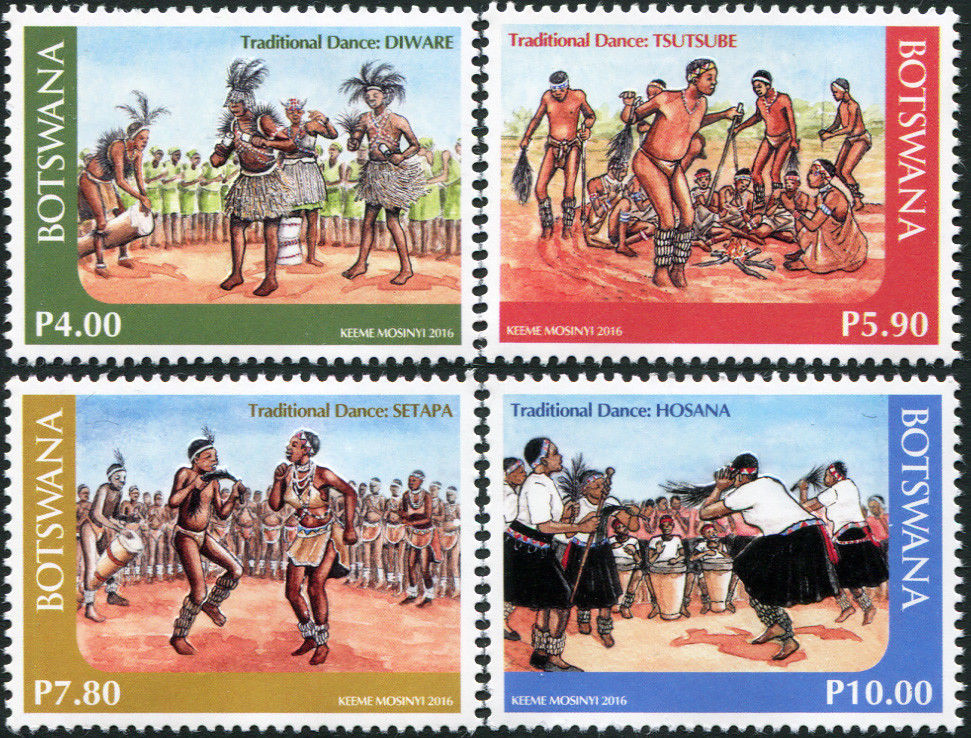
Botswana - Traditional Dance in Botswana 2016


Technical Details:
Date of Issue: 26 May 2016
Stamp Size: 40mm x 30mm
Denomination: P4.00, P5.90, P7.80, P10.00
Artist: Keeme Mosinyi
Graphic Designer: Irfan Kokabi
Process: Four Colour Process
Printer: Southern Colour Print, New Zealand
Paper Format: 103gsm, Tulis Russell High Reading Yellow/ Green Phosphor Gummed Stamp Paper

Introduction
This commemorative stamp issue illustrates a sample of diverse Botswana ethnic dances. Various communities sustained identity through dances, the heritage being passed orally by community elders. These dances and songs without instruments addressed socio-psychological needs, such as healing, quest for rain, celebrating a harvest or purification. In the absence of modern technology and medicine, the tradition worked and reassured our ancestors.

In modern day Botswana, these dances and songs create employment and generate phenomenal income as performing arts during various events. They are featured during National Arts Competitions and Festivals and have contributed significantly to nation-building as dance troupes across the country learn dances from areas that are not indigenous to them.

The Stamps, as follow:

4,00 Botswana Pula - Diware
A unique Hambukushu healing ritual which is still alive today in places like Maun, Gumare, Etsha, and Kasane where traditional healers use song and dance to revive a patient. Traditionally, the Hambukushu would consult a healer, then song and dance would start as women, dressed in long skirts with shawl draped over their shoulders, clap hands and sing Tjmbukushu healing songs for the medicine man. The climax of the ceremony is when the medicine man successfully casts away the illness, reviving the patient into a healthy vibrant person who immediately joins him to perform energetic dance moves in celebration of the healing. Diware performance characterized by healing theatrics performed by the medicine man is built around him and the patient who wear 'special regalia' while the singers, wearing formal clothes encircle them.

5,90 Botswana Pula - Tsutsube
A healing dance of the ancient citizens of Southern Africa, the San/ Basarwa who foraged in the hot/ dry Kgalagadi Desert. Elegantly dressed women adomed with the red ocher paint, long strands of ostrich egg shell beads, clapped their palms and mimicked beautiful songs. Agile and great medicine men encircle the group, the sick lay helplessly in front of the fire. The healing songs last all night and at dawn when enough energy has been transferred through the fire, loud songs and dances to the sick, suddenly the medicine men pounces on the sick and they are instantly healed and proceed to join the dances in celebration of the healing.

7,80 Botswana Pula - Setapa
A dance of the Bangwaketse of South-East Botswana. The dance evolved from the Setswana word, "go-tapa-tapa" meaning forward food stamping it has borrowed styles from the San/ Basarwa and form mine workers wearing boots (gum-boot dance). During the harvest season, young men and women congregated to sing a songs of their ancient warriors, appreciate the good harvest or convey social concerns to their leaders. Men wear skin and leather while women wear the same and accessories with the red ocher and ostrich egg shell beads and ankle raffles that provide the rhythm of the dance.

10,00 Botswana Pula - Hosana
An ancient song and dance of the Bakalanga (North Eastern Botswana) associated with the quest for rain, performed for the rain god Mwali, located in alow hill with a cave. The Hosana dancers were a group of women who had once manifested a common illness but had since healed. They were led by an needs of the community to Mwali through the medium of the millet beer prepared by Hosanas. During the ritual performance, at midnight, a coded voice is heard from the cave, with a response from the rain god. The dancers wear black skirts, while t-shirts and heavy black and white glass beads. They dance very fast and clap their hands with a lot of drumming. They were well respected by the community.

The FDC, as follow:

Seperu
The Seperu dance is performed by the Basubiya community on ceremonial occasions including the installation ceremony of a chief, weddings, the harvest home (letsema) and the arrival of special guests. The unique elements of the dance include the flywhisk, the whistle and the peacock shaped "mushishi" dress, a layered dress that lakes the shape of a peacock's tail. The male dancer leads a succession of skilled women dancers in pairs as a group of vocalists encircles the dancers, singing, and clapping throughout the performance.

Sebirwa
This dance was for social purification "go phasa" by the Babirwa of Eastern Botswana. Sebirwa is dominated by loud drumming, whistles and hand in rattles, female lead dancers inn colourful dresses lead the dance in procession from a starting place a destination.

Polka
Polka was originally called Boerewalf. It is said the dance came to Botswana with the white farmers and Dutch people. It is the staple dance in the South Western part of Botswana. The Polka has now reached mainstream and it is now recognised among Botswana's traditional dances often being featured at national commemorative events countrywide.

Monday, November 12, 2018

Brunei Darussalam - Royal Brunei Police 1971


Poland 2003 - Folk Dances, 50th Anniversary of Slask


Technical Details:
Date of Issue: 29 October 2003
Subject: 50th Anniversary of "Slask"
Width: 31.5 mm
Height: 39.5 mm
Denomination 1.20 PLN
Number in Set: 2
Layout/Format sheet of 4 of 2 designs
Perforations 11.6 by 11.2
Stamp Issuing Authority: Polish Post
Printer: PWPW Polska Wytwórnia Papierów Wartosciowych

Śląsk: The National Ballet of Poland
ŚLĄSK has been acclaimed as: "One of the grandest and most dazzling spectacles in the world."

The "Śląsk" Song and Dance Ensemble was founded in 1953 by Prof. Stanisław Hadyna, who also became its art director. Śląsk Ensemble has performed more than 6000 shows for over 20 million people worldwide.

ŚLĄSK is an ensemble of 90 singers, dancers and & musicians who enchant audiences in 1600 vibrant costumes which represent different regions of Poland.

With one of the world's most beautiful choreographic, vocal and musical performances, ŚLĄSK is a colorful and impetuous kaleidoscope of Polish national and folk culture. This Gala Concert includes dances and songs from 15 regions of Poland, as well as, the national Polish dances including Polonaise, Mazurka, Kujawiak, Oberek and Krakowiak.

Denmark - Ethnic Jewelry & Costumes 1993


Technical Details: 
Date of Issue: 16. September 1993
Sheetsize: 50 
Design: Jørgen Levinsen 
Perforation: 12¾

3.50 Denmark Kroner - Falster
3.75 Denmark Kroner - Amager
5.00 Denmark Kroner - Læsø
8.75 Denmark Kroner - Rømø

Saturday, October 13, 2018

Austria - Traditional Costume of the Thayatal 2018


Product Information:
Date of Issue: 24 June 2018
Number of Copies: 350.000
Print Style: Offset
Design: Anita Kern
Type: Sondermarke
Printed: Joh. Enschedé Stamps B.V

In the picturesque Thayatal

For some years now the “Classic traditional costumes” series has been dedicated to the attractive traditional costumes for everyday wear of the various regions of Austria. With this issue we are presenting the traditional costume of the Thayatal in the Waldviertel region of Lower Austria.

Mention the Thayatal, and many people immediately think of the National Park Thayatal, which opened in 2000. Here, where the River Thaya forms the border with the Czech Republic, you will find a real natural paradise – diverse landscapes and an impressive variety of species make the National Park a perfect refuge for nature lovers. Its location in the border region has meant that the flora and fauna were long left to develop undisturbed. Across the border the national park continues as the Národní park Podyjí, also enticing many visitors across the Thaya bridge in Hardegg to the neighbouring country. The picturesque Hardegg Castle, the castle ruins at Kaja and Raabs Castle are also popular tourist destinations in the region.

The traditional costume of the Thayatal

The traditional costume of the Thayatal was revived in the 1920s and 1930s and was developed further by the folklorist and traditional costume researcher from Lower Austria, Helene Grünn, in the 1950s. It is not particularly common even today.

The traditional everyday dirndl of the Thayatal comprises a light, usually natural-coloured top which laces at the front with a red ribbon. The slightly square neckline is emphasized by means of breast gores; the bodice is edged with red piping and embellished with embroidery at the edges, while the back is plain with a rounded neckline. The skirt is usually made of blue cotton with a finely scattered pattern or of checked sheeting, whilst the red and white apron to match the skirt has a finely striped or floral pattern. The dress is worn with a simple white dirndl blouse, possibly with lace trim on the sleeves.

There is no special traditional costume for the men of the Thayatal – they wear dark-coloured trousers with the traditional jacket. Likewise, no special accessories such as hats or scarves are worn with the dirndl. The traditional costume of the Thayatal comes across as plain and practical, as is normal for traditional working garb, yet is attractive thanks to the light colours.

Austria - Traditional Costume of Grinzing 2017


Product Information:
Date of Issue: 11 October 2017
Number of Copies: 405.000
Print Style: Offset
Design: Anita Kern
Type: Sondermarke
Printed: Joh. Enschedé Stamps B.V

The word Grinzing immediately conjures up thoughts of Heurige (small drinking establishments), wine and Wienerlieder (or Viennese songs). Fittingly, there is also a unique Grinzing traditional costume, which is now being presented on a commemorative stamp. Since Grinzing is a classic wine-growing region, this dirndl is also called a traditional wine-maker’s dress.

Located at the foot of the Kahlenberg, Grinzing was once a suburb of Vienna. Since 1892 it has been part of Döbling, Vienna's 19th district. The picturesque vineyards and the traditional culture of the Heurige make Grinzing a popular destination for visitors from around the world. The historic centre with the Late Gothic Grinzing Church and the grassy village green still give the place the feel of a village, even if Grinzing is now a popular address for Austrian celebrities.

The traditional costume for everyday wear has been known in its current form since the 19th century and was already revived based on historic models around 80 years ago in the inter-war period. Today the stipulations are not too strict. What is special about the dirndl is the cut of the bodice, which is typical of the traditional costumes of Vienna: the right front crosses over the left and buttons at the side. The buttons are also a characteristic decoration, being placed either evenly spaced below one another or with a gap below the top button. This overlapping produces an angular neckline at the front, repeated on the back, which has simple scalloped seams. The neckline, closing edge and scalloped seams are piped. In addition to this asymmetric bodice there is a variant which is laced at the front or back, usually in shades of brown or blue.

The everyday dirndl is made from red, blue and white checked cotton or linen, in the past often being made from the remnants of bedding material. The pattern of the skirt, which comes down to around the ankles, can be different. The buttons are mother of pearl. It is worn with a coordinating, plain coloured or lightly patterned apron which hangs about five centimetres below the hem of the skirt and is tied tightly at the waist. A white dirndl blouse with short or mid-length sleeves finishes the costume. A variant for special occasions is made using finer materials such as silk or brocade in light or dark blue with silver buttons and a fine silver edging. However, this costume for special occasions is rarely seen.

There is no typical traditional dress for the men of Grinzing. In the wine-growing regions of Lower Austria and Vienna the so-called “Kalmukjanker”, also known as the “Hauerjanker” or wine-grower's jacket, is widespread. Kalmuk is a robust, densely packed cotton or sheep’s wool material (in the past waste fabric was also used to make it), which is used to make jackets for the sailors on the Danube. The jacket is worn in varying cuts, with a raised collar, single or double-breasted. It was originally fastened with mother of pearl buttons. Buttons made from antlers only began to appear in the 20th century.

Austria - Traditional Costume of Pöttschinger 2017


Product Information:
Date of Issue: 08 May 2017
Number of Copies: 305.000
Print Style: Offset
Design: Anita Kern
Type: Sondermarke
Printed: Joh. Enschedé Stamps B.V

For the “Classic traditional costumes” series it is, on this occasion, the traditional costume of the municipality of Pöttsching in the north of Burgenland that is to be presented.

This traditional costume’s origins can be traced back to the traditional folk costumes of Burgenland and the musician from Pöttsching, Peter Zauner. Among other things, Peter Zauner was a violinist under Carl Michael Ziehrer and also a composer: he wrote the melody for the regional anthem for Burgenland. After the First World War he founded the Pöttsching brass band. In 1928 a large musical festival was organised in his home region, at which Zauner and his band appeared for the first time in the traditional costume of Burgenland, and where traditional songs and folk dances were performed with great success. Thereafter it was decided to include folk music and dances in the national education and thus to ensure that these traditions survived for future generations. Even today, folk dance and music continue to be accorded great
significance in this little municipality, with a musical clef even being included in its coat of arms.


1980 and 1981 saw the first performances of folk dance at the Pöttsching Farmers’ Ball and at farmers’ markets, initially in a variety of dirndls with the males dressed in black trousers, white shirts and red neckerchiefs. Eventually the traditional dress of Pöttsching was reproduced by Martina Löffler and Dr. Clara Prickler from Heimatwerk using old photographs. It was made and embroidered by the dancers themselves in 1984 and was presented for the first time at the music festival to celebrate the 15th anniversary of the Pöttsching music society. The men’s traditional dress was made in 1985 based on the traditional costume worn by Peter Zauner.

The men’s traditional costume is typical for Burgenland: black breeches and boots, a white shirt, a waistcoat with a collar, a red edging and silver buttons, the last four of which are dress fasteners. The waistcoat is either worn open or with the bottom six rows of buttons fastened. A particularly eye-catching feature is the “Firta”, a kind of apron or cloth worn around the waist by the men, one corner of which is tucked into the waistband at the hip, on the right-hand side for single men and the left for married men. In summer a black hat is added or the head left bare, whilst in winter it is worn with an Astrakhan hat – a sailor’s hat made from karakul wool – and a black jacket.

The women’s clothing comprises a black stomacher laced at the front and a white blouse. Girls wear a white skirt with scattered flowers and three blue bands at the hem; older ladies sometimes a dark blue skirt with scattered flowers. This is worn with a blue striped apron and, on cold days, a short black jacket or a shawl. The head is usually left bare.

The Pöttsching folk dance group was founded in 1979 and its 20 or so members are committed to preserving traditional customs. It performs at both regional and international folk dance events and demonstrates both the dances of Burgenland and international traditional folk dances.

Austria - Traditional Costume of Schärding 2016


Product Information:
Date of Issue: 29 May 2016
Number of Copies: 470.000
Print Style: Offset
Design: Anita Kern
Type: Sondermarke
Printed: Joh. Enschedé Stamps B.V

As part of its "Klassische Trachten" (classic traditional costumes) series, Austrian Post is presenting the summer costume of the Schärding district, which is still very new: this revised traditional costume was only approved in this style by the Heimatwerk for Upper Austria in 2003. Like many others, this costume for everyday wear is made from cotton or linen, but has an unusual style and was designed as the summer costume for the Schärding region as part of a revival of national costumes in Upper Austria. The bodice is made of checked cotton or linen with a rounded neckline, and is fastened at the front by means of hooks. A bias-cut bib, which, like the neck and armholes, is finished with monochrome piping, is attached over the fastening. The sides of the back section are also bias-cut. The skirt, in a matching pattern or made from a matching monochrome linen or cotton, is hand-gathered and is pleated beneath the apron. The colour of the cotton or linen apron is determined by the dress. If the bodice and skirt are checked, then a floral or monochrome apron is chosen, otherwise it can be striped or have a printed motif. A fine white, usually collarless, cotton blouse with puffed or three-quarter length sleeves is also worn as part of the summer costume. A kimono blouse can also be worn. There has been a traditional costume for special days for Schärding since 1950, but the summer costume has only existed since 2003. The summer costume for the Schärding district was created as part of a revival of traditional costumes in Upper Austria, where, under the motto "Altes erhalten – Neues gestalten" ("Keep the old – bring in the new"), they are striving not only to retain the traditional costumes, but also to revive them and make them a part of current everyday life through sensitive reworking. As a result, every municipality in the Schärding district now has its own local traditional costume. The municipalities of Schärding and Neuhaus am Inn and of Wernstein and Neuburg am Inn share a local costume, including this summer costume, which represents the Schärding district and was designed by the women of the Goldhaubengemeinschaft (an association dedicated to the preservation of local traditions) of the Unteres Innviertel region. A book cataloguing the local traditional costumes from this area has been published, showing not only the clothes themselves, but also suitable accessories, such as the "Handstiezel", knitted or crocheted mitts which can be worn with the splendid Goldhauben dress (www.goldhauben.net).However, it is not only matters relating to the revival of traditional costumes that keep the women of the Goldhaubengemeinschaft busy; they also collect money for charity by selling Easter and Christmas cards and use it to support institutions such as Caritas, Licht ins Dunkel, the Kinderkrebshilfe children's cancer charity and many others.

Austria - Traditional Costume of the Montafon 2016


Product Information:
Date of Issue: 30 June 2016
Number of Copies: 470.000
Print Style: Offset
Design: Anita Kern
Type: Sondermarke
Printed: Joh. Enschedé Stamps B.V

In Vorarlberg traditional costumes vary greatly by region. As part of its “Klassische Trachten” (classic traditional costumes) series, Austrian Post is presenting the traditional working garb of the Montafon, which is still worn unchanged to this day, and is one of the historic traditional costumes worn in the valley. This so-called “Wärchtigjüpple” (workday dress), the everyday working garb of the ladies of the Montafon, impresses with its simplicity. Both the skirt and the bodice are made from a dark, plain-coloured worsted flannel or pure wool. The tightly fitted bodice is high-necked, but allows the lace (“Spitzle”) of the white blouse worn underneath to show at the neck. This “Hemdle” or blouse is made of linen, and the borders are decorated with hand-made lace or decorative stitching (“Bäumlestich”). A blue striped or plain-coloured cotton apron is worn over the skirt; a black striped silk apron creates a particularly fine effect. This is accompanied by black stockings and a cotton scarf. The latter is white with a scattered red or blue pattern and is folded into a triangle and worn around the neck. The men’s costume comprises black loden knee breeches, black woollen hose, a white shirt and a red waistcoat, called the “Lieble”. The “Tschopa”, a dark blue jacket with two rows of buttons at the back is worn over this. Particularly eye-catching is the headgear: a black top hat which is only found in the Montafon. As for the traditional costume for festival days worn by the women of the Montafon, which dates back to the Baroque era, it is the embroidered stomacher which is laced into the front of the bodice and the elaborately decorated ribbons over the apron in its muted colours which are particularly eye-catching. The “Glöggli-Tschopa”, the short jacket, is accompanied by an otter skin hat, a “Mäßli” – a kind of brimless top hat – or a “Sanderhut”, a black straw hat with a bow. The term “Schlutta” describes a brocade jacket with delicate white lace at the collar. This costume for special days is completed by a red underskirt and red stockings, buckled shoes and a bow at the neck. Unmarried girls in the Montafon wear a special outfit, called the “Schäppelmaigana”: The “libli” (bodice) with its embroidered stomacher is worn with a white blouse. The name comes from the “Schäppel”, the headgear: a small coronet of silver or gold filaments and coloured glass balls which is affixed to the head. The artistically embroidered ribbons are woven into the girls’ plaited hair and hang down their backs to the ground. The Schäppel is only worn when the weather is good and with no outer wear over it. These historic traditional costumes continue to be worn by numerous societies for traditional costumes, music and dance groups, with the Vorarlberger Landestrachtenverband (national association of people wearing traditional costume for Vorarlberg) supporting this tradition and ensuring that local traditions are maintained.

Austria - Traditional Costume of Tyrol 2015


Product Information:
Date of Issue: 02 May 2015
Number of Copies: 550.000
Print Style: Offset
Design: Anita Kern
Type: Sondermarke
Printed: Joh. Enschedé Stamps B.V

Tyrol has a colourful and unique wealth of classical trachts and the customs that are interwoven with it. The Ziller Valley, for instance, stands out for its uniform tracht that is above all a must at festive occasions – Austrian Post is presenting, however, the old Tux everyday tracht, today undergoing a fashion renaissance, as a commemorative from the “Classical tracht” series. The Tux everyday tracht is characterised by muted colours. This is due to the fact that the Tux tracht is not only made using entirely natural materials such as cotton, linen and wool but also the fabrics are coloured using natural dyes. The apparent simplicity of the everyday Tux tracht is broken up by the fine and complex details that are often only seen at second sight. One conspicuous feature, for instance, is the single-coloured embroidered belt, which, in the original, is decorated with quill embroidery. This belt, originally worn mainly by farmers to protect them against blows from a sabre, is today made using genuine peacock quills and an amazing degree of skill in only a few craft businesses. The loden, made using the wool from Tyrolean mountain sheep, is sewn into a light grey jacket, the “Tuxer”. The men’s everyday tracht also includes knickerbockers made of coarse linen, a woollen bib, white kneelength socks, black shoes, a white shirt with upright collar and a narrow black tie. A dark felt hat serves to cover the head. Today’s Tux women’s tracht is much more varied than the men’s. The festive tracht in black, the “Röckl”, is characterised by a colourful apron and a white shawl, a richly decorated hat with gold tassles, and above all the square neckline in which an embroidered white silk cloth is worn. The high quality fabrics and the fine finishing make this tracht very expensive, and for this reason the garments used to be passed on from generation to generation. The basic elements of the simple everyday tracht include a dark bodice, under which, to combat the chilly temperatures in the Tyrolean Alps, a mostly long-armed linen blouse with puffed sleeves is worn. An apron made of wool or silk is tied mostly high up on the waist of the skirt, the manner in which the bow is tied indicating the marital status of the woman wearing it. The commemorative shows the Tux everyday tracht, which has lost nothing of its originality. This is in particular the achievement of the Tyrolean Tracht Association, which is committed to ensuring the preservation of regional peculiarities and customs.

Austria - Traditional Costume of Austrian 2014


Product Information:
Date of Issue: 18 July 2014
Number of Copies: 700.000
Print Style: Offset
Design: Anita Kern
Type: Sondermarke
Printed: Joh. Enschedé Stamps B.V

The Ausseer Tracht commemorative is the ideal continuation of the “Classical traditional costumes” series, since in the Ausseerland the traditional costume is still today worn by young and old – and not only on festive occasions. In this charming region of the Styrian Salzkammergut, tradition remains alive, intertwined with modern everyday life. Archduke Johann had a particular close connection with his people and, when at the beginning of the 19th century he began to show himself in the traditional Styrian hunter’s costume, this former working garb of the simple rural population became socially respectable. His grandnephew, Emperor Franz Joseph, adopted this style and spent his summer in the Salzkammergut dressed in Loden. Elegant society soon began to imitate him, and in this way the traditional peasant costume became the elegant outfit that, while adapting to current fashion trends, never lost its original nature. The classical Ausseer women’s Tracht today consists of a green top, a pink skirt and a lilac apron, replaced by a black apron on festive occasions. In contrast, men wear handsewn lederhosen, the length adjusting to the season of the year, Loden jacket with a broad pleat at the back, long green socks, sturdy shoes, hat and a “Bindl”, the Ausseer cravat. The multiplicity of the variations, the fine patterns and colourful accessories make the Ausseer Tracht a focus of attention, an expression of the joy of life and the love of the homeland, as well as providing the right attire for practically every occasion. This great love of the Tracht is also the basis for an important branch of the economy in the Ausseerland. In no other region of Austria are there so many craft businesses for the making of the Tracht, ensuring the originality and authenticity of the clothing. These include bespoke tailors and seamstresses, lederhosen makers, milliners and quill embroiderers. Hand-printers make the attractive silk scarves, silk aprons and cravats using what are known as “Models”, complex stencils made of wood or brass with which the patterns are printed onto the material by hand. The Tracht Biennale has already taken place twice in Bad Aussee, an event presenting not only music and dance but also the colourful splendour of the Tracht

Austria - Traditional Costume of Gmunden 2013


Product Information:
Date of Issue: 23 August 2013
Number of Copies: 812.000
Print Style: Offset
Design: Anita Kern
Type: Sondermarke
Printed: Joh. Enschedé Stamps B.V

The present commemorative is the start of a new series presenting classical traditional costumes (tracht), hence a series that constitutes an interesting combination of tradition, love of the home country, fashion and everyday life in a contemporary interpretation and a corresponding pictorial language.

The first stamp presents the costume from Gmunden, a charming small town on the north banks of Lake Traunsee in the Upper Austrian Salzkammergut. Back under the Austro-Hungarian monarchy, Gmunden was regarded as a popular spot for a summer holiday, and even today the town with its approx. 13,000 inhabitants is one of the most popular holiday resorts in the region. The term tracht (from Old High German “traht(a)”, Middle High German “dracht”: “what is worn”) is generally defined as a traditional or historic costume.

It is the dress code for a specific area, a province or members of specific groups of the population or professions. In many parts of the world, traditional costume has largely vanished in the course of globalisation, which has also included culture and fashion, and is only still worn in the form of “festive costumes”. In many areas however, people still wear traditional clothing for everyday use – the kilt in Scotland, the sari in India or the kimono in Japan are, at least as far as concerns the stereotypical image, the dirndl and the lederhosen in Austria.

The origin of the regional popular costume dates back to the Biedermeier age and the Rococo. In contrast to other types of clothing the Tracht is precisely defined in terms of colour, cut, choice of material and even the way it is worn. Generally a distinction is made between the “everyday Tracht” and the “festive Tracht”, the latter often being a very complex piece of work. The success of the Gmunden Tracht is probably due to the fact that while retaining the tradition aspect it has changed slightly again and again over the course of time, reflecting the influence of fashion. The dirndl was sometimes longer, sometimes shorter, and also the colours of the individual items have changed regularly. However, in Gmunden the Tracht is still alive and is certainly more than just a relic from bygone days. And it almost goes without saying that the people here attend festive occasions in their best gear – and that is quite simply the attractive Dirndl and the smart Janker jacket.

Friday, October 12, 2018

Fiji - Weddings in Fiji 2009


Date of Issue: 17 August 2009

0.20 Fijian Dollar - Chinese Wedding
0.40 Fijian Dollar - Muslim Wedding
1.50 Fijian Dollar - Indian Wedding
3.00 Fijian Dollar - Fijian Wedding

Tuesday, October 9, 2018

Hong Kong 2018 - Cantonese Opera Repertory


Technical Details:
Date of Issue: 09 October 2018
Design: Arde LAM
Illustration: Martin LAU
Printer: Joh. Enschedé Stamps B.V., the Netherlands
Process: Lithography
Stamp Size: 43 mm x 36 mm
Stamp Layout: Pane of 25 stamps
Perforation: 14 x 13.25 (one elliptical perforation on each vertical)
Paper: Paper with security fibres

"Cantonese Opera Repertory" Special Stamp Issue

Cantonese opera is a representative traditional performing art form in Hong Kong that was officially inscribed onto the United Nations Educational, Scientific and Cultural Organization's Representative List of Intangible Cultural Heritage of Humanity in 2009. It has become an important icon of our local culture - one which is worth savouring and passing on. In Cantonese opera the performers present various stories with the "four basic skills" of singing, acting, narrating and martial arts, complemented by distinctive music, costumes, props and stage settings.

The set of special stamps on "Cantonese Opera Repertory", featuring six immensely popular Cantonese opera plays and their classic scenes, includes The Story of Princess Changping ($2), The Moon Pavilion ($2.60), Lord Guan Gong Releasing Lady Diao Chan ($3.40), The Princess in Distress ($3.70), Butterfly Lovers ($4.90) and Lady Zhaojun Departing for the Frontier ($5). The stamps show an important scene from each opera with vivid and distinctive portrayals of the characters in the plays.

Most of the plots are based on folk tales, Chinese history and myths. As the scripts of the plays are often created by talented writers, the lyrics are regarded as literary classics. Apart from being a popular form of entertainment, Cantonese opera is also a precious cultural tradition that we should preserve. For those looking to learn more, the stories behind these six great works are outlined in some detail in an attractive bilingual Prestige Stamp Booklet, accompanied by colourful photos of the key scenes from the performances.

Official First Day Covers at $1.30 each will be put on sale at all post offices from tomorrow (September 21). The special stamps and associated philatelic products will be displayed at the General Post Office, Tsim Sha Tsui Post Office, Tsuen Wan Post Office, Sha Tin Central Post Office and Tuen Mun Central Post Office from the same day. Advance orders for servicing self-provided covers will be accepted at all philatelic offices from tomorrow to September 28.

Stamp products include mint stamps, stamp sheets, mini-pane, presentation pack and prestige stamp booklet. Serviced first day covers are also available at the philatelic offices on the issue day only.

Sunday, October 7, 2018

Austria 2015 - Leather Pants


Release Date 24 September 2015
Number of Copies: 150000
Design: D. Swarovski KG, Wattens, Tyrol
Type: Block Issue
Stamp Size: 34.83 mm x 41.50 mm x 1 mm
Face Value: 6.30 Euro
Printed by: D. Swarovski KG, Wattens, Tyrol
Printing Style: Alcantara Laserschnitt with XILION Flat Backs in Golden Shadow

In 2004, special stamps featuring Swarovski crystals were presented for the first time, which were presented as a world first in the Swarovski Crystal Worlds. The cooperation with the internationally renowned company Swarovski, which produces high-quality crystals in the Tyrolean town of Wattens for more than 120 years, is continued with this unconventional edition: Swarovski crystals adorn a special stamp made of alcantara leather in the form of alpine leather trousers.

About Swarovski

Swarovski offers a comprehensive product portfolio characterized by unique quality, craftsmanship and creativity. The company was founded in Austria in 1895 and develops, produces and sells jewelery, accessories and lighting solutions in addition to high-quality crystals, synthetic gemstones and genuine gemstones. The Crystal business unit, which celebrates its 120th anniversary this year and is run by the family in its fifth generation, has approximately 2,560 stores worldwide in approximately 170 countries. More than 25,000 employees generated sales of around 2.33 billion euros in 2014. Together with its sister companies Swarovski Optik (optical precision instruments) and Tyrolit (grinding tools), the Crystal business unit forms the Swarovski Group. In 2014, the group, with more than 30,000 employees, generated sales of around 3.05 billion euros. In 2012, the Swarovski Foundation was founded, which - in the philanthropic tradition of company founder Daniel Swarovski - promotes creativity and culture and works for the benefit of mankind and the protection of natural resources. The combination of Swarovski crystals with leather pants is actually obvious: both are something of a symbol of the Alpine region and are often associated with Austria. So the leather pants for many Tyroleans is a fashionable basic equipment. Usually it is made of deerskin and hand-sewn, shows in everyday rather short, on holidays, however, as Kniebundhose. Suspenders not only ensure a good fit, but are often artistically embroidered on the crossbar. The buttoned bib is also typical for a traditional leather pants, as emperor Franz Joseph used to hunt more than 100 years ago, as well as the edelweiss or oak leaf embroidery on the trouser legs. Today, many national costume associations are dedicated to the preservation of traditional costumes in the Austrian provinces, and through events such as the Munich Oktoberfest, dirndl and lederhosen are today even considered modern, but usually in less traditional variants.Incidentally, staghorn buttons are usually used on real leather pants, not Swarovski crystals. The high-quality leather stamp with sparkling Swarovski crystals thus combines two traditions characteristic of Austria in a completely new form into a very special little work of art.

===========================================================

In 2015, Austria issued the first postage stamp made of leather. It is in the shape of a pair of lederhosen and has 6 Swarovski crystals embedded in it.

The combination of Swarovski crystals and a pair of lederhosen is actually obvious. Both are a kind of symbol of the Alpine world and are often associated with Austria. For instance, lederhosen are part of the basic wardrobe for many a Tyrolean. They are usually made out of deerskin, sewn by hand and short for daily wear or in the form of knickerbockers for special occasions. Braces serve to ensure that the trousers sit well and often have fine embroidery work on the cross-piece. The buttoned fly flap is also typical of traditional lederhosen as worn by Emperor Franz Joseph when out hunting over 100 years ago, and the trouser legs are often decorated with edelweiss or oak-leaf embroidery. Many traditional costume associations are today dedicated to the preservation of the traditional costumes in Austria’s provinces, while events such as the Munich Oktoberfest have helped to make the dirndl and the lederhosen modern once again, although in less traditional designs. Incidentally, the buttons on real lederhosen are usually made of buck horn and not Swarovski crystals.

The high-quality leather stamp with sparkling Swarovski crystals thus combines two traditions characteristic of Austria in a completely new way to create a very special miniature work of art.